If your lease is covered by the SPCC rule, the plan has to meet the general requirements in 40 CFR 112.7 and the production-specific ones in 112.9. For a tank battery, that means containment sized to the largest single tank plus rain, sealed dike drains, scheduled tank and piping inspections, at least one overfill safeguard, and a written flowline maintenance program. Everything else in the section is detail on how those pieces apply to process vessels, produced water tanks and gathering lines.
This guide assumes you already know the site is covered. If you’re still working that out, start with our guide on whether your site needs secondary containment and come back here. What follows walks 112.9 the way a company man would walk the location: drains, tanks, vessels, produced water, then the lines.
Who 112.9 applies to (and who it doesn’t)
Section 112.9 covers onshore oil production facilities and expressly excludes drilling and workover facilities. A rig on location runs under a different section of Part 112. Once the well is producing into a battery, 112.9 is the section your plan is built around.
The EPA thresholds that pull a facility into SPCC in the first place are more than 1,320 gallons of aboveground storage (counting containers of 55 gallons or more) or more than 42,000 gallons buried, plus a reasonable chance a discharge reaches navigable waters or shorelines. EPA’s upstream page lists both. Oil/water separators used in production count toward that storage total, according to EPA’s onshore production presentation, and equipment that treats only gas, such as glycol dehydrators, is outside the rule.
When the plan is due on a new production site
Most facilities need their plan in place before they start operating. Production facilities get a short grace period. Under 112.3(b), a production facility that came online after November 10, 2011 has to prepare and implement its plan within six months after it begins operations.
That six months goes fast on a pad that is still being built out. The containment, the facility diagram and the inspection procedures all have to match what is actually on the ground, so it pays to design the battery with the plan in mind instead of writing the plan around whatever got set.
PE-certified or self-certified: Tier I and Tier II
By default, a licensed Professional Engineer has to review and certify the plan (112.3(d)). The PE attests that they or their agent visited the facility, that the plan follows good engineering practice and that inspection and testing procedures exist.
Smaller sites can self-certify as a “qualified facility” under 112.3(g):
| Plan type | Aggregate aboveground capacity | Largest single container | Spill history (prior 3 years) | Who certifies |
|---|---|---|---|---|
| Tier I qualified facility | 10,000 gal or less | 5,000 gal or less | No single discharge over 1,000 gal, and no two discharges over 42 gal each within any 12 months | Owner/operator, can use EPA’s Tier I template |
| Tier II qualified facility | 10,000 gal or less | Any size | Same as above | Owner/operator self-certifies |
| Everyone else | Over 10,000 gal | Any size | Any | Licensed PE |
EPA’s production page confirms production facilities can be qualified facilities if they stay under 10,000 gallons and the discharge history is clean. A single 500-barrel tank is 21,000 gallons, so most Permian batteries land in the PE column.
What 112.9 requires, component by component
This is the core of the section. Each row points to the paragraph so you can check the exact wording.
| Component | What the rule asks | Paragraph |
|---|---|---|
| Dike drains at tank batteries and treating areas | Kept closed and sealed except when draining uncontaminated rainwater. Inspect before draining and skim any oil off first | 112.9(b)(1) |
| Field drainage, ditches, sumps, oil traps | Inspect on a regular schedule for oil from small leaks and promptly remove it | 112.9(b)(2) |
| Tanks (material) | Material and construction compatible with what’s stored and the conditions | 112.9(c)(1) |
| Tank battery, separation and treating installations | Secondary containment for the entire capacity of the largest single container plus enough freeboard for precipitation. Drainage from undiked areas goes to a catchment basin or holding pond | 112.9(c)(2) |
| Tanks (inspection) | Visual inspection on a regular schedule, including foundations and supports | 112.9(c)(3) |
| Overfill prevention | At least one of: enough capacity that a late pumper won’t overfill a tank, overflow equalizing lines, vacuum protection, or high-level sensors tied to a computer production control system | 112.9(c)(4) |
| Flow-through process vessels | Sized containment, or the alternative: scheduled inspection and testing, repairs, prompt cleanup | 112.9(c)(5) |
| Produced water containers | Sized containment, or an oil-skimming procedure plus inspection, repairs and cleanup | 112.9(c)(6) |
| Aboveground valves and piping | Scheduled inspection of flanges, valve glands, drip pans, supports, polish rod stuffing boxes, bleeder and gauge valves | 112.9(d)(1) |
| Saltwater disposal facilities | Inspect often, especially after a sudden temperature change | 112.9(d)(2) |
| Flowlines and intra-facility gathering lines | Contingency plan and written commitment of manpower and equipment where there’s no containment. Written maintenance program for all of them | 112.9(d)(3), (d)(4) |
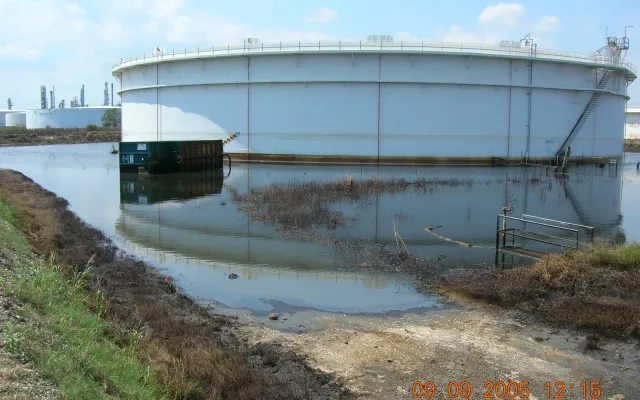
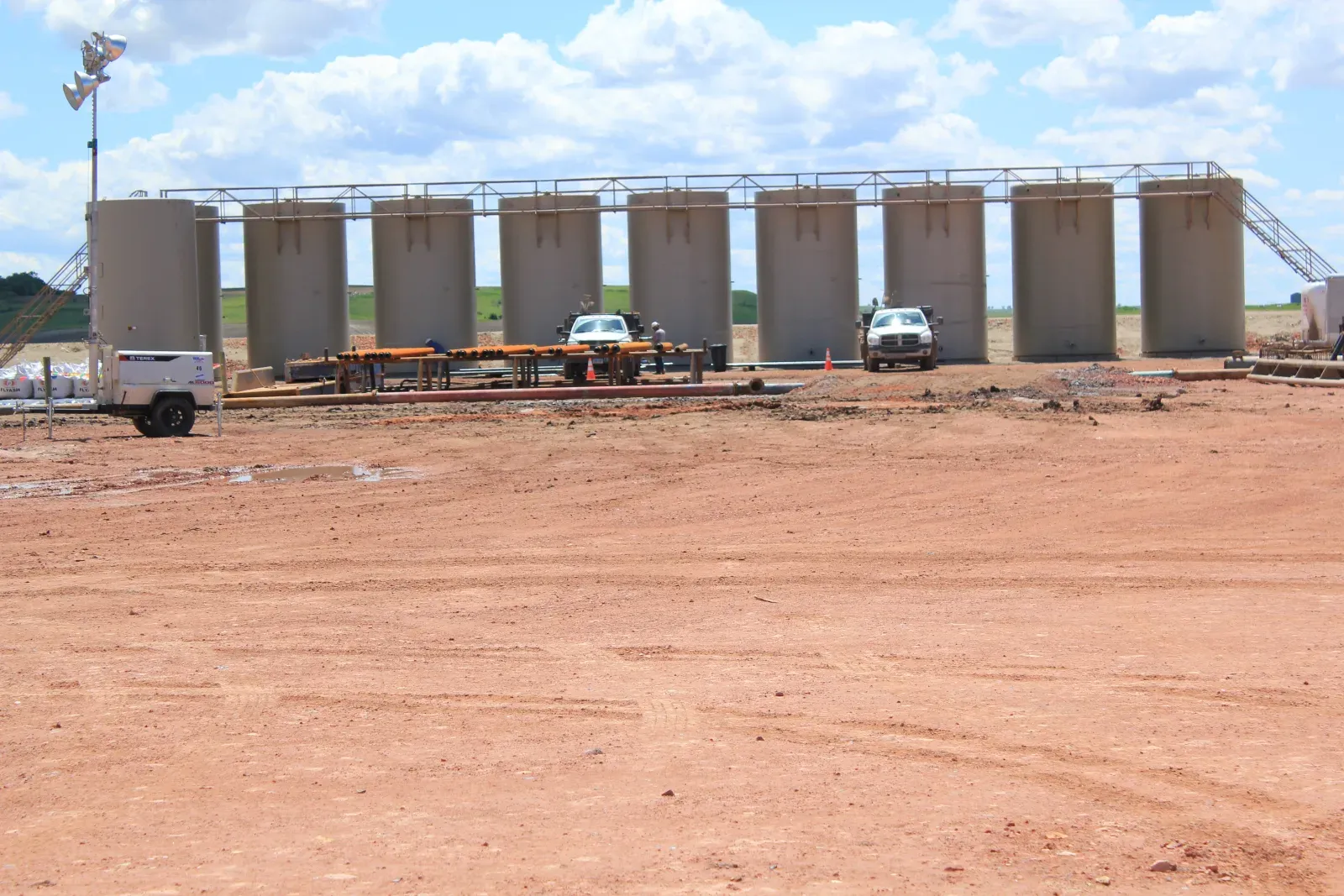
Tank battery containment: largest tank plus rain
This is the requirement inspectors look at first. The containment around the battery has to hold the whole volume of the biggest tank, with room left over for rainwater. The rule doesn’t put a number on the freeboard. Your PE sets it, and it has to be documented in the plan.
In the field, capacity is usually lost through slow changes rather than a bad design. Caliche washes into the bottom of the dike, a new tank or a pump skid gets set inside the berm and takes up volume, or someone leaves a drain valve cracked. The rule’s answer to that last one is blunt: drains stay closed and sealed unless you’re letting out clean rainwater after an inspection.
Lined, purpose-built containment holds its volume better than a pushed-up dirt berm because the walls and floor don’t erode and the liner keeps oil from soaking into the base. That’s the work our containment systems crews do: primary containment pads fitted to the battery layout, high-wall systems where the volume is large or the ground slopes, and HDPE liners.
Flow-through process vessels: the alternative and its trap
Heater-treaters, free-water knockouts and gun barrels are flow-through process vessels. Under 112.9(c)(5) you can skip sized containment for them if you inspect and test them on a schedule, fix what you find and clean up oil promptly. General containment under 112.7(c) still applies.
The trap is in (c)(5)(iv). If the facility has a discharge from those vessels of more than 1,000 gallons at once, or more than 42 gallons in each of two discharges within twelve months, every flow-through vessel at the facility has to get sized containment within six months. One bad dump valve season can undo the alternative.
Produced water containers: skim it and write it down
Produced water tanks carry free oil on top. Under (c)(6) you can either contain them like oil tanks or run a regular procedure that separates the free-phase oil. If you take the procedure route, the plan has to describe it, how often it runs and how much oil is expected to sit in the tank, and a PE must certify it. You also keep records. If the procedure isn’t followed or there are no records, you’re back to sized containment. The same 1,000-gallon and 42-gallon discharge triggers apply.
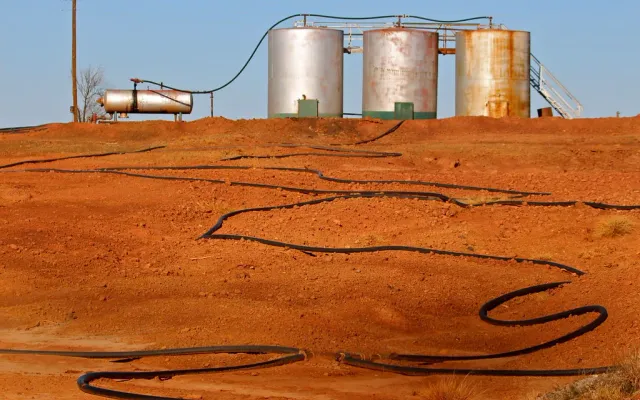
Flowlines and gathering lines
Most flowlines aren’t contained, and the rule accepts that if the plan includes an oil spill contingency plan under 40 CFR Part 109 and a written commitment of manpower, equipment and materials. Every operator also needs a written flowline maintenance program covering material compatibility with the production fluids, a regular inspection or testing schedule, repairs, and prompt cleanup of any oil.
EPA’s onshore production presentation notes there is no industry standard for flowline maintenance. Your program is whatever you write and can show you follow, so keep it specific to the lines you actually run.
The general 112.7 items production sites forget
Section 112.9 sits on top of 112.7, and a few of those general requirements come up again and again on production inspections:
- Facility diagram. Marks the location and contents of each fixed oil container and where portable containers are stored.
- Inspection records. Written procedures, signed records, kept with the plan for three years. Records kept under your usual business practice can count.
- Training and briefings. Oil-handling personnel trained on equipment, discharge procedures and the plan, with discharge prevention briefings at least once a year.
- Plan location. At the facility if it’s attended at least four hours a day, otherwise at the nearest field office.
- Five-year review. EPA’s production inspection checklist asks whether the plan has been reviewed at least once every five years, and whether technical amendments were PE-certified.
Plan-readiness checklist for a production lease
Run through this before an inspector does:
- The facility diagram matches what’s on the pad today, including any tanks or vessels added since the last amendment.
- Each tank battery’s containment volume has been checked against its largest tank, with the freeboard basis written down.
- Dike drains are closed and sealed, and there’s a log of rainwater drainage with the pre-drain inspection noted.
- The overfill option you rely on (capacity, equalizing lines, vacuum protection or high-level alarms) is named in the plan and actually installed.
- If you use the flow-through vessel or produced water alternatives, the inspection and skimming records exist and are current.
- The flowline maintenance program is written, and inspection records match its schedule.
- Inspection records go back three years and are signed.
- The last annual briefing date is on file.
- The plan’s certification (PE or self) matches the facility’s current capacity and spill history.
Where containment hardware fits in
Site Safe Solutions doesn’t write or certify SPCC plans. That’s the job of your PE or environmental consultant. What we do is the physical side that a plan depends on: containment systems sized and installed around batteries and treating equipment, and drive-over Fast Mats for temporary tanks, service trucks and transfer points while work is going on. If your plan calls for containment you don’t have yet, or the berm you have no longer holds what the plan says it does, get in touch and we’ll look at the site with you.