
Fast Mats: Drive-Over Containment for Leak & Spill Protection
- Key point
- Built for vehicle traffic
- Applies to
- Temporary stations, service trucks, small fluid transfers
Have this ready when you call
- What is being contained, and roughly how much fluid could be released
- The footprint the mat needs to cover
- Whether vehicles will drive over it
- How long it needs to stay in place
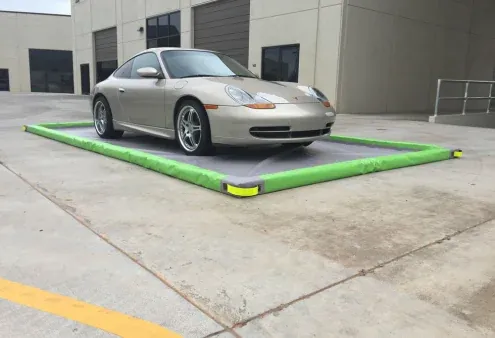
When you need quick, effective containment for a single leak or spill event, our Fast Mats provide rapid-response protection. Site Safe Solutions’ drive-over mats are built for ease of deployment, designed to handle vehicle traffic and configured in custom sizes to suit your specific site need.
Whether it’s a temporary station, a service truck spill, or a containment pad for a small fluid transfer, Fast Mats deliver immediate spill protection without full pad build-out. Choose a tailored solution from our range of sizes, soak the risk, and keep your site safe and compliant.
How it works
- Rapid-response containment for a single leak or spill event
- Drive-over mats designed to handle vehicle traffic
- Custom sizes configured to your site
- Temporary stations, service truck spills and small fluid transfers
- Immediate spill protection without a full pad build-out
Common questions
General information, not a compliance determination for your site.
When you need protection for a single leak or spill event, or for short-term work — a temporary station, a service truck, a small fluid transfer — where building out a full pad would be out of proportion to the risk.
Containment that vehicles can drive onto and off, so a truck can sit inside the contained area during a transfer or repair. Drive-over mats and berms commonly use low, flexible or foam walls that flatten under a tire and recover, so the containment stays in place while traffic keeps moving.
Yes. They are designed to handle vehicle traffic. That matters because containment that has to be pulled every time a truck needs through often does not go back, and a mat that stays in place is the only kind that protects you when the leak actually happens.
Because the cost of a release is decided by whether product reaches soil. A leak caught on an impervious surface is a clean-up; the same leak on native ground becomes excavation, disposal and possibly reporting. Containment that is already in place closes that window; containment fetched from storage usually arrives after it.
Guides
All containment articles- 55 Gallon Drum Containment on Oilfield Locations
- IBC Tote Containment for Oilfield Chemical and Oil Totes
- Generator Spill Containment on Oilfield Locations
- Well Pad Basics: Layout, Life Cycle and Spill Control
- Fuel Tank Spill Containment for Oilfield Locations
- Spill Containment Berms: Sizing, Wall Types, Field Use
- SPCC Inspection Checklist for Oil Production Sites
- Drive Over Containment Berms: Wall Types, Sizing, Fit
- Secondary Containment Calculator: Worked Examples
- Spill Containment Mats: Sizing, Walls and Traffic
- Oilfield Tank Battery: Leak Points and Containment
- Produced Water Spills in the Permian: Why Brine Hurts