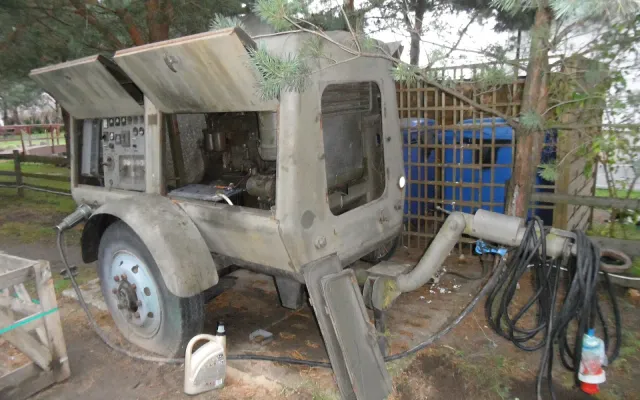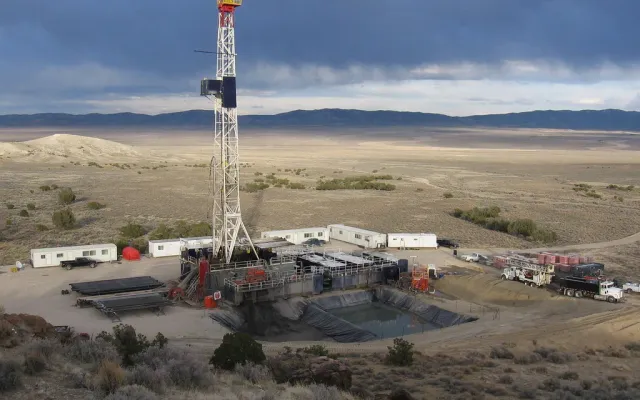
IBC tote containment means setting every tote of oil or chemical on a berm, pallet or lined cell that can hold the full contents of the largest tote, plus room for rain. On an oilfield location that’s usually a small berm or containment pad next to the injection skid, the compressor or the rig’s lube station. If the tote holds oil and is 55 gallons or bigger, the federal SPCC rule treats it as a mobile or portable container. EPA’s inspector guidance names totes and IBCs as examples. Containment for those has to be sized to the largest single container with freeboard for precipitation.
What is an IBC tote?
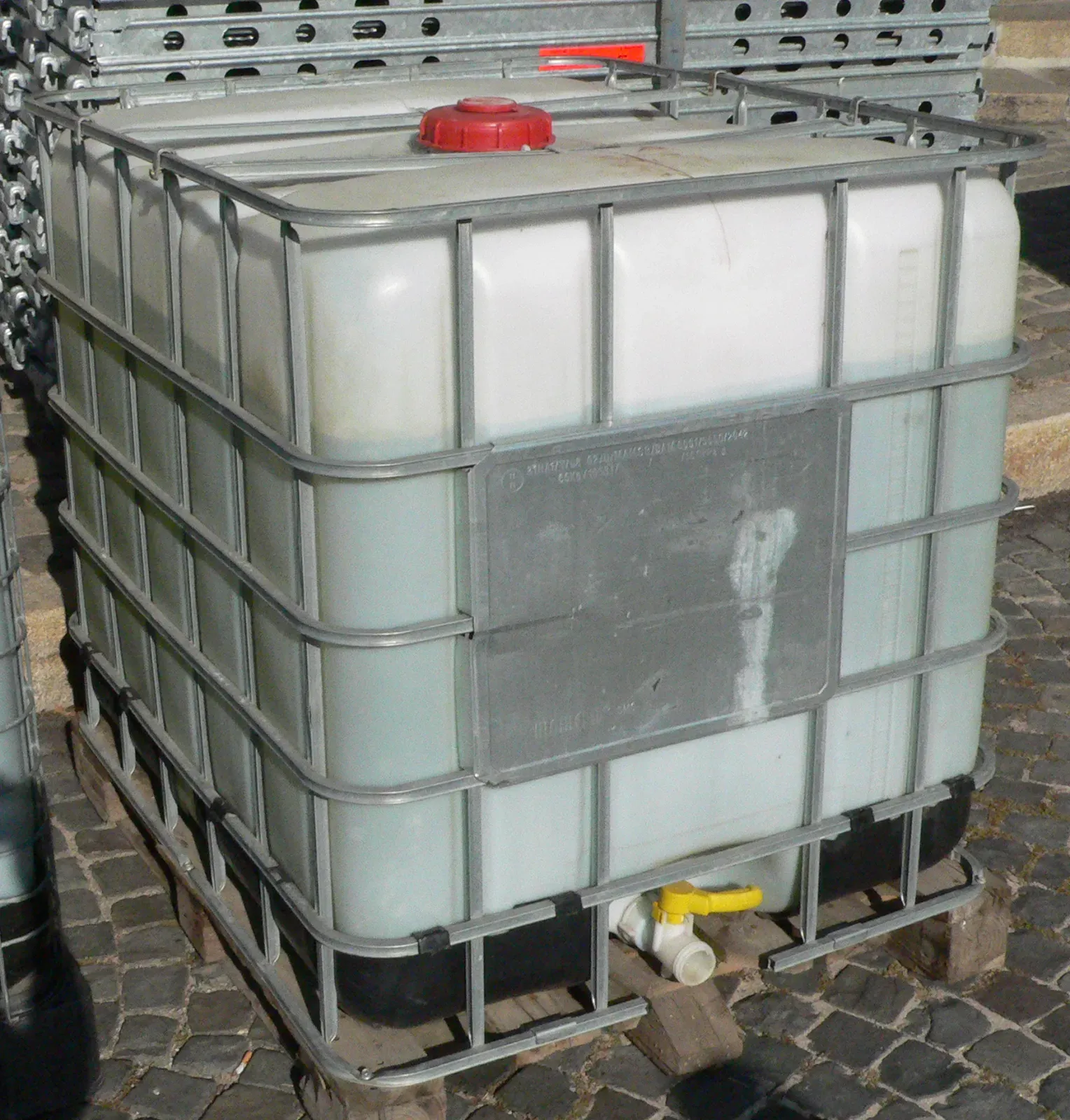
An intermediate bulk container is a pallet-sized tank. The common caged type is a blow-molded HDPE bottle inside a steel cage on a pallet base. It has a top fill port and a bottom discharge outlet, typically a 2-inch ball valve. Sizes in common US use are 275 and 330 gallons. Federal hazmat rules allow IBCs up to 3 cubic meters, about 793 gallons.
On a lease or pad, totes hold lube oil, hydraulic fluid, compressor oil and used oil. They also hold treating chemicals such as corrosion inhibitor, scale inhibitor and biocide feeding a chemical pump. A tote is easy to set down with a forklift on bare caliche, which is how a lot of them end up with nothing underneath.
Do IBC totes need secondary containment?
If the tote holds oil, usually yes. The SPCC rule (40 CFR 112) applies when a facility’s aggregate aboveground oil storage is over 1,320 gallons. Only containers of 55 gallons or more count toward that, and smaller ones are exempt (40 CFR 112.1). A 330-gallon tote counts. Four of them reach 1,320 gallons, the most an exempt site can hold, and most locations also have tanks.
“Oil” is defined broadly in 40 CFR 112.2. It covers petroleum, fuel oil, sludge, synthetic oils, mineral oils, oil refuse and oil mixed with wastes. Lube oil, hydraulic oil and used oil totes are clearly in. A water-based chemical isn’t oil, and SPCC doesn’t reach it. Check the safety data sheet for what’s actually in the tote.
For oil totes, 40 CFR 112.8(c)(11) says to position mobile or portable containers to prevent a discharge and to provide “a secondary means of containment, such as a dike or catchment basin, sufficient to contain the capacity of the largest single compartment or container with sufficient freeboard to contain precipitation.”
EPA’s SPCC Guidance for Regional Inspectors adds how inspectors read that:
- Parked totes. When drums, skids and totes are parked, the requirement can be met with permanent containment like dikes, curbing or catchment basins. An operator can designate an area for mobile containers when they aren’t in use. That area has to be identified on the facility diagram in the SPCC Plan.
- Totes in use. Containers in use must also have containment, and the areas where they’re used must be marked on the facility diagram.
- Tier I qualified facilities follow 112.6(a)(3)(ii) instead.
On a producing lease, your SPCC Plan’s certifying engineer decides which section the totes fall under. The sizing idea is the same either way.
What about chemical totes that aren’t oil?
SPCC stops at oil, but a leaking tote of inhibitor still contaminates the pad and still has to be cleaned up. Under OSHA’s Hazard Communication standard, every safety data sheet has the same 16 sections in the same order (29 CFR 1910.1200(g)(2)). Read three of them before setting a chemical tote:
- Section 6, Accidental release measures: what to do and what to use when it leaks.
- Section 7, Handling and storage: storage conditions for that product.
- Section 10, Stability and reactivity: what it reacts with. Read it before two different chemicals share a berm.
Keeping incompatible chemicals in separate containment costs a second berm. Mixing them in one after a leak can cost much more. Your company’s HSE program and any state or local rules may also apply, so check with them.
How to size containment for IBC totes
Totes are tall and square, and they sit inside the containment they need, so every tote standing in a berm takes up floor area a spill can’t use.
A worked example with two 330-gallon totes in one berm:
- Largest container: 330 gallons ÷ 7.48 = 44.1 cubic feet. You size for one tote, not both.
- Berm floor: an 8 ft × 10 ft berm has 80 square feet.
- Tote footprints: a caged tote’s pallet base is close to 1,200 × 1,000 mm, about 3.9 × 3.3 ft, or roughly 12.9 square feet. Two totes take about 25.8 square feet. If one leaks, the other still stands in the liquid, and the leaking one does too until it empties. Subtracting both is the conservative way.
- Usable area: 80 − 25.8 = 54.2 square feet.
- Liquid height: 44.1 ÷ 54.2 = 0.81 feet, or about 9.8 inches.
So an 8 × 10 berm with a 12-inch wall holds the tote but leaves only about 2 inches for rain. The rule doesn’t define “sufficient freeboard.” EPA’s guidance says it considers a 25-year, 24-hour storm the proper standard, though it isn’t enforceable as a rule. Rain over the full 80 square feet goes into that 2 inches. A bigger footprint or taller wall fixes it. A tote spill pallet works for one or two totes under cover. Outside, with rain, a berm sized like this does the job. The secondary containment calculator walkthrough has more worked examples.
Where tote spills start
The bottom valve is the weak point. It sits at pallet height, where forklift forks, hoses and boots hit it. Typical tote releases on location:
- A bottom valve left cracked open after filling a chemical pump’s day tank.
- A hose or cam-lock fitting on the valve outlet leaking at the threads.
- A fork tine through the bottle when a tote gets moved in a hurry.
- A damaged cage letting the bottle shift and crack.
- Overfilling through the top port when a tote gets refilled from a truck.
Transfer areas are where most of these happen, so the containment should reach the hose and the pump, not only the tote. See spill containment pads for transfer areas for that layout.
Check the tote, not only the containment
The DOT rules for IBCs in hazmat service give a good checklist for a tote’s condition. Under 49 CFR 180.352, metal, rigid plastic and composite IBCs carrying liquids need a leakproofness test before first use and every 2.5 years. They need an external visual inspection on the same 2.5-year cycle and an internal inspection at least every five years. An IBC that’s due can’t be filled and offered for transport until the test is done.
Those dates govern shipping hazmat, and a tote parked on your pad isn’t bound by them. The inspection items still make a good field check. The external inspection covers whether the markings are readable, whether the service equipment (valves and closures) is fully functional and undamaged, and whether there are cracks, warpage, corrosion or other damage. Pull any tote that fails those checks off location.
Tote area checklist
- Every oil tote of 55 gallons or more counted toward the SPCC total and shown on the facility diagram
- A designated tote area with containment sized for the largest tote plus rain freeboard
- Tote footprints subtracted from the berm volume
- Incompatible chemicals in separate containment, checked against SDS Section 10
- Bottom valves closed, capped and protected from forklift traffic
- Hoses, pumps and fittings inside the containment
- Cages, bottles and markings plates checked when the tote arrives
- Rainwater checked for sheen before it’s drained from the berm
Containment for tote areas on Permian locations
Site Safe Solutions designs and installs containment systems for oilfield locations in the Permian Basin, from small berms around chemical and oil totes to primary pads and high-wall systems with liners. If you’re setting up a tote area, cleaning up after an SPCC inspection finding or adding chemical injection to a lease, tell us what’s going on the pad and we’ll size containment around it. For what inspectors look at once it’s built, see the SPCC inspection checklist.