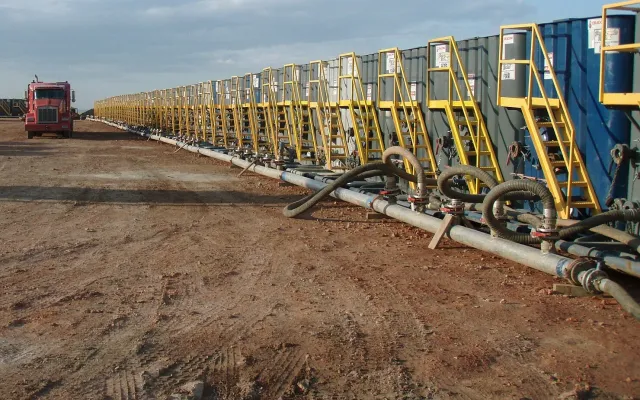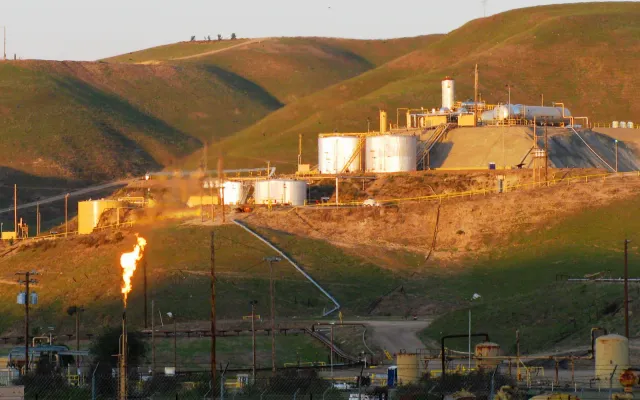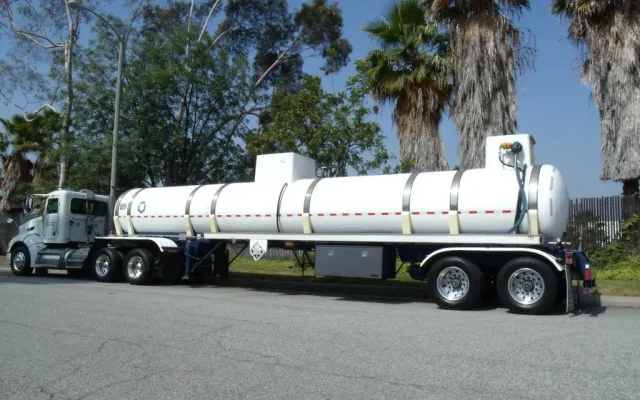
A fuel tank on a lease needs secondary containment sized to its largest container plus room for rain when it sits at a site covered by EPA’s SPCC rule. On a drilling or workover location the rule asks for catchment basins or diversion structures instead. The test for coverage is simple: more than 1,320 gallons of aboveground oil storage at the facility, counting only containers of 55 gallons or more. A single 500-gallon diesel skid won’t get you there alone. A diesel tank, a hydraulic oil tote and a used-oil tank might.
Does the fuel tank count toward the 1,320-gallon threshold?
The SPCC rule doesn’t look at one tank. Under 40 CFR 112.1(d)(2)(ii), a facility is outside the rule when its aggregate aboveground storage capacity is 1,320 gallons or less, and “only containers with a capacity of 55 U.S. gallons or greater are counted.” Add up everything on the site that holds oil.
Here’s how that goes on a real location:
| Container | Capacity (gal) |
|---|---|
| Diesel skid tank | 500 |
| Hydraulic oil tote | 330 |
| Used-oil tank | 500 |
| Total | 1,330 |
That’s ten gallons over. Drums under 55 gallons don’t count toward the total, but a handful of 55-gallon drums do.
Two exclusions matter to fuel tanks. A “motive power container” is an onboard tank that mainly powers a vehicle’s movement, so the diesel tank on your pickup stays out of the count. But the definition in 40 CFR 112.2 “does not include oil drilling or workover equipment, including rigs.” A rig’s fuel tank counts. And the rule is specific about fueling: “The transfer of fuel or other oil into a motive power container at an otherwise regulated facility is not eligible for this exemption.” The tank on the truck is exempt. The act of filling it at your fuel point is not.
Which containment rule fits which tank
Different tanks fall under different paragraphs. EPA’s inspector guidance sorts them this way:
| Tank or area | Rule | What it asks for |
|---|---|---|
| Mobile refueler or fuel trailer | 112.7(c) | General containment for the typical failure mode and the most likely quantity discharged |
| Portable or skid tank at a non-production facility | 112.8(c)(11) | Containment sufficient for the largest single compartment or container, with freeboard for precipitation |
| Tank battery containers at a production facility | 112.9(c)(2) | Containment sized to the largest container plus freeboard |
| Drilling or workover location | 112.10(c) | Catchment basins or diversion structures for fuel, crude oil or oily drilling fluids |
On drilling and workover sites, EPA says this paragraph “contains no specific sizing requirement, and no freeboard requirement.” It reads much like the general requirement. That’s a lower bar on paper, and a reason not to treat it as permission to skip the berm. A bare pad with a diesel tank on it has nothing to intercept a failed valve.
A fuel tank isn’t automatically part of a tank battery, so the production paragraph won’t always apply. The definition of a production facility in 40 CFR 112.2 does include “workover equipment” and “auxiliary non-transportation-related equipment” used in production, which pulls many lease tanks in. Which line is yours depends on how the location is classified in its SPCC plan. Ask whoever wrote or certified it.
How much containment is enough?
The rule says “the entire capacity of the largest single container and sufficient freeboard to contain precipitation.” It doesn’t define freeboard. EPA’s guidance notes that a 25-year, 24-hour storm event is “appropriate for most facilities,” then says that standard isn’t enforceable, because the rule never adopted it. EPA adds that a “110 percent of storage tank capacity” rule of thumb “may be an acceptable design criterion in many situations,” while warning that in some places it won’t hold a storm.
Here’s a worked example. Two tanks share one containment: a 1,000-gallon diesel tank and a 500-gallon tank. Only the largest counts.
- Footprint. A 10 × 16 ft containment is 160 square feet.
- Rain allowance. One inch of rain over 160 square feet is 160 × (1/12) = 13.3 cubic feet, about 100 gallons. I’m using one inch as an illustration. Use your own local storm data.
- Required volume. 1,000 + 100 = 1,100 gallons. At 7.48 gallons per cubic foot, that’s 147 cubic feet.
- Wall height. 147 ÷ 160 = 0.92 ft, roughly 11 inches of usable wall.
- Displacement. The 500-gallon tank and its pump skid take up floor area. If they cover 30 square feet, the open area drops to 130, and the wall height becomes 147 ÷ 130 = 1.13 ft, about 14 inches.
So buy walls that give you at least 14 inches of usable height, and that’s before anything for a sagging liner or a low corner. Gallons for any rectangle come from length × width × height in feet × 7.48.
Notice how close the 110 percent rule lands here. 1,100 gallons is exactly 110 percent of the largest tank. It works because one inch of rain happens to equal about 10 percent of this tank. On a larger footprint or a wetter site it comes up short.
Where fuel containment fails on a lease
Most failures happen around the edges of the containment, not in the tank walls.
The fill point. Spills happen while someone’s attending the transfer. EPA’s guidance says an active measure such as a mat or portable barrier may be appropriate there, provided it can contain “the most likely volume of an oil discharge from a typical failure mode” and is deployed in time. Put it down before the hose comes off the truck. Section 112.8(c)(8) also requires at least one overfill device on bulk containers, such as a high liquid level alarm or a pump cutoff set to stop flow at a set level.
Rain left in the berm. A containment full of water has no room for fuel. The rule requires you to “promptly remove any accumulations of oil in diked areas,” so look for a sheen before you pump out clean-looking water.
Trucks driving through the walls. Fuel trucks need to get close to the tank. A rigid wall that a truck crushes or drives over stops being containment. Where traffic has to cross, use drive-over wall sections or a drive-over mat at the fill point.
Temporary gear left for good. EPA warns that portable barriers “are typically not engineered for long-term deployment,” and that precipitation, UV and cold can affect them. A fuel tank that stays for years wants an engineered berm or lined pad, inspected like any other containment.
Ground and floor damage. Check the ground under a liner for rock and the floor for tire cuts after every move. A liner with a hole holds nothing.
Setup checklist for a lease fuel tank
- Add up every oil container of 55 gallons or more on the site. If the total passes 1,320 gallons, find out which SPCC paragraph covers the tank.
- Size containment to the largest container plus rain, then subtract what stands in it.
- Put a mat or drip pan under the fill point and the pump.
- Confirm an overfill device and know who’s watching during a transfer.
- Walk the containment on a schedule, remove water and look for sheen.
- Write down the dimensions you used so the plan matches the pad.
Containment for lease fuel tanks from Site Safe Solutions
Site Safe Solutions builds containment systems: primary and high-wall containment liners for tanks and pads. For the fill point, it supplies Fast Mats, drive-over containment mats made in custom sizes for a service truck, a temporary station or a small fluid transfer. If you’re not sure whether your site passes the threshold, start with whether your site needs secondary containment. Then tell us the tank sizes and the pad layout and we’ll work out the containment with you.