A spill containment berm is a low-walled, liquid-tight basin that sits under a tank, trailer or transfer point and holds whatever leaks until you can pump it out. Choose the wall type by how equipment gets in and out. Size it for the largest tank plus rain, after taking out the room the other tanks occupy. Then protect the floor from the things that actually tear berms on location: tank skids, rocks and wind.
Every result on page one for this search is a product grid. This guide covers what the grids leave out.
What is a spill containment berm, and when does the rule call for one?
For oil, the federal SPCC rule names “dikes, berms, or retaining walls sufficiently impervious to contain oil” as one of the accepted onshore containment methods in 40 CFR 112.7(c). Portable berms show up most often under mobile and portable containers. At onshore facilities other than production facilities, 40 CFR 112.8(c)(11) requires a secondary means of containment for those containers, “such as a dike or catchment basin, sufficient to contain the capacity of the largest single compartment or container with sufficient freeboard to contain precipitation.” Mobile refuelers and other non-transportation tank trucks are excepted.
On a production lease, tank batteries fall under the sized requirement in 112.9(c)(2) instead, and those are usually built as permanent lined or wall systems rather than a portable berm. Whether your site is covered at all is a separate question. Your SPCC Plan should answer it.
Berm wall types compared
Portable berms differ mostly in how the wall stands up and how a truck gets over it. The floor is a coated fabric or geomembrane in all of them.
| Wall type | How it works | Best fit | Where it fails in the field |
|---|---|---|---|
| Foam wall | Foam-filled sidewalls that flatten under a tire and spring back | Drive-in, drive-out use: service trucks, fueling, equipment wash-down | Low wall height limits volume. Foam takes a set if a tire parks on it, and the wall stays low |
| L-bracket / removable brace | Wall fabric held up by angle brackets in sleeves. Pull a bracket to drop a section | Tanks set in once, then left | Brackets left out after a move. Wall leans in wind when the berm is empty |
| Collapsible / swivel wall | Wall supports pivot down for access and back up after | Frequent access with taller walls than foam | Pivots pack with sand and caliche and stop locking up |
| Rigid steel or stake wall | Steel panels or staked walls with a liner draped over | Larger volumes and longer jobs | More parts to haul and set. Liner wears where it folds over the wall top |
| Earthen dike | Compacted soil with or without a liner | Permanent locations with room | Not portable. EPA says native soil alone usually isn’t adequate unless it’s homogeneous and shown to hold oil |
If trucks need to drive into the containment, start with foam wall or modular drive-over sections. If tanks get set and stay for weeks, a braced or rigid wall gets you more height for the same footprint. More height means a smaller berm for the same volume, which matters on a crowded pad.
How to size a spill containment berm
The rule asks for the largest single container plus “sufficient freeboard to contain precipitation.” EPA’s inspector guidance fills in the method:
- Tanks permanently manifolded together count as one container.
- Other tanks inside the same berm displace volume below the wall height, so deduct their footprint times the wall height.
- Freeboard is an engineering call. EPA calls a 25-year, 24-hour storm the proper standard but did not make it enforceable. It calls 110% of the largest tank an acceptable rule of thumb in many situations, with a warning that 110% may not hold a real storm.
Worked example: four frac tanks near Midland
The numbers below are an example to show the method. They aren’t a spec for your site.
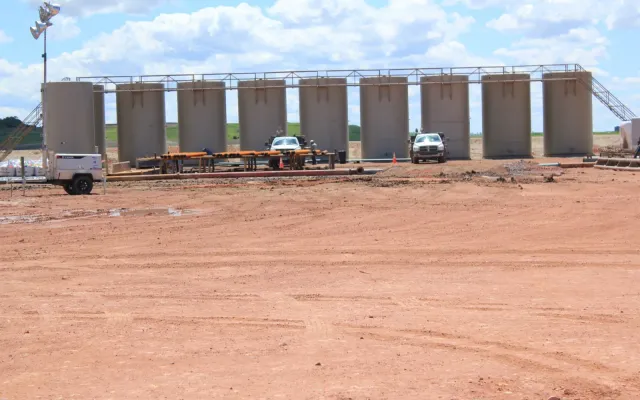
Assume four 500-barrel tanks in one berm measuring 60 ft by 50 ft, and assume each tank sits on a 9 ft by 45 ft footprint.
- Largest tank volume: 500 bbl × 42 gal = 21,000 gal ÷ 7.48 gal per cubic foot = about 2,807 cubic feet.
- Berm floor area: 60 × 50 = 3,000 sq ft.
- Area lost to the other three tanks: 3 × 405 = 1,215 sq ft. Usable area for the spill: 1,785 sq ft.
- 110% rule of thumb: 2,807 × 1.1 = about 3,088 cubic feet ÷ 1,785 = 1.73 ft of wall, about 21 inches.
- Rainfall basis: NOAA Atlas 14 puts the 25-year, 24-hour rainfall at Midland at about 5.0 inches (about 4.7 inches at Odessa). Rain falls on the whole 3,000 sq ft: 3,000 × 5.0/12 = 1,250 cubic feet. Add the tank: 2,807 + 1,250 = 4,057 cubic feet ÷ 1,785 = 2.27 ft of wall, about 27 inches.
On this layout the rainfall basis needs about 6 more inches of wall than 110%. Six inches is the difference between a foam wall and a braced wall. It’s also why a berm that looked big enough on paper overflows the first time a West Texas storm parks over location. Your SPCC Plan’s engineer picks the design storm, so use their number. Pull your own site’s rainfall from the NOAA Precipitation Frequency Data Server, because it changes across the basin.
Liner material: crude, brine and sun
The rule doesn’t name a material. It says the walls and floor must be capable of containing oil until cleanup. In practice that comes down to three things.
Compatibility
Ask the supplier for chemical resistance data against crude, condensate, diesel and produced water. Brine on its own is easy on most liners. Hydrocarbons and some treating chemicals are harder on them.
Sun
EPA’s guidance notes that portable barriers left in place long-term lose performance to precipitation, ultraviolet light and cold. For HDPE geomembrane, the industry specification GRI-GM13 covers sheet from 30 to 120 mils and calls for 2.0 to 3.0% carbon black, which is what gives HDPE its UV resistance. Ask for the spec sheet that shows which standard the material meets.
Puncture
The berm floor is thinner than the tank and takes all the abuse. Put a geotextile or rubber underlay below it on rock and caliche, and put a sacrificial layer or mat under every tank skid and stair foot.
Field failures to watch for
Most berm failures on location aren’t the berm’s fault. They come from things done to it:
- Tank skids dragged across the floor during spotting. Set tanks first and pull the berm under with the wall down, or spot onto protective pads.
- Wind on an empty berm. An unballasted berm with its walls up turns into a sail. Keep a little water in it or weight the corners until tanks are set.
- Rainwater left standing. Every inch of rain sitting in the berm is an inch of freeboard gone. At production tank batteries, 112.9(b)(1) wants drains closed and sealed except while draining uncontaminated rainwater after inspection. Running that discipline on portable berms too keeps an oily sheen from going out with the water.
- Equipment added later. A pump or a fifth tank set inside after the fact takes up volume the berm was sized without.
- Hoses run over the wall. Lines draped over a foam wall hold it down permanently. Use a hose bridge or a gate section.
If a berm does catch a release, the response clock starts the same way it does for any spill. Our first hour of a spill guide walks through it.
Portable berm or something bigger?
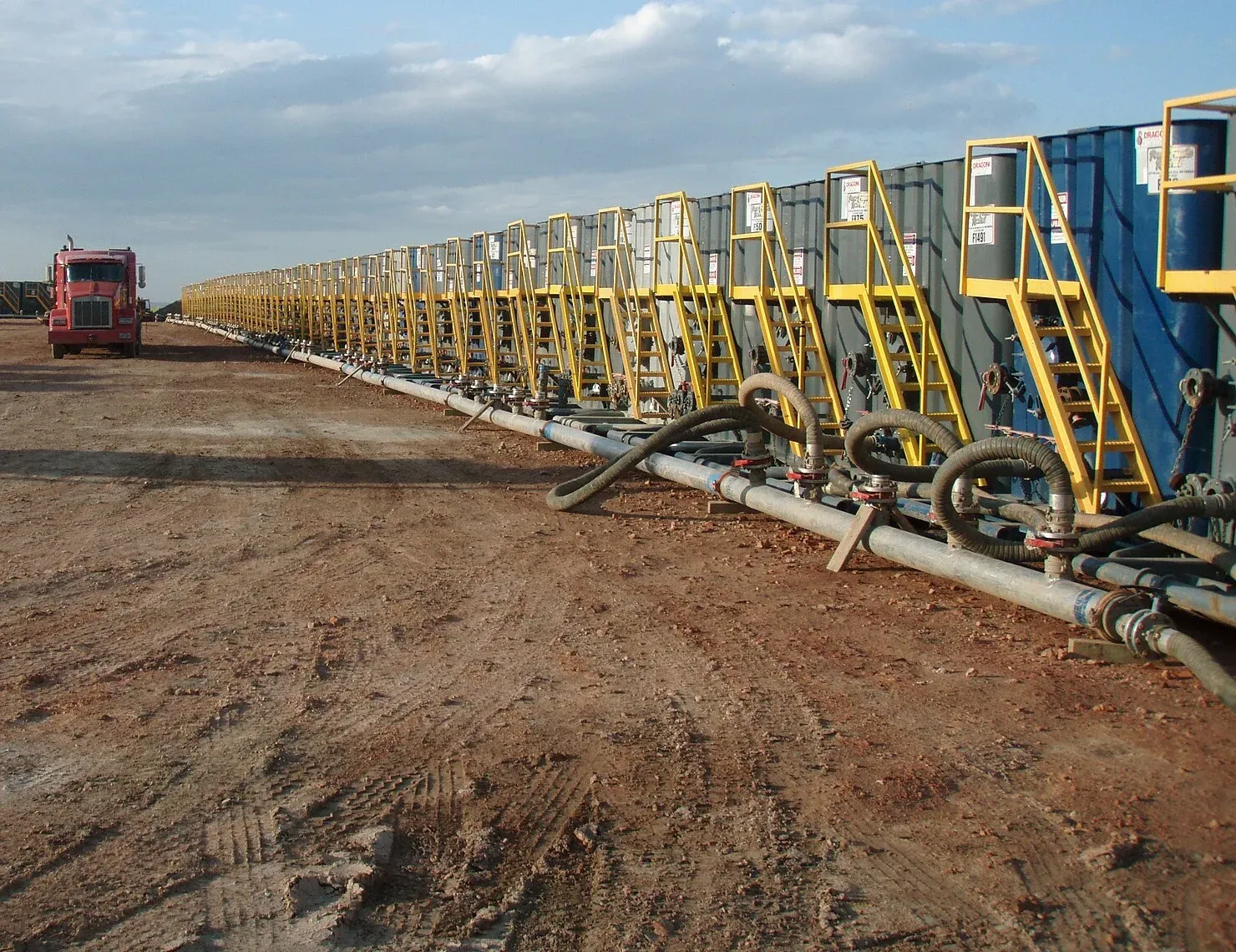
Portable berms are the right tool for frac and completion tank lines, temporary fuel storage, and equipment that moves. For a single hookup or a service truck stop, a drive-over mat is often enough. Our Fast Mats are built for that job. For a tank battery that will sit for years, or a big tank farm on a slope, a lined pad or high-wall system makes more sense than a portable berm.
Site Safe Solutions builds and installs containment systems for Permian Basin locations, from modular drive-over containment to high-wall systems with HDPE liners, set by factory-trained crews. If you’re planning a tank line and want a second set of eyes on the sizing, get in touch with the tank count, sizes and pad dimensions.