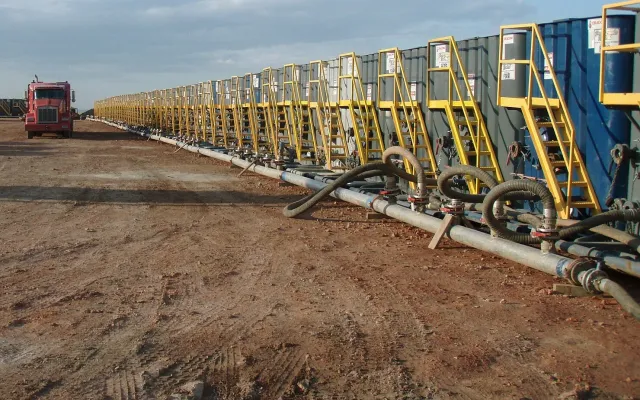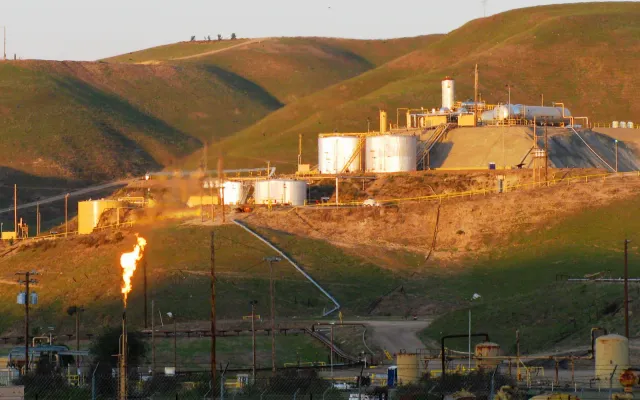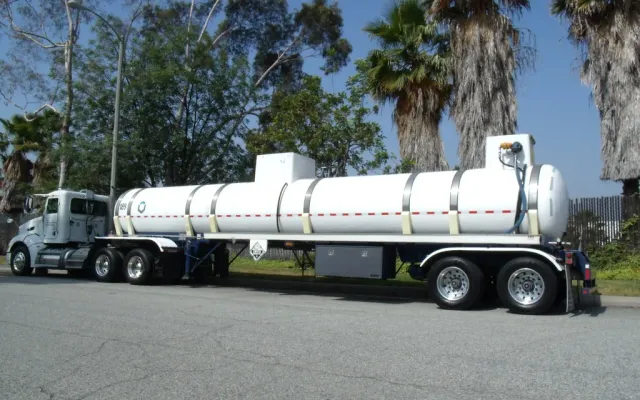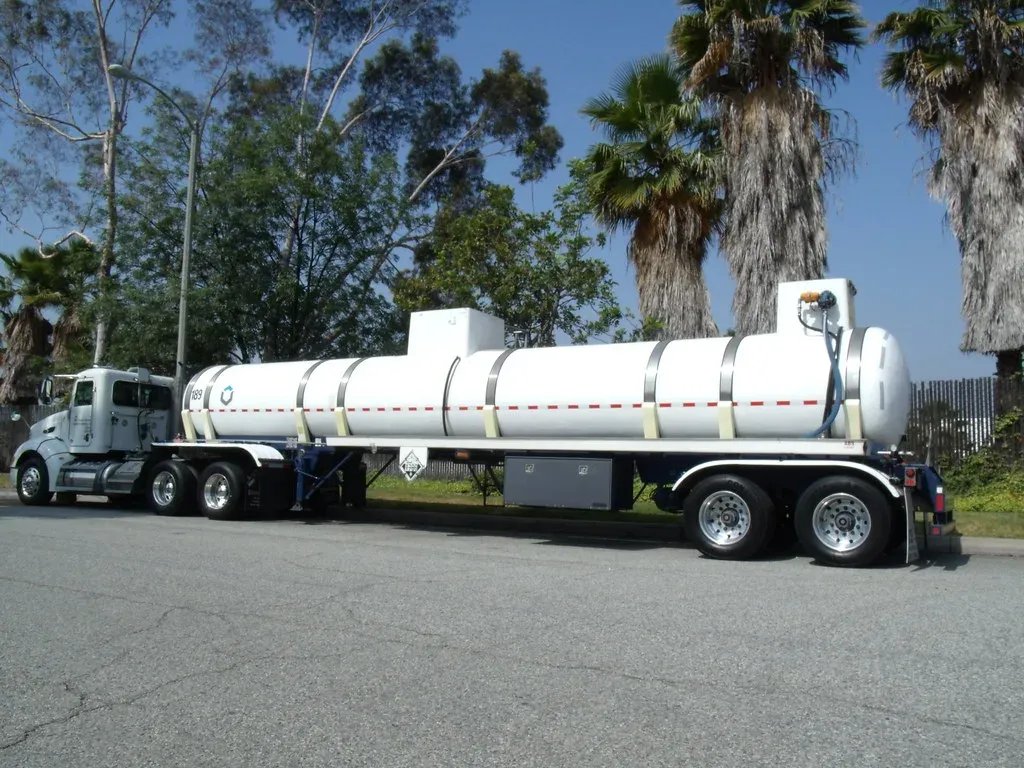
A spill containment pad at a transfer area is a lined, curbed surface where a truck parks or a hose connects. Whatever leaks during a load-out or hookup stays on the pad instead of in the caliche. On a production lease, the federal rule treats these spots as general containment under 40 CFR 112.7(c). You size the pad to the most likely release from the most likely failure, not to a tank. Get the drainage right and inspect it. Most of the trouble with transfer pads comes from rainwater and from pads nobody looks at.
Why transfer points deserve their own containment
Tanks get the attention because they’re big. But oil is most likely to escape where it changes hands. EPA’s inspector guidance lists the usual failure modes at a transfer area: “a failed hose connection; improper transfer equipment connection or disconnection; pump, valve, flange or pipe fitting leak; or overfill of a container.”
On a lease that means:
- The truck load-out at the tank battery, where crude goes from tanks to a transport
- The LACT unit and its meter run, if the lease sells into a pipeline
- Produced water load lines, where water trucks hook up
- Chemical totes and injection skids
- Fuel transfers to generators and equipment
EPA’s guidance gives “transferring crude oil from an oil production tank battery into tank trucks” as a textbook example of a transfer area.
What 40 CFR 112.7(c) asks of a transfer area
The general containment requirement applies to “all areas with the potential for a discharge,” and EPA’s guidance names loading and unloading areas specifically. The rule text says:
- The containment “including walls and floor, must be capable of containing oil” until cleanup.
- You size it to “the typical failure mode, and the most likely quantity of oil that would be discharged.”
- It “may be either active or passive in design.”
- Acceptable onshore methods include dikes or berms, “curbing or drip pans,” sumps, drainage systems, barriers, ponds and sorbents.
EPA’s guidance is clear that “the SPCC rule does not require specifically sized containment for transfer areas.” That’s the key difference from the tank battery next door, which needs containment for the largest tank plus rain under 112.9(c)(2).
Loading racks are a separate case. A loading/unloading rack, as the rule defines it, brings the stricter 112.7(h)(1) requirement: containment for “at least the maximum capacity of any single compartment of a tank car or tank truck.” EPA notes that oil production facilities “do not typically have loading/unloading racks,” and that truck transfers on a lease normally fall under general containment instead. If your site does have a true rack, size for the largest compartment.
How big should a transfer-area pad be?
Work it out from the failure, the same way EPA does. Its inspector guidance gives a worked example. A truck loading at 150 gallons per minute has an attendant who can close the valve and kill the pump. Using a conservative 15-second reaction time, the most likely discharge is:
150 gal/min × (15 s ÷ 60) = 37.5 gallons
EPA’s conclusion is that containment “should be at least 37.5 gallons,” and more if it takes longer to shut down. Apply the same method to your own site:
| Factor | Question to answer for your load-out | Effect on pad size |
|---|---|---|
| Transfer rate | What’s the pump rate on the transport or the line? | Higher rate, bigger pad |
| Detection | Is someone standing at the connection the whole time? | Unattended transfers need more volume |
| Shutoff | How far is the valve or pump kill from the hose? | Longer reach, longer discharge |
| Failure mode | Is the realistic failure a hose drip, a parted hose, or an overfill? | A parted hose at full rate is the big one |
| Hose and line volume | How much drains when the hose is uncoupled? | Add it to the total |
Two more things EPA tells PEs to weigh are the slope between the transfer point and the nearest drainage, and the time it would take a release to get there. On a West Texas lease that “nearest drainage” is often a dry wash or a road ditch. Under the SPCC rule those can be the path to navigable water.
What a transfer pad looks like on a lease
EPA’s guidance notes that “dikes or berms may not be appropriate in areas where vehicles continuously need access.” It points instead to “curbing, drainage systems, active containment measures, or a combination.” It even describes a production-site load-out “designed to drain discharges away to a topographically lower area using a crescent or eyebrow-shaped berm.”
In practice there are three common builds:
| Build | How it works | Best for |
|---|---|---|
| Lined pad with low curb or ramped edges | Impermeable liner over a graded base, with a curb the truck rolls over. Drains to a sump | Permanent load-outs used daily |
| Eyebrow berm and lined catch area | A crescent berm on the downhill side of the connection, steering a release to a lined low spot | Load-outs on sloped pads where trucks pull straight through |
| Drive-over mat or modular section | Containment the truck parks on, with walls that fold under the tires | Temporary or low-use transfer points, service stops |
The hose connection is the part that has to sit over containment. The whole truck doesn’t. A pad that covers the trailer but not the valve box is in the wrong place.
Drainage and rainwater: where pads go wrong
A curbed pad catches rain as well as oil, and a pad full of rainwater has no room for a spill. The production rule covers this in 112.9(b)(1). Drains on dikes or “equivalent measures required under § 112.7(c)(1)” must be closed and sealed “at all times,” “except when draining uncontaminated rainwater.” Before you drain, you inspect the water. You remove any oil and handle it by “legally approved methods,” and you keep records of the drainage.
Practical rules for a transfer pad:
- Slope the pad to one sump or low corner, away from the hose connection.
- Keep any drain valve closed and sealed, and use a manual open-and-closed valve. The rule for non-production facilities bans flapper-type drain valves on diked areas (112.8(b)(2)), and that’s good practice on a lease too.
- Check for sheen before you pump or drain water off. Water with oil on it is waste, not rainwater.
- Log every drainage. EPA inspectors ask for those records. EPA’s guidance notes that a containment that’s never drained after heavy rain can be a sign the water is leaking out through the floor.
Section 112.9(b)(2) adds a related job: inspect “field drainage systems (such as drainage ditches or road ditches)” and sumps regularly for oil, and remove it promptly. The ditch below a busy load-out is the first place to look.
Chemical totes and drums at the transfer point
Totes and drums of 55 gallons or more are “mobile or portable containers” under the SPCC rule. At non-production facilities, 112.8(c)(11) requires sized containment for them: the largest container plus freeboard. On a production lease they fall under the general requirement. Either way, a tote sitting on bare ground next to an injection skid isn’t contained. A small curbed pad or a containment pallet under it fixes that for very little money.
Transfer pad inspection checklist
Under 112.9(d)(1), aboveground valves and piping at transfer operations have to be inspected “periodically and upon a regular schedule.” The list covers “flange joints, valve glands and bodies, drip pans, pipe supports” and bleeder and gauge valves. Records of required inspections are kept with the SPCC Plan for three years under 112.7(e). A pad walk-through that covers the same ground EPA’s inspectors use:
- Liner or surface intact, with no cuts, cracks or tire damage at the curb
- No standing liquid, sheen or stained soil on or around the pad
- Drain valve closed and sealed, and drainage log up to date
- Sump has capacity (not full of rain or silt)
- Hose connection sits over the containment, and drip pans are emptied
- Load-line valves, flanges and caps tight, with no weeping
- Ditch or low ground below the pad checked for oil
- Stained soil or dead vegetation just outside the curb (a sign the pad is overflowing or leaking)
Getting a transfer pad built
Site Safe Solutions builds lined containment systems on Permian leases, including primary containment pads designed around the site layout. For temporary or low-use transfer points it supplies drive-over Fast Mats. If you have a load-out or LACT area that needs containment, send us the layout, the transfer rate and how trucks approach it. For what to do when something does get out, see the first hour of a spill.