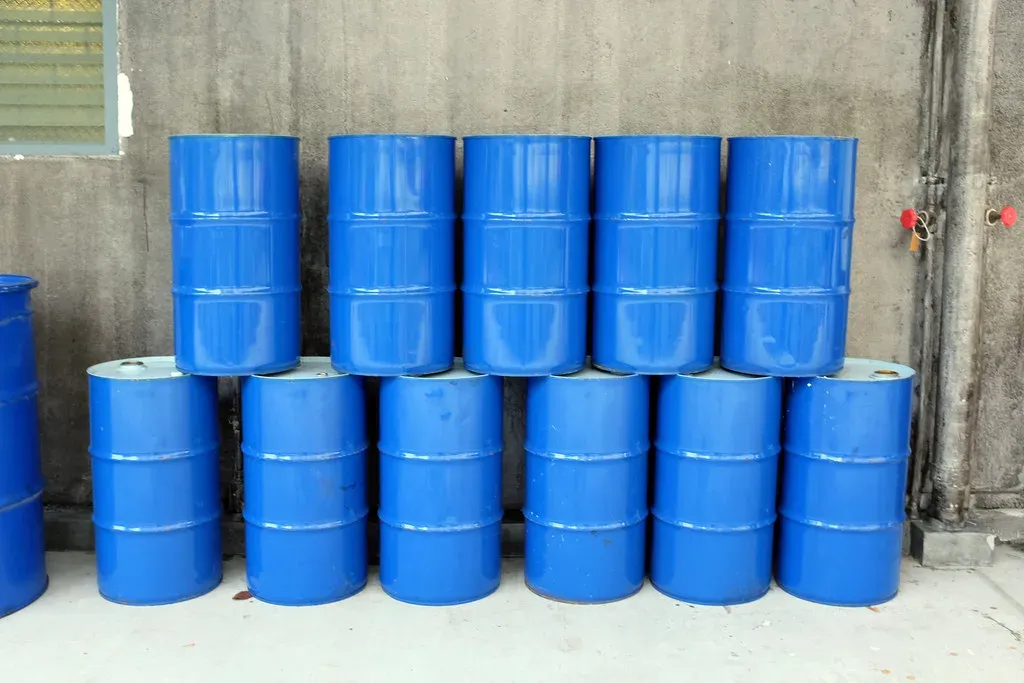
55 gallon drum containment on an oilfield location means a berm, pallet, tray or lined pad under every drum of oil or chemical, sized to hold the biggest drum in the group plus room for rain. The 55-gallon size is also the exact point where the federal SPCC rule starts counting a container, so a pad full of drums can put a lease over the threshold on its own. Which rule sizes the containment depends on what’s in the drum and where it sits.
Why 55 gallons is the number that matters
The SPCC rule (40 CFR 112) applies to a facility once its aggregate aboveground oil storage passes 1,320 gallons. In working out that total, 40 CFR 112.1(d)(2)(ii) says “only containers with a capacity of 55 U.S. gallons or greater are counted.” Section 112.1(d)(5) exempts “any container with a storage capacity of less than 55 gallons of oil.”
So a 55-gallon drum is the smallest container that counts, and it counts fully. Twenty-four drums of lube oil add up to 1,320 gallons. On a lease with a tank battery, the drums come on top of that. On a yard or compressor station with no tanks, two pallets of drums plus a day tank can push the site into SPCC.
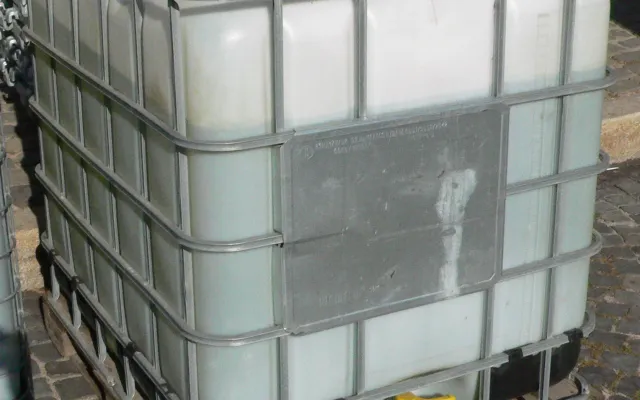
Five-gallon pails and 30-gallon drums don’t count. Switching lube deliveries to a 300-gallon tote doesn’t help, because a tote counts too; see IBC tote containment.
Which rule sets the containment for a drum?
The table gives the common cases on an oilfield location.
| Drum and situation | Rule | What it asks for |
|---|---|---|
| Oil drum (lube, hydraulic, used oil) at an SPCC-regulated non-production facility | 40 CFR 112.8(c)(11) | Containment “sufficient to contain the capacity of the largest single compartment or container with sufficient freeboard to contain precipitation” |
| Oil drum at an SPCC-regulated production facility (lease, tank battery) | 40 CFR 112.9(c)(2) and 112.7(c) | Containers at tank battery, separation and treating installations: “the entire capacity of the largest single container” plus freeboard; drums elsewhere on the lease: the general containment rule |
| Drum being dispensed from (faucet, hand pump, hose) | 40 CFR 112.7(c) | Containment sized for “the typical failure mode, and the most likely quantity of oil that would be discharged”; drip pans are a listed method |
| Drum of hazardous waste at a permitted storage area | 40 CFR 264.175(b) | A crack-free, sloped base holding “10 percent of the volume of containers or the volume of the largest container, whichever is greater” |
| Drum of flammable liquid (gasoline, solvent) stored outside | 29 CFR 1910.106(d)(6) | Area graded to divert spills from buildings, or a curb at least 6 inches high; at most 1,100 gallons next to a building |
EPA’s SPCC Guidance for Regional Inspectors settles whether drums are covered. Its examples of mobile or portable containers “include, but are not limited to, 55-gallon drums, skid tanks, totes, and intermediate bulk containers (IBCs).” When drums are parked, the guidance says, the requirement can be met with permanent measures such as dikes, curbing, drainage systems and catchment basins, and the drum area has to be shown on the facility diagram in the SPCC Plan. Areas where drums are in use have to be marked on the diagram too.
The last row surprises people. OSHA’s flammable liquids standard defines a container as “any can, barrel, or drum,” and its outside storage rule is about fire, not groundwater, so a graded pad counts. A drum of solvent may not be “oil” under SPCC at all, so read the safety data sheet before deciding which rule you’re under. Your SPCC Plan’s certifying engineer makes the call for an oil drum.
What “typical failure mode” means for a drum
The SPCC rule has two levels of containment. The specific rule for bulk and mobile containers assumes the whole container lets go, so containment holds the full largest drum. The general rule in 112.7(c) only has to address “the typical failure mode.” For a drum being dispensed, that’s a dripping faucet or a hose pulled off a hand pump, not the drum splitting.
That’s why EPA’s guidance lists drip pans as “commonly used with product dispensing containers (usually drums).” A sorbent sock around a drum is a different thing. EPA calls sorbents an active measure, one someone has to deploy, and says active measures should be limited to cases where a professional engineer has found the typical failure involves a small volume. A full drum emptying onto caliche is a big one.
How to size containment for a group of drums
Every drum standing inside a berm takes up floor the spill can’t use, so size for the largest single container, subtract the footprints, then check the rain allowance.
A worked example with four 55-gallon drums on one small berm:
- Largest container: 55 gallons ÷ 7.48 = 7.35 cubic feet. You size for one drum, not four.
- Berm floor: a 4 ft × 6 ft berm has 24 square feet.
- Drum footprints: a standard steel drum is close to 23.5 inches across at the chimes, roughly 3.0 square feet each, or 12.0 square feet for four. Subtract all four, because three still stand in the liquid while the fourth drains.
- Usable area: 24 − 12 = 12 square feet.
- Liquid height: 7.35 ÷ 12 = 0.61 feet, about 7.4 inches.
A 4 × 6 berm with a 12-inch wall holds one full drum with about 4.6 inches to spare for rain. The rule doesn’t define “sufficient freeboard.” EPA’s guidance calls a 25-year, 24-hour storm the proper standard while noting it isn’t enforceable. Rain over the whole 24 square feet goes into those 4.6 inches. The secondary containment calculator walkthrough has the rain math.
The RCRA rule for waste drums gives a useful check on spill pallets: 10 percent of the total or the largest container, whichever is greater. For four drums, 10 percent is 22 gallons and the largest container is 55, so a four-drum pallet has to hold a full drum. Pallets are built for covered areas; outside on a pad the sump fills with rain and loses its rated capacity.
Where drum spills start on a lease
Most drum releases are small and slow, so they reach the soil before anyone notices.
- Bung seals. A closed-head steel drum has a 2-inch and a 3/4-inch bung on top. A bung left loose after sampling weeps every time the drum warms up and breathes.
- Faucets and hand pumps. A faucet in the 2-inch bung drips. A hand pump left in a drum overnight siphons when it’s knocked.
- Rain on the drum head. Water pools inside the top chime of an upright drum, gets drawn in past a loose bung as the drum cools, and the oil overflows the next time the drum is pumped.
- Forklift damage. Fork tines punch the side wall when a pallet is picked up off-center, and a dented chime won’t seal an open-head lid.
Most of these happen at the transfer point, so containment should cover the pump and hose too. See spill containment pads for transfer areas.
Inspecting drums and their containment
The SPCC rule also requires the drums themselves to be inspected. Section 112.8(c)(6) requires the outside of each container to be inspected frequently for deterioration, discharges or oil accumulating inside diked areas. At a production facility, 112.9(c)(3) asks for regular visual inspection of each container, including its foundation and support. Section 112.7(e) requires written inspection procedures and records kept with the plan for three years. On a drum pad that’s a walk-around on a set schedule: stains under drums, water in the containment, bungs and faucets, rust on the bottom chime, and the berm drain. Section 112.9(b)(1) lets uncontaminated rainwater be drained from a dike at a production facility, but the drain has to stay closed and sealed otherwise.
Drum area checklist for a Permian location
- Every 55-gallon oil drum counted toward the SPCC total, and the drum area shown on the facility diagram
- Containment under parked drums sized for one full drum plus rain, with footprints subtracted
- A drip pan or containment pad under any drum being dispensed from, reaching the pump and hose
- Spill pallets under cover, or a berm outside
- Bungs tight, faucets closed, hand pumps pulled at the end of the shift
- Drums off bare ground, with forklift traffic kept to one side
- Flammable-liquid drums on a graded or curbed area away from buildings (OSHA 1910.106(d)(6))
- Berm drain closed, rainwater checked for sheen before release, walk-around on a written schedule
Containment for drum areas on Permian locations
Site Safe Solutions designs and installs containment systems for oilfield locations in the Permian Basin, from small lined berms around a drum or tote pad to primary containment pads and high-wall systems. If an inspection has flagged your drum storage, or you’re adding a lube station or a used-oil collection point to a lease, tell us how many drums sit there and whether trucks need to reach them, and we’ll size the containment around that.