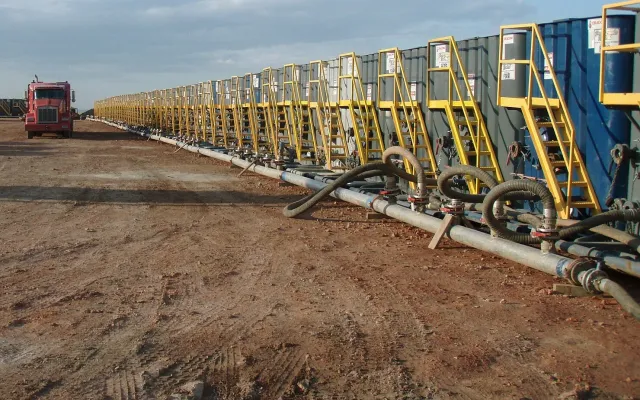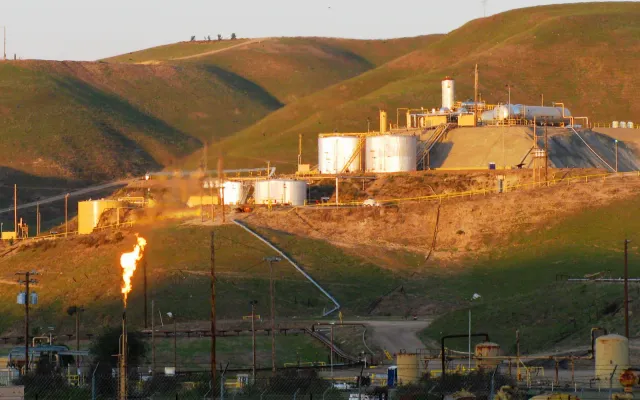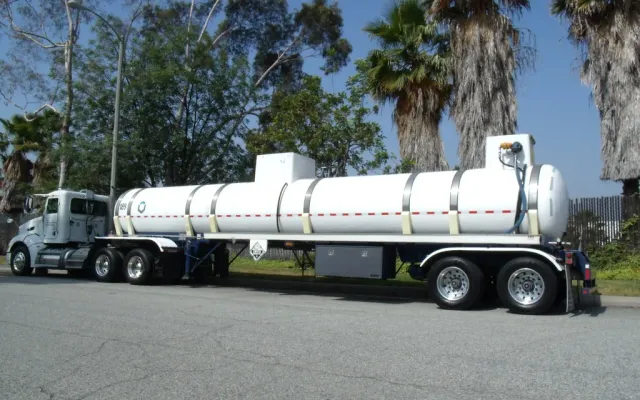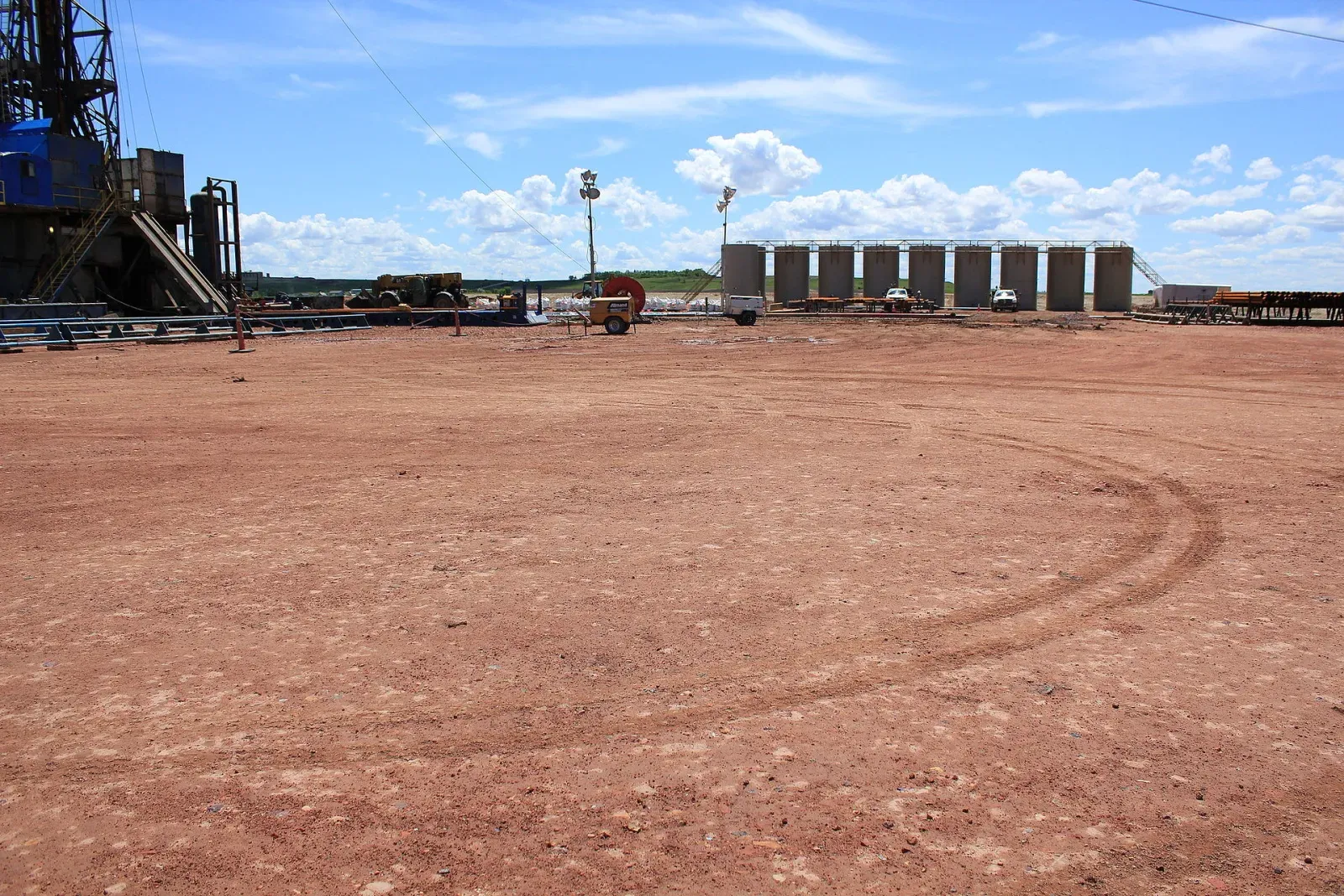
An oilfield tank battery is the group of vessels on a lease where the well stream gets separated, treated, measured and stored before the oil is sold and the water is sent to disposal. Most of the lease’s oil sits there, so it’s where federal SPCC rules expect sized secondary containment and where a slow leak does the most damage before anyone sees it. Below: where batteries leak, what the rule asks for, and how the containment gets laid out and sized.
What is a tank battery in oil and gas?
Walk any Permian lease and the layout is familiar. Flowlines come in from the wells, vessels split gas, oil and water, oil goes to a row of stock tanks and water to its own tanks, and the oil leaves by truck or through a LACT unit. The “battery” is all of it, named for the row of tanks.
| Component | What it does | Notes for containment |
|---|---|---|
| Inlet manifold and flowlines | Bring production in from the wells | Covered by the flowline maintenance program in 40 CFR 112.9(d) |
| Separator / free-water knockout | Splits gas from liquid, and free water from oil | A flow-through process vessel under the SPCC rule |
| Heater treater or gun barrel | Uses heat and settling time to get water and sediment out of the oil | Flow-through process vessels (EPA’s own examples) |
| Oil stock tanks | Hold sales oil until it’s hauled or run | Bulk storage containers. These drive the containment size |
| Produced water tanks | Hold water after separation, before disposal or reuse | Own option under §112.9(c)(6) |
| LACT unit or truck load line | Measures and transfers oil to the buyer | Where hoses get made up and broken |
| Gas side (meter, dehydrator, VRU, flare) | Handles the gas stream | Gas-only vessels aren’t subject to SPCC, per EPA |
One detail trips people up: EPA’s onshore production guidance counts oil/water separators used in production toward the facility’s total oil storage capacity.
Where does a tank battery actually leak?
Most battery releases are small and slow. The big ones usually start as a small one nobody caught. The SPCC rule’s own inspection list for production transfer operations, §112.9(d)(1), names the usual suspects: flange joints, valve glands and bodies, drip pans, pipe supports, polish rod stuffing boxes on pumping wells, and bleeder and gauge valves.
| Release point | How it usually happens | Typical control |
|---|---|---|
| Stock tank overfill | Pumper delayed, a run doesn’t happen, a level switch fails | One of the four overfill measures in §112.9(c)(4), plus sized containment |
| Tank shell or bottom | Corrosion, mostly from water and sediment sitting in the bottom | Scheduled visual inspection of each container, including its foundation, under §112.9(c)(3) |
| Valves, flanges, bleeders | Packing and gaskets weep, bleeders get left cracked | Inspection on a schedule, drip pans, a lined floor inside the berm |
| Dump valves on treaters and separators | Valve sticks open or leaks by | Inspection and testing of flow-through vessels and their components under §112.9(c)(5) |
| Produced water tanks | Oil carried over and floating on the water, corrosion from brine | The skimming procedure in §112.9(c)(6), or sized containment |
| Dike drain valve | Opened to drain rainwater and never closed | Drains kept closed and sealed except when draining clean rainwater, per §112.9(b)(1) |
| Truck load line | Hose disconnect drips, a coupling fails, a driver pulls away early | Containment at the transfer point (drip pan, curbed pad or a drive-over mat) |
A berm with an open drain valve is just a fence. The rule wants those drains closed and sealed except when releasing uncontaminated rainwater, after the diked area is inspected and any oil on the water is removed.
What does 40 CFR 112.9 require around a tank battery?
If you’re not sure whether your lease is covered by SPCC at all, start with our guide on whether a site needs secondary containment. Assuming it is covered, these are the parts of §112.9 that shape the battery:
- Sized containment. Tank battery, separation and treating installations need secondary containment for “the entire capacity of the largest single container and sufficient freeboard to contain precipitation” (§112.9(c)(2)). Drainage from undiked areas has to be confined in a catchment basin or holding pond.
- Flow-through vessels get an alternative. Separators and treaters can skip sized containment if they’re inspected, tested and repaired on a schedule and any oil is promptly cleaned up (§112.9(c)(5)). General containment still applies. A discharge over 1,000 gallons, or two over 42 gallons each in twelve months, from those vessels ends the option: all of them then need sized containment within six months.
- Produced water tanks have a similar option built on a PE-certified skimming procedure (§112.9(c)(6)).
- Overfill protection. At least one of: spare capacity for a late pumper, equalizing lines, vacuum protection, or high-level alarms to a production control computer (§112.9(c)(4)).
The general rule in §112.7(c) accepts dikes, berms or retaining walls “sufficiently impervious to contain oil,” along with curbing, drip pans, sumps and similar measures. That phrase matters on a caliche pad. A dirt berm on a porous base can hold its shape and still let oil through the floor.
Earthen berm, steel walls, liner or high-wall: what fits a battery?
The right answer depends on the footprint, the ground and how long the battery is going to sit there. These are the trade-offs we see in the field.
| Option | Where it works | Where it struggles |
|---|---|---|
| Earthen berm, unlined | Cheap to push up with a blade on a new pad | Floor and walls may not be impervious; erodes in storms; hard to inspect for seepage |
| Earthen berm with HDPE liner | Large batteries on open ground | Liner needs a cushion over rock and caliche and protection where people walk in |
| Modular steel or composite walls with liner | Batteries that get re-configured, tight pads, sites that need a clean inspection surface | Wall joints and corners need proper liner detailing |
| High-wall system | Big volumes in a small footprint, or sloped ground where a low berm would sprawl | Taller walls change access for gauging and maintenance |
| Drive-over containment at the load line | Truck transfer points and LACT areas where traffic has to cross | Needs walls rated for the traffic it will see |
Site Safe Solutions builds containment systems in all three of the main forms: modular drive-over, primary containment pads laid out to the site, and high-wall systems for large volumes or steep terrain, with HDPE liners and factory-trained installation crews.
How big does containment around a tank battery need to be?
The federal floor is the largest single container plus enough freeboard for rain. Your SPCC Plan sets the actual freeboard figure, so use its number. What catches people out is displacement: the other tanks sitting inside the berm take up volume below the top of the wall.
A worked example with round numbers (illustrative, not a design):
- Four oil stock tanks of 500 barrels each, each 15.5 ft in diameter, inside a berm with a 60 ft by 40 ft inside floor.
- Largest single container: 500 bbl × 42 gal = 21,000 gal. At 7.48 gal per cubic foot, that’s about 2,808 ft³.
- Floor area: 60 × 40 = 2,400 ft².
- Footprint of each other tank: π × 7.75² ≈ 188.7 ft². Three of them take up about 566 ft².
- Effective floor area: 2,400 − 566 ≈ 1,834 ft².
- Wall height to hold the largest tank: 2,808 ÷ 1,834 ≈ 1.53 ft, or about 18.4 inches.
- Then add the freeboard from your plan for precipitation, plus anything else inside the berm (a treater skid, piping supports, a pump).
Two things change that number over time. Equipment gets added inside the berm, and silt and caliche wash in and build up on the floor. Both eat capacity that was there on day one.
Don’t forget the load line
Hoses get made up and broken at the load line, so small releases cluster there. The general containment requirement in §112.7(c) covers it. A drip pan handles drips. For a truck parked over the connection, a drive-over mat catches what a pan can’t. Site Safe’s Fast Mats are custom-sized drive-over mats for exactly that kind of short-term coverage without a full pad build-out.
A safety note for anyone gauging tanks
Containment protects the ground. The hatch is a hazard to the person. CDC reviewed nine oil and gas worker deaths from January 2010 to March 2015 tied to hydrocarbon vapors and low oxygen. The workers were gauging, sampling or transferring fluids, or had opened tank hatches, and all nine were working alone. The recommended controls include remote gauging, sample points that keep people off the hatch, gas monitoring and not working alone. Plan where gauging happens when you plan where the berm walls go.
Texas: notice and cleanup if it does get out
Statewide Rule 20 (16 TAC §3.20) requires immediate notice of a leak or spill, with oil losses reportable once they exceed five barrels in the aggregate. Statewide Rule 91 (16 TAC §3.91), amended effective July 1, 2025 alongside the RRC’s new Chapter 4 waste rules and still in force, requires free oil removed immediately and, in non-sensitive areas, soil cleaned to 1.0% TPH by weight within one year. For the first steps on spill day, see the first hour of a spill.
A quick battery walk-through checklist
- Dike drain valves closed and sealed. Is there a record for each time rainwater was released?
- Liner or floor intact, with no standing oil or stained soil inside the berm.
- No silt build-up or new equipment eating into capacity.
- Tank shells, bottoms and foundations checked, with no weeps at chime or nozzles.
- Dump valves, bleeders and gauge valves not leaking by.
- Overfill measure working, and the load line over a pan or containment with hoses capped.
Planning containment for a battery
If you’re building a new battery or a berm has stopped doing its job, Site Safe Solutions can look at the layout, the largest tank and the traffic pattern and suggest drive-over, primary pad or high-wall containment that fits. The SPCC Plan and its certification stay with your environmental team or PE, and the physical containment is what we build. Send the location and what’s on the pad through our contact page.