A spill containment mat is an impermeable mat with raised edges that sits under a truck, trailer, pump or hose connection and holds whatever leaks until you can clean it up. It’s the right tool when the job is short, the equipment moves, or the likely spill is small: a service truck, a fuel trailer, a transfer hookup. It’s the wrong tool for a tank battery, where the rule wants containment sized to the largest tank. Size the mat from the volume that could realistically come out before someone stops it, and pick a wall that suits whether trucks drive over it.
Mat, berm or pad: which one fits the job
These three get sold side by side, and buyers mix them up. The difference is how long they stay, what they hold, and whether anything drives across them.
| Containment mat | Portable berm | Lined pad (primary containment) | |
|---|---|---|---|
| Typical job | Service truck, fuel trailer, pump, hose connection, temporary station | Frac tanks, tank rows, equipment parked for weeks | Tank battery, fixed equipment that stays for years |
| Volume | Small: the most likely spill at that spot | Sized to the largest container plus rain | Sized to the largest container plus rain |
| Traffic | Drive-over versions are built to be driven on | Walls block traffic unless it has drive-over sections | Designed around equipment, not through traffic |
| Setup | Minutes, by the crew on site | Hours | A planned build |
| SPCC role | Usually general containment under 40 CFR 112.7(c) | Can meet sized containment | Can meet sized containment |
The split comes from the federal rule. Section 112.7(c) is the general containment requirement. It asks you to address “the typical failure mode, and the most likely quantity of oil that would be discharged,” and it says containment “may be either active or passive.” Sized containment (largest single container plus freeboard for rain) applies to tank batteries and other bulk storage under 112.8 and 112.9. A mat almost always lives in the general category.
What EPA says about mats as containment
EPA’s inspector guidance names spill mats directly. It lists “spill mats, storm drain covers, and dams” as barriers that count as active containment measures “as long as they can be implemented in time to prevent the spilled oil from reaching navigable waters.”
Two conditions in that guidance shape how you use a mat:
- Timing. For discharges that happen during attended work like transfers, EPA says a mat or other portable barrier may be appropriate, and “ideally” it should be “deployed prior to initiating the activity.” A mat that’s down before the hose is connected is containment. A mat on the trailer is just equipment.
- Capacity. The measure has to be “capable of containing the most likely volume of an oil discharge from a typical failure mode.” That’s a number you can work out, and it’s how you size the mat.
On drilling and workover sites, 40 CFR 112.10 requires “catchment basins or diversion structures to intercept and contain discharges of fuel, crude oil, or oily drilling fluids.” EPA notes there’s no specific sizing or freeboard requirement there, so it works much like the general requirement. Mats under fuel tanks, pumps and generators on a workover location are a common way to meet it.
How to size a spill containment mat
Work out what could come out, then make sure the mat holds it with room to spare.
Step 1: find the most likely spill. EPA’s own worked example for a transfer area uses flow rate times reaction time. A truck loading at 150 gallons per minute, with an attendant who can shut the valve in 15 seconds, gives a most likely discharge of 37.5 gallons. Use your own pump rate and an honest reaction time.
Step 2: work out the mat’s capacity. Multiply length by width by usable wall height (all in feet) for cubic feet, then multiply by 7.48 for gallons. Divide by 42 for barrels.
Step 3: subtract what’s sitting in the mat. Tires, jack stands and pump skids take up volume below the wall height.
Three worked examples:
| Scenario | Most likely release | Mat that holds it |
|---|---|---|
| 3-inch transfer hose, 50 ft long, drains when uncoupled | Hose volume: π × (0.125 ft)² × 50 ft ≈ 2.45 ft³ ≈ 18 gal | A 6 × 8 ft drip mat with 4-inch walls holds about 16 ft³, roughly 120 gal |
| Hookup on a vac truck pumping at 5 bbl/min (210 gpm), 20-second reaction | 210 × 20 / 60 = 70 gal | 10 × 12 ft with 4-inch walls ≈ 40 ft³ ≈ 299 gal, before you subtract the tires |
| Fuel trailer, failure of one compartment valve | The compartment volume, from the trailer plate | Size to that compartment and don’t round down |
The pump rates in that table are examples to show the math, not standards. Use the numbers off your own equipment. And if the typical failure mode on a fuel trailer is a compartment emptying, a mat is likely too small. That’s a berm job.
Wall height vs drive-over
There are two basic mat designs.
Fixed-wall mats have rigid or foam-filled sides. They hold more for their footprint and they don’t move when you lean on them, but trucks can’t cross them, so they suit pumps, generators, totes and parked trailers.
Drive-over mats have walls that fold down under a tire and stand back up after it passes. They’re built for service trucks and vac trucks that pull on and off the mat during the job. They give up some capacity and rely on the wall recovering every time. Before you buy, ask the supplier three things:
- What axle load is the wall rated for, and how many cycles?
- Does the wall stand back up in cold weather?
- What is the floor material and thickness, and how is it repaired when a tire cuts it?
The point of a drive-over mat is that it stays down. Containment that has to be pulled every time a truck needs through tends not to go back down.
Absorbent mats are not containment mats
This is the confusion that costs people the most. A product sold as an “oil mat” or “spill mat” might be either of two things:
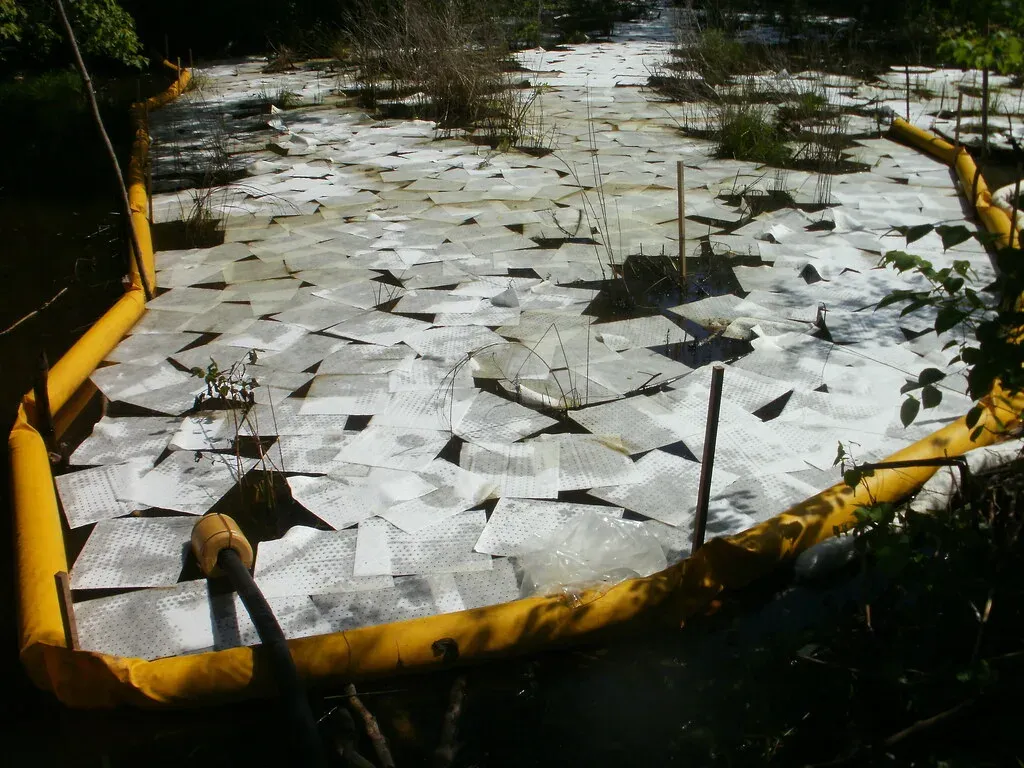
- Absorbent (sorbent) mats and pads soak up liquid. They’re good for drips under equipment and for cleanup.
- Impermeable containment mats hold liquid on a surface that doesn’t let it through, so it can be pumped up.
Both are legitimate. EPA lists “sorbent materials” among the acceptable containment methods in 112.7(c), and its stormwater guidance for equipment areas recommends drip pans and spill pads under stored vehicles and equipment. But EPA’s own guidance puts a number on how little sorbents hold. A 600-gallon discharge “would require deploying more than 900 ‘high-capacity’ sorbent pads (20 inches by 20 inches) since each pad absorbs less than 0.7 gallons of oil.” It also notes that most commercial spill kits are built for roughly 150 gallons or less.
So keep sorbents for drips and cleanup, and use an impermeable mat for the release you’re actually planning for. The best setup on a service truck is often both: a drive-over containment mat under the work, with pads on hand for the fittings.
Where mats get misused
- Left out for months and treated as permanent containment. EPA’s guidance warns that portable barriers “are typically not engineered for long-term deployment” and that rain, ultraviolet light and cold can affect how they perform. Inspect them like any other containment.
- Full of rainwater. A mat holding 4 inches of rain has no capacity left. Empty clean rainwater before the job, and handle any water with a sheen as waste.
- Under a tank. A mat doesn’t replace sized containment around bulk storage.
- Torn floor. One tire cut through the floor and the mat is a tray with a hole in it.
For what happens in the minutes after a release, see the first hour of a spill.
Fast Mats from Site Safe Solutions
Site Safe Solutions supplies Fast Mats: drive-over containment mats built to handle vehicle traffic, made in custom sizes, and meant for a single leak or spill event, a temporary station, a service truck or a small fluid transfer. Where the risk calls for something bigger, the same crew builds containment systems for tank batteries and pads. Tell us the footprint, what’s on it and roughly how much could come out, and we’ll size it with you.