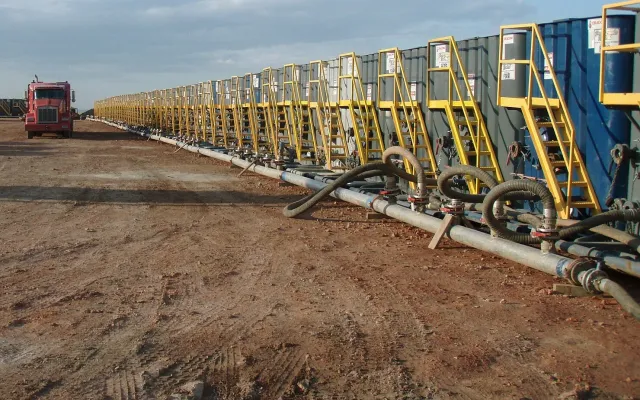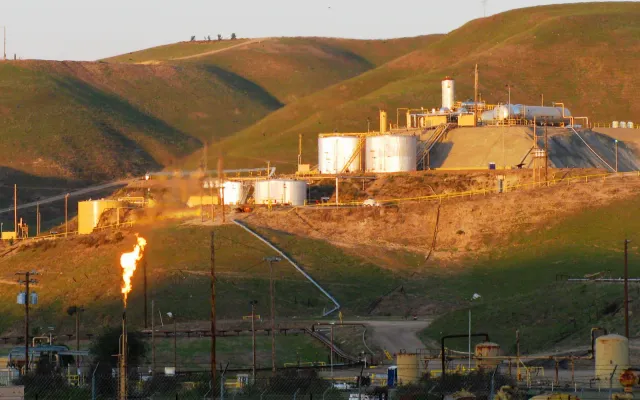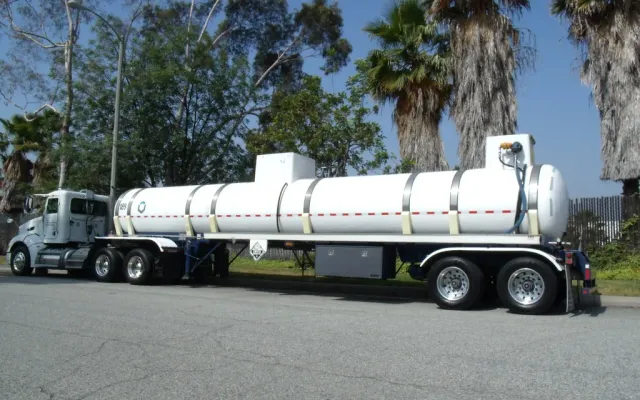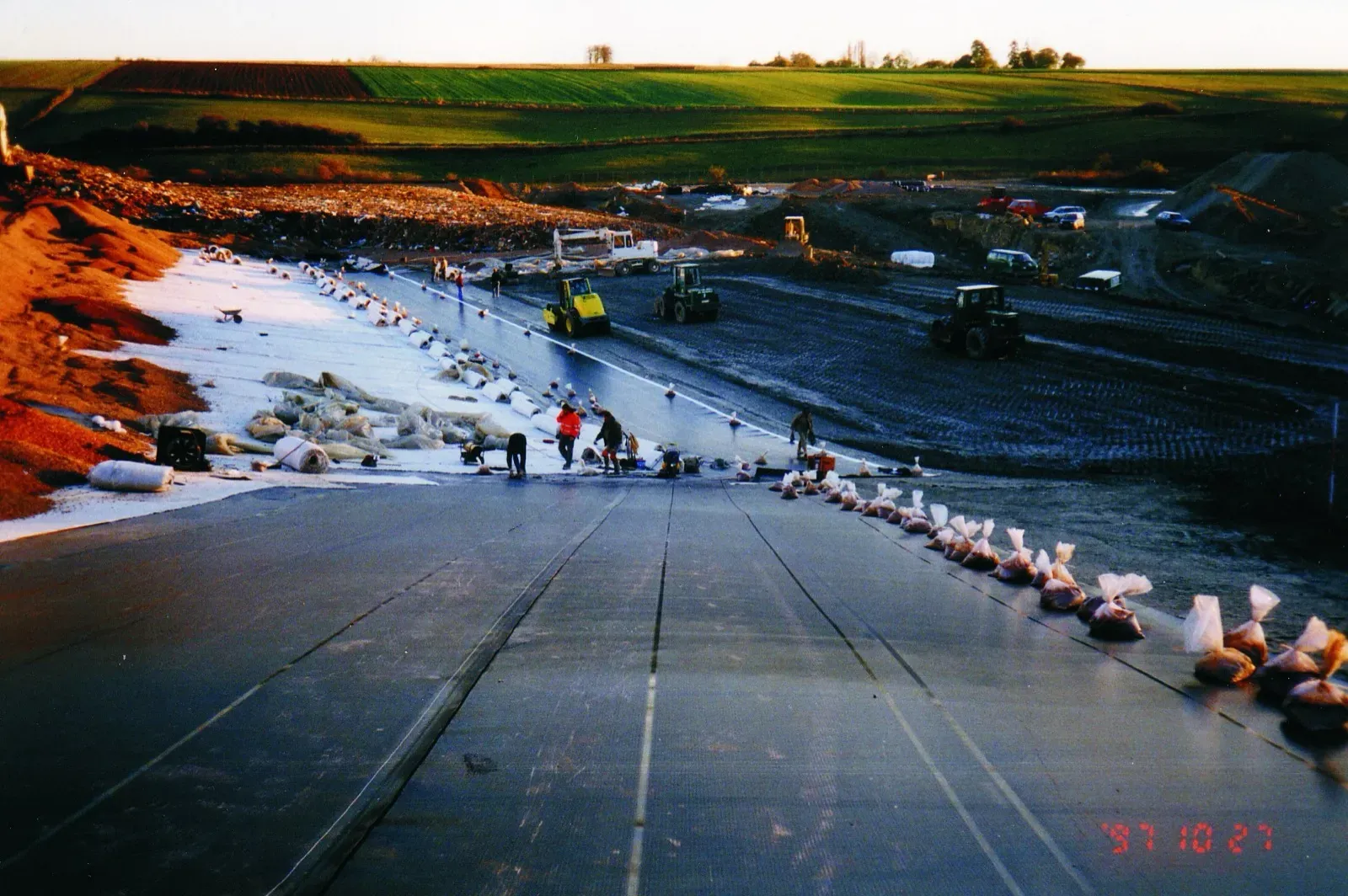
HDPE has good UV resistance when it’s made for outdoor service, and the reason is mostly carbon black. Geomembrane-grade HDPE carries 2 to 3 percent carbon black plus an antioxidant package, and the industry specification tests how much of that protection is left after accelerated UV exposure. Properly formulated black HDPE can sit exposed for decades. It still ages, and it ages fastest where the sheet is under stress and the sun and heat are relentless. That describes an exposed containment liner on a Permian pad.
This article explains what the GRI-GM13 specification requires, what testing shows about exposed life in hot, dry climates, where exposed liners fail first, and how to inspect one.
How HDPE resists UV
Sunlight’s ultraviolet band breaks polymer chains in polyethylene through a series of free-radical reactions. The 2021 laboratory study in Membranes summarizes the defense. Carbon black, about 2 to 3 percent by mass, is added to the resin during manufacturing to protect the polymer from UV. Antioxidants slow the oxidation that follows.
Those antioxidants are consumed over time. Once they’re depleted, the polymer itself starts to degrade. Wikipedia’s geomembrane article describes the long-term pattern: the sheet becomes more brittle, with less elongation at failure, a higher stiffness and a general loss of ductility.
What GRI-GM13 requires
GRI-GM13 is the Geosynthetic Research Institute’s standard specification for HDPE geomembranes. It’s the spec most liner suppliers quote. It covers sheet from 30 to 120 mil thick with a formulated density of 0.940 g/cc or higher. It’s a manufacturing quality control spec, so it sets minimum values for the sheet as made, not a service-life guarantee.
The values that bear on UV and aging:
| Property (GRI-GM13) | Requirement | Why it matters outdoors |
|---|---|---|
| Carbon black content | 2.0 to 3.0 percent | Primary UV screen |
| Carbon black dispersion | Specified by ASTM D5596 | Clumped carbon black leaves unprotected areas |
| Oxidative induction time (OIT), as made | At least 100 min (standard) or 400 min (high pressure) | Measures the antioxidant package |
| Oven aging | At least 55 percent standard OIT, or 80 percent high-pressure OIT, retained after 90 days | Shows how antioxidants hold up under heat |
| UV resistance (ASTM D7238) | At least 50 percent high-pressure OIT retained after 1,600 hours | Accelerated test: 20-hour UV cycles at 75°C followed by 4 hours of condensation at 60°C |
| Stress crack resistance | 500 hours (per GRI-GM10) | Resistance to cracking under sustained stress, such as at creases and seams |
When you compare liner quotes, ask for the manufacturer’s certification against GM13 and the current revision (Revision 16 is dated March 2021). A liner described only as “UV stabilized” tells you very little.
How long does exposed HDPE last?
This is the question everyone asks and the one sources are most careful with. Wikipedia’s geomembrane article notes that geomembranes degrade slowly enough that their full lifetime behavior is “as yet uncharted.” Lifetime has to be estimated from accelerated testing.
The best-known estimates come from the Geosynthetic Institute’s White Paper #6. For exposed geomembranes in a dry, arid climate, its lab-to-field predictions, updated in 2011, were:
| Geomembrane | Specification | Predicted exposed lifetime (dry, arid climate) |
|---|---|---|
| HDPE | GRI-GM13 | More than 36 years (testing ongoing at the time) |
| LLDPE | GRI-GM17 | About 36 years (half-life) |
| fPP | GRI-GM18 | About 30 years (half-life) for one formulation; more than 27 years (ongoing) for another |
| PVC (North American) | About 18 years (half-life) |
Three points from the same paper are worth knowing in West Texas:
- The lab-to-field calibration came partly from West Texas. GRI correlated its weathering-chamber hours to field exposure using failed flexible polypropylene liners, including two sites in West Texas. It settled on about 1,200 hours of lab light exposure as equal to one year in a hot climate.
- Formulation matters more than polymer name. One poorly formulated fPP geomembrane failed after 26 months exposed at El Paso.
- Covering a liner helps enormously. For buried HDPE, GRI’s predicted half-life ranges from 446 years at 20°C to 69 years at 40°C. Heat alone shortens life even without sunlight.
Treat these figures as what they are: laboratory predictions for properly formulated, specification-grade sheet. They don’t account for punctures, poor seams, traffic or chemical attack, and they aren’t a warranty on any liner.
What a laboratory UV study found
The 2021 Membranes study exposed 1.0 mm (about 40 mil) virgin HDPE geomembrane to a UV fluorescent weatherometer for 8,760 hours and a xenon-arc unit for 2,160 hours. Its findings line up with the GM13 approach:
- Antioxidants were used up steadily. After 8,760 hours of UV fluorescent exposure, standard OIT fell by 75 percent and high-pressure OIT by 36 percent.
- Tensile strength and elongation dropped by about 30 percent on average under UV fluorescent exposure. The sheet lost ductility but didn’t become brittle in the test period.
- The tested sheet met most GM13 values but fell short on stress crack resistance and OIT. That’s a reminder that certification matters.
Why exposed liners fail at seams and creases first
UV and heat age the whole sheet, but cracks start where the sheet is under stress:
- Seams. Wikipedia’s geomembrane article notes that because of stress concentrations from seam geometry, seams can lose some tensile strength or elongation compared with the parent sheet. A seam is the weak line in an aging liner.
- Creases, folds and wrinkles. Sheet folded during handling, or wrinkled where it was laid in the heat, carries locked-in stress. GM13’s stress-crack test exists because sustained stress is what drives slow cracking in polyethylene.
- Edges and anchors. Where the liner bends over a berm wall or into an anchor trench, it’s both stressed and fully exposed.
- Wear lanes. Where trucks, people or equipment cross the liner, abrasion removes surface material and exposes fresh polymer.
On a Permian pad, add the temperature swing from hot afternoons to cooler nights. The liner expands and contracts every day, which keeps working those stressed spots.
HDPE or LLDPE for exposed containment
| HDPE (GRI-GM13) | LLDPE (GRI-GM17) | |
|---|---|---|
| Density | 0.940 g/cc or higher | 0.939 g/cc or lower |
| Carbon black | 2.0 to 3.0 percent | 2.0 to 3.0 percent |
| Break elongation (smooth, min.) | 700 percent | 800 percent |
| Predicted exposed life (GRI WP6, arid) | More than 36 years (ongoing) | About 36 years |
| Field strengths | Stiffer; good chemical resistance; widely used | More flexible; conforms better to rough subgrade and corners |
For most exposed oilfield containment, HDPE is the common choice. LLDPE’s flexibility can help where the liner has to follow uneven ground or tight details. The installer’s subgrade preparation and seaming quality will matter more than the choice between the two.
Inspecting an exposed liner
Look at the liner on a regular schedule and after anything unusual: storms, equipment moves, a spill.
- Walk the seams. Look for separation, lifting edges or hairline cracks along the weld.
- Check creases, folds and the bends over walls and into anchor trenches for cracking.
- Look for chalky, dull or crazed surfaces, a sign the surface has weathered.
- Check wear lanes and areas under equipment for scuffing, thin spots and punctures.
- Look for blisters or bubbles, and for liquid or vegetation under the sheet.
- Feel exposed edges. Sheet that has lost its flexibility can crack when bent.
- Record what you find with photos and locations so you can compare next time.
A liner that was right when it went in can still fail years later. The containment systems page lists UV exposure, seam separation and punctures among the usual reasons existing containment stops working.
Liners specified and installed for the site
Site Safe Solutions designs and installs containment systems for oilfield sites, with material specification that includes advanced HDPE liners, and layouts designed for ease of installation and maintenance. If you’re not sure whether a site needs containment at all, start with does my site need secondary containment. To talk about a new liner or one that’s showing its age, contact Site Safe Solutions.