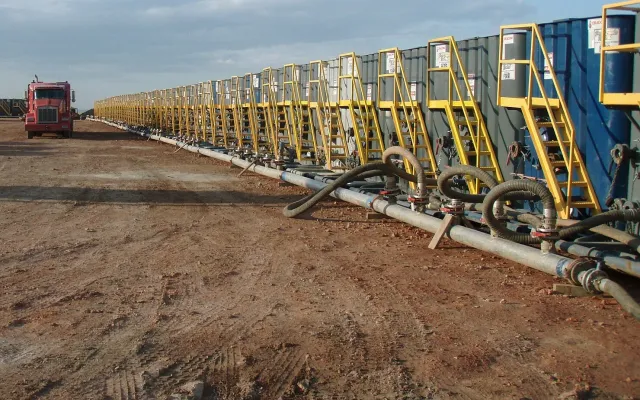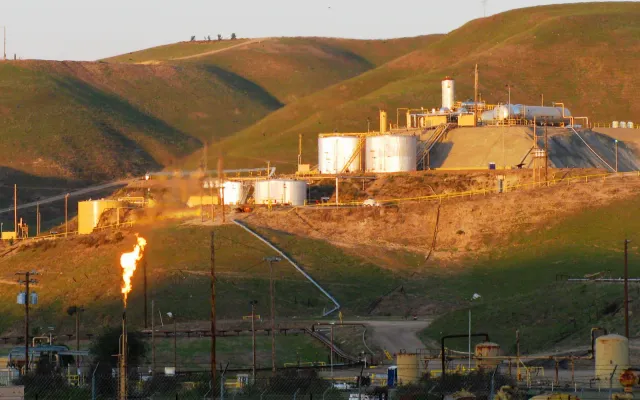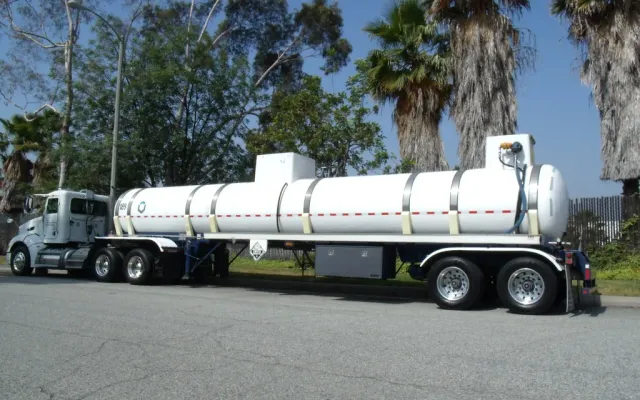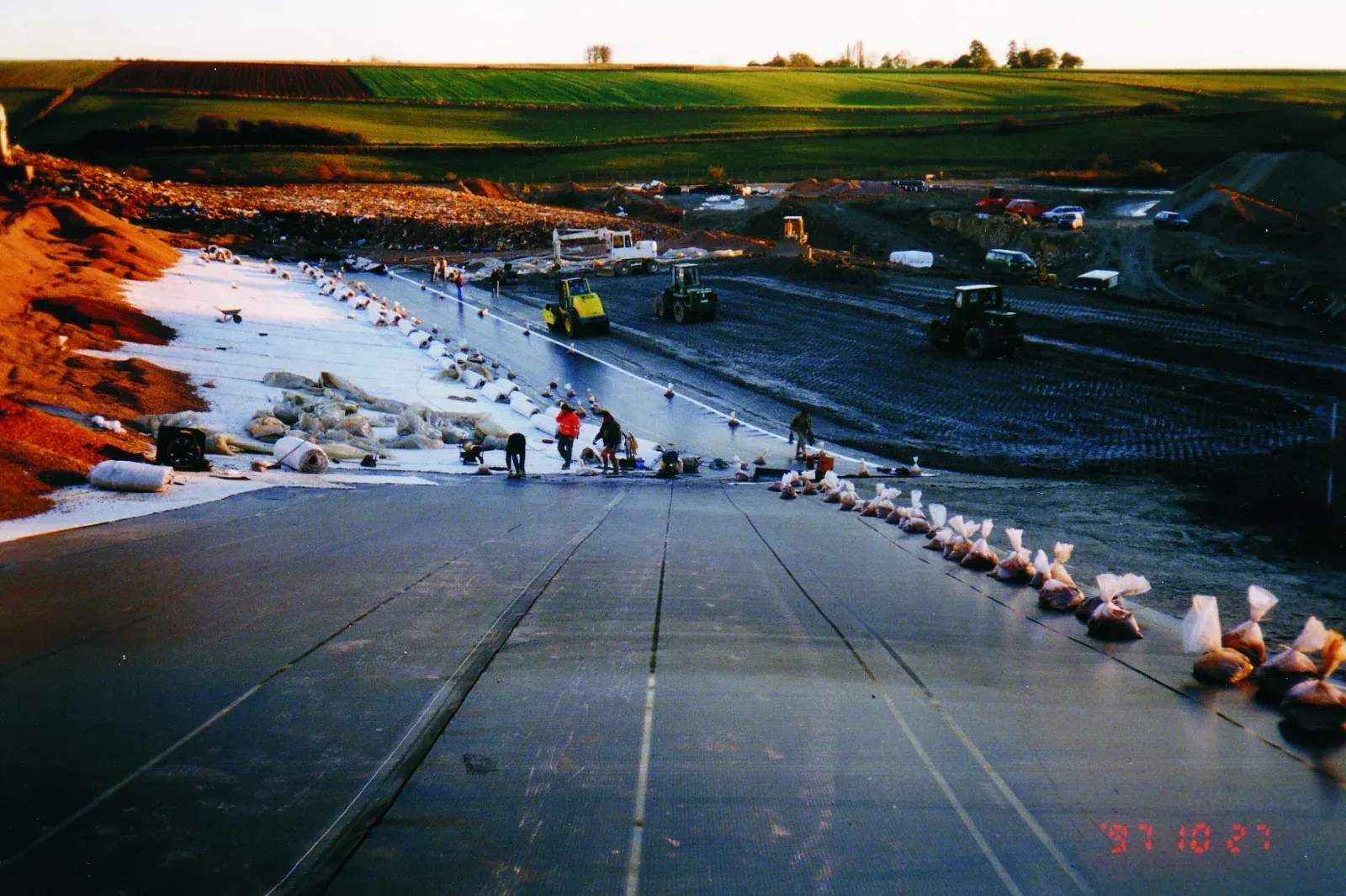
For an oilfield containment liner, HDPE is the default and PVC is the exception. HDPE is the stiffer, more chemically resistant sheet, built to sit exposed in the sun with 2–3% carbon black, and it’s welded with seams you can air-test. PVC is far more flexible and easier to fold and fit. Its flexibility comes from plasticizer, though, and that’s the property to question when the liner will hold crude and condensate in West Texas sun. In between sit LLDPE and flexible polypropylene (fPP), which give you most of PVC’s flexibility on a polyolefin you can weld like HDPE.
If you searched “HDPE vs PVC” and landed on pipe comparisons, this is the liner version. The two questions don’t share answers.
Four liner materials you’ll be quoted
US geomembrane use is split across a handful of polymers. A widely cited market breakdown puts HDPE at about 35%, LLDPE at about 25%, PVC at about 25% and flexible polypropylene at about 10%, with CSPE and EPDM making up most of the rest. For oilfield containment you’ll mostly see the first two, sometimes the third and fourth.
| HDPE | LLDPE | PVC (flexible) | fPP | |
|---|---|---|---|---|
| Governing spec | GRI-GM13 | GRI-GM17 | Separate PVC specs (not GRI-GM13/17) | GRI-GM18 |
| Stiffness | Stiffest; needs a smooth subgrade | Flexible; conforms to rough ground | Very flexible; drapes and folds | Flexible |
| How flexibility is achieved | Polymer itself | Lower-density polyolefin | Plasticizer added to the PVC | Polymer blend |
| Exposed UV performance | 2–3% carbon black and a UV test required by GM13 | 2–3% carbon black; lower UV-retention value in GM17 | Depends on formulation; ask for data | Depends on formulation; ask for data |
| Field seams | Hot wedge (air-testable) and extrusion | Hot wedge and extrusion | Thermal or solvent/chemical bonding | Hot wedge and hot air |
| Typical oilfield use | Tank batteries, primary pads, exposed walls | Rough subgrade, liners that need to conform | Small fabricated panels, short-term or covered use | Fabricated panels, flexible exposed use |
Hydrocarbons and produced water
A containment liner might hold crude, condensate, diesel, produced water and treating chemicals. Sometimes it holds all of them, and sometimes for weeks before cleanup. The material has to keep its properties while that happens.
HDPE and LLDPE are polyolefins with nothing added to make them flexible. That’s the main reason HDPE became the standard for hydrocarbon containment.
Flexible PVC is a different case. Plasticizers are what make PVC usable as a flexible sheet. They’re added to the resin, not chemically bonded to it, and they can escape a plastic by migration. Phthalate plasticizers in particular aren’t covalently bound to the polymer, which makes them susceptible to leaching. A flexible PVC liner that loses plasticizer gets stiffer and more brittle. Whether a given PVC sheet holds up to your fluids is a question for test data, not a sales sheet.
EPA has a test method for exactly this question: SW-846 Method 9090A, the “Compatibility Test for Wastes and Membrane Liners.” Liner samples are immersed in the actual fluid for at least 120 days, at room temperature and at 50°C, and their physical properties are measured before and after. If a supplier proposes PVC (or anything other than HDPE) for a liner that will see hydrocarbons, ask whether they have compatibility data against crude or condensate. If they don’t, that tells you something.
Sun on an exposed pad
Exposed liners in the Permian take a lot of sun. The GRI specs build UV protection in for the polyolefins:
- GRI-GM13 (HDPE) requires 2.0–3.0% carbon black. Under its UV-resistance test, the high-pressure OIT (a measure of remaining antioxidant) has to keep at least 50% of its value after 1,600 hours.
- GRI-GM17 (LLDPE) also requires 2.0–3.0% carbon black, but the UV-retention minimum is 35%.
Lab data shows that even HDPE ages. In a 2021 study in Membranes, a 1.0 mm HDPE geomembrane lost about 30% of its tensile properties after 8,760 hours of fluorescent UV exposure. Any exposed liner needs inspecting. On PVC and fPP, UV resistance depends on how the sheet is formulated, so get the manufacturer’s exposed-use data before putting one in direct sun.
Flexibility over caliche and rock
Here PVC and LLDPE have a real advantage. Compare GRI-GM17 with GRI-GM13 at 40 mil. LLDPE’s minimum break elongation is 800% against HDPE’s 700%, and LLDPE has a maximum stiffness limit that HDPE doesn’t. In practice, LLDPE and PVC drape over a lumpy subgrade and conform to corners and pipe boots without the stress that builds where stiff HDPE bridges a rock or a hollow.
HDPE’s stiffness doesn’t rule it out on a caliche pad. It means the subgrade prep and the cushion under it have to be done properly, and you should go up to 60 mil where tanks sit. The GM13 puncture minimum rises from 72 lb at 40 mil to 108 lb at 60 mil. Compare that with LLDPE at 40 mil, which has a GM17 puncture minimum of 56 lb. Flexibility and puncture resistance trade off against each other.
Seaming and field repair
This is where the polyolefins pull ahead for oilfield work. GRI-GM19a covers seams for HDPE, LLDPE and fPP, made by hot wedge (single or dual track) and extrusion fillet. A dual-track wedge seam leaves an air channel between two welds. You can pressurize the channel to test the full length of the seam without cutting it. That’s a big deal on a liner nobody wants to dig up later.
PVC is usually joined thermally or with solvent bonding. Both work when done well, but field quality control depends heavily on the crew. For HDPE and LLDPE, field repairs are extrusion-welded patches tested with a vacuum box, and any containment installer will have the gear.
Which liner to specify
- Permanent tank battery or primary containment pad, exposed to sun: HDPE to GRI-GM13, 60 mil, on a cushioned subgrade, with dual-track wedge seams.
- Short-term frac or completion pad on a smooth, prepared surface: HDPE at 40 mil can work. Go to 60 mil if the tanks will sit on it.
- Rough or uneven subgrade you can’t fully smooth, or lots of details and corners: LLDPE to GRI-GM17, with extra cushion under load points.
- Small fabricated panels, berm inserts or covered and temporary use: PVC or fPP can make sense. Get chemical compatibility and exposed-use data first.
- Anywhere trucks cross: none of these on their own. Use a wear layer, a drive-over section or drive-over containment mats in the traffic lane.
Whatever you pick, the federal SPCC rule cares about the result, not the polymer. The containment, “including walls and floor,” must hold oil until cleanup. For whether your site needs containment at all, see does my site need secondary containment.
Talk through your liner spec
Site Safe Solutions installs containment systems on Permian Basin sites, including HDPE liners specified to the site and installed by factory-trained crews. If you’re comparing liner quotes and want a second set of eyes on the material, thickness and seam spec, send us what’s on the pad and how long it will be there.