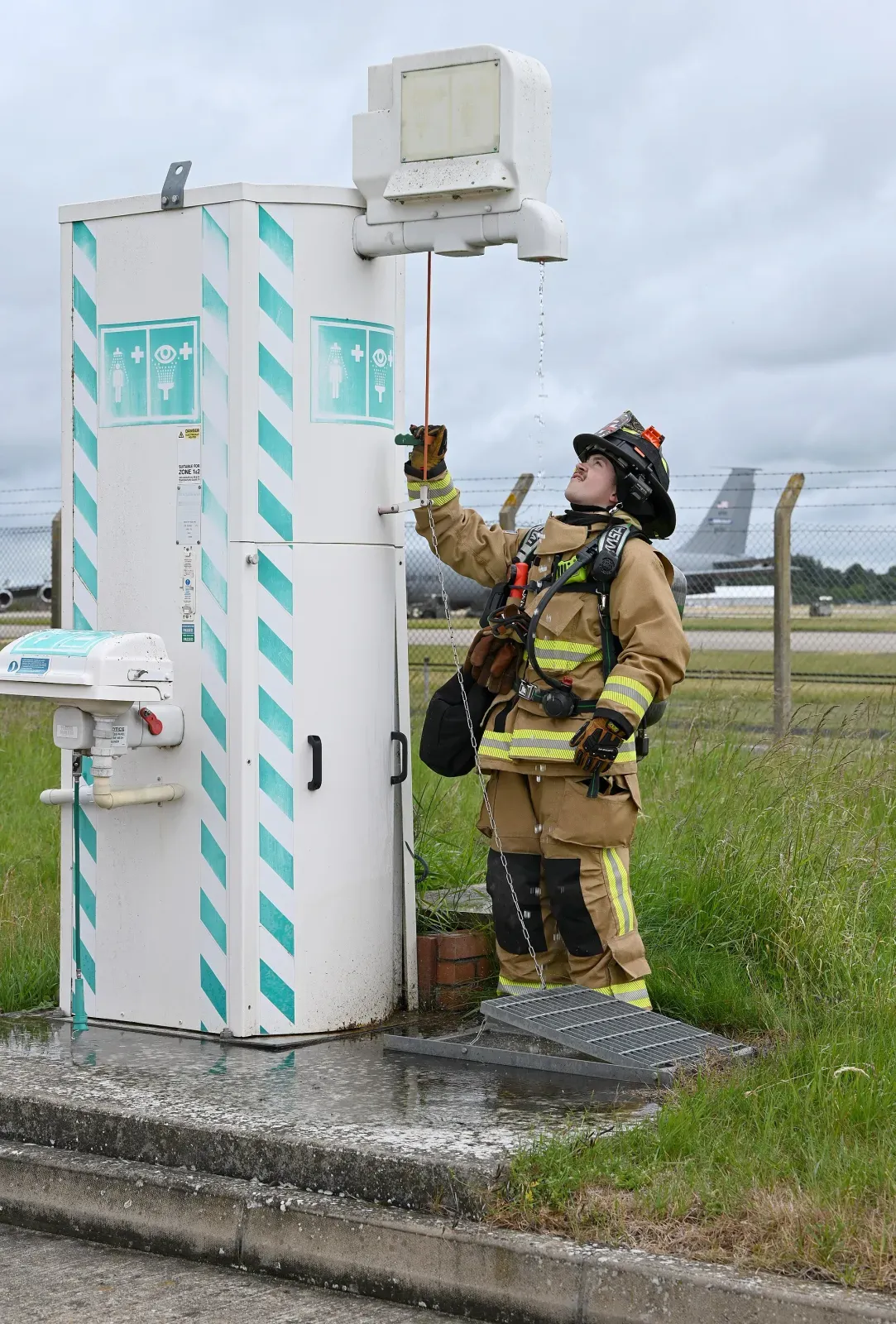
ANSI Z358.1 is the consensus standard that defines a “suitable” emergency shower or eyewash. A shower has to deliver tepid water at 20 gallons a minute for 15 minutes, from a unit a worker can reach in about 10 seconds. OSHA never adopted the standard. Its own rule is one sentence long, and the agency points employers to Z358.1 for the detail. On a well site those details are harder to meet than in a plant. There’s usually no water line, the summer sun beats on everything, and the work moves around the pad and from lease to lease.
What OSHA requires, and where ANSI Z358.1 comes in
The federal rule is 29 CFR 1910.151(c): “Where the eyes or body of any person may be exposed to injurious corrosive materials, suitable facilities for quick drenching or flushing of the eyes and body shall be provided within the work area for immediate emergency use.” The construction standard, 1926.50(g), uses the same words.
The rule gives no flow rate, temperature or distance. OSHA’s 2002 interpretation letter on this exact question said ANSI standards become mandatory only when OSHA adopts them, that Z358.1 was not adopted, and that OSHA has often referred employers to it as guidance. The same letter said a citation for missing or unsuitable flushing facilities is written under 1910.151(c), not the General Duty Clause.
In practice, OSHA decides whether you need a shower, and Z358.1 is how you show the one you provided is suitable. Minnesota OSHA’s instruction, for one, tells its inspectors to check units against Z358.1-2014. It says that travel time much greater than ten seconds, a route through several doors, or minimal flow generally makes a unit unsuitable, and that these violations are usually cited as serious.
In the Permian the basin crosses a state line, and that changes who enforces the rule. Texas has no OSHA-approved State Plan, so most private-sector work there falls under federal OSHA. New Mexico runs its own State Plan covering most private-sector workers. A crew that works both sides is under two programs, so check New Mexico’s rules before assuming the federal letters settle a question there.
When does an oilfield location need an emergency shower?
The trigger is exposure to injurious corrosive materials. OSHA’s 2009 letter spells out both edges. If the safety data sheets show nothing corrosive in the work area, 1910.151(c) doesn’t require a shower or eyewash. A corrosive sealed in a container that won’t be opened doesn’t trigger it either. A tap or sample point where workers draw the material off does.
On location the usual triggers are:
- Acid. FracFocus lists acid among the most commonly used frac fluid additives, used to dissolve minerals and start cracks in the rock. Minnesota OSHA’s list of common eye and skin hazards includes hydrochloric (muriatic) acid.
- Battery acid. The same list includes sulfuric acid. In construction, 1926.441(a)(6) requires facilities for quick drenching of the eyes and body within 25 feet of battery handling areas.
- Caustics and treating chemicals. The list includes sodium hydroxide, potassium hydroxide and ethanolamine, which it notes is used as a corrosion inhibitor.
Minnesota’s instruction also gives a usable SDS test. If the SDS says irritation only, it doesn’t support a shower requirement. If it says burns, corneal damage or blindness can occur, it does. The instruction also treats a pH from 0 to below 2, or above 11 to 14, as able to cause at least major eye irritation and possibly permanent damage. And it says exposure is judged without regard to PPE. Goggles, face shields and slicker suits lower the odds of a splash reaching the skin, and the shower is still required.
Where a shower is needed, an eyewash is needed too. Minnesota’s checklist accepts a combination unit for both.
ANSI Z358.1 emergency shower requirements
These are the shower provisions of the 2014 edition, with the section numbers given in the manufacturer’s compliance checklist.
| Item | What Z358.1-2014 calls for | Section |
|---|---|---|
| Flow | At least 20 gpm (75.7 L/min) for 15 minutes | 4.1.2, 4.5.5 |
| Valve | On in 1 second or less, stays open hands-free until shut off | 4.1.5, 4.2 |
| Actuator | Easy to find, no more than 69 in above the floor | 4.2 |
| Water column | Top between 82 and 96 in above the floor | 4.1.3 |
| Spray pattern | At least 20 in across at 60 in above the floor; center at least 16 in from any obstruction | 4.1.4 |
| Temperature | Tepid, 60 to 100 F | 4.5.6 |
| Location | About 10 seconds away (roughly 55 ft), same level as the hazard, clear path; next to the hazard for strong acids and caustics | 4.5.2, Appendix B5 |
| Marking | Highly visible sign, well-lit area | 4.5.3 |
| Upkeep | Plumbed units activated weekly; every unit inspected annually against the standard | 4.6.2, 4.6.5 |
| Training | Everyone exposed knows where it is and how to use it | 4.6.4 |
How much water a portable safety shower has to carry
A plant connects its shower to a water line. A well site usually has none, so the unit carries its own supply, and the 15-minute flush turns into a tank size.
At 20 gallons a minute for 15 minutes, one shower needs 300 gallons before anyone uses the eyewash. A combination unit with an eye/face wash at 3 gallons a minute adds 45 gallons, so 345 in total. The standard requires a combination unit’s supply to hold the required flow with the shower and the eye or eye/face wash running at the same time.
Questions worth asking about any portable unit or rental trailer:
- How many gallons does it hold, and what flow does it put out at the head?
- How is the water kept tepid in July and January?
- Who refills it after a test or a real use, and how fast?
Tepid water in West Texas heat and cold
Z358.1 defines tepid as 60 to 100 F. Minnesota OSHA’s instruction explains the limits. Water above 100 F has been shown to harm the eyes and can speed up a chemical reaction. Water that’s too cold can bring on shock or hypothermia in a shower, and either extreme makes people stop flushing early.
On a Permian pad both ends are real. NOAA’s 1991-2020 climate normals for Midland International Airport put the average July high at 95.8 F and the average January low at 32.7 F. A water tank that sits in July sun all day can’t be assumed to stay under 100 F, and a January morning can leave the supply too cold or the lines frozen. The checklist calls for freeze protection where equipment can freeze. Its listed options include heat-traced and insulated units and heated enclosures. Check the temperature at the shower head on a hot afternoon and a cold morning, because a mild midday test misses both.
Where the shower sits on location
The 10-second rule is about 55 feet at a normal walking pace, according to Appendix B of the standard as quoted by Minnesota OSHA. Three parts of the placement rule trip up oilfield setups:
- Same level. A worker hit on a frac pump deck, a tank top or a rig floor has to come down stairs to reach a shower on the ground, and the standard asks for the unit on the hazard’s level. Stairs between the hazard and the shower are worth raising in the JSA.
- Clear path. Hoses, iron and fluid lines laid across the pad block a route that looked open at rig-up. Someone who can’t see will trip over them.
- The work moves. When the acid or chemical transfer moves to the other side of the pad, the shower has to move with it. For strong acids and caustics, the standard puts the unit right next to the hazard.
Give it a sign that can be seen from the work and light it for night operations. Training should include walking the route, so the first time a hand finds the shower isn’t with chemical in their eyes.
Weekly activation and annual inspection
Plumbed units get activated weekly, long enough to confirm water flows and the line is clear. Self-contained units are maintained to the manufacturer’s instructions, including keeping them full and changing the fluid on schedule. Every unit gets a yearly inspection against the standard.
Weekly flushing also keeps stored water from going stale. OSHA’s InfoSheet on contaminated flushing water warns that stagnant or untreated water in poorly maintained units can carry Acanthamoeba, Pseudomonas and Legionella, which can reach the eyes and skin or be inhaled. A worker whose skin or eyes were just burned by a chemical is more open to infection. Keep a tag or log on the unit with the date, who ran it, and what they found.
Where the runoff goes
The standard has no provisions for disposing of the water. The compliance checklist notes this and says the runoff still shouldn’t pool where someone can slip, or freeze. On location there’s a second issue. The water coming off a worker who was splashed with acid or produced fluid carries some of it. Setting the shower where the runoff lands in containment keeps a medical response from turning into a spill. The first hour of a spill guide covers the reporting side if it does.
Pre-job shower check
- SDS reviewed for every chemical on location; corrosives identified (1910.151(c))
- Shower and eyewash, or a combination unit, within about 10 seconds of each corrosive task, on the same level
- Tank holds at least 300 gallons for a shower, 345 for a combination with eye/face wash
- Water tepid at the head, 60 to 100 F, checked at the hottest and coldest parts of the day
- Path clear of hoses and iron, sign visible, area lit at night
- Weekly activation logged; annual inspection on file
- Crew shown the route and how to use it, and the shower moved when the work moves
For the jobs on location where splashes are most likely, see flowback hazards.
Emergency shower trailers in the Permian Basin
Site Safe Solutions rents emergency shower trailers for oil and gas locations in the Permian Basin and West Texas. We deliver the trailer, rig it up on location and maintain it during the rental, and the setup suits long-term rentals. Tell us the lease, what the crews handle there, the crew size on each shift, how long you need it and where on the pad it should sit.