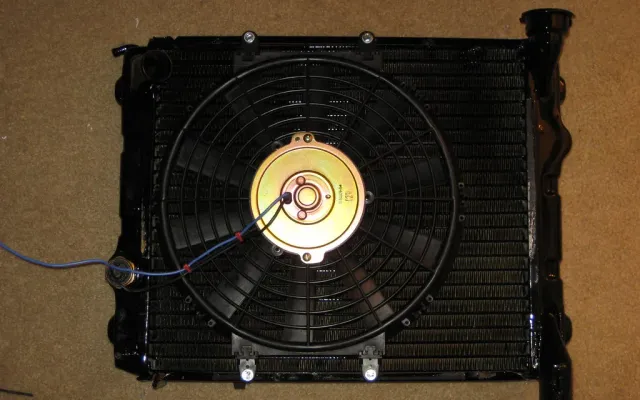
Cooling system maintenance on heavy equipment has two halves. The inside is the coolant: its level, its condition and the parts it flows through. The outside is airflow through the radiator core. Most car-care advice is about the inside. On a loader, generator or pump unit working on a caliche pad in a Permian summer, the outside is usually what fails first. A core packed with dust and oily grime can’t shed heat, however good the coolant is.
This guide covers both halves, gives a symptom-to-cause table for machines that run hot, lists the cleaning limits one major OEM publishes, and suggests an inspection routine that follows the dust instead of the calendar.
Why West Texas is hard on cooling systems
Two things work against a radiator here.
The first is heat. National Weather Service normals for Midland put the typical July daily high at about 95 to 96°F, with record highs on individual July days of up to 112°F. A cooling system rejects heat based on the difference between coolant temperature and air temperature. The hotter the air, the less margin the system has.
The second is dust. Caliche dust, sand and chaff collect in the fins, and on oilfield equipment they often stick to an oily film from leaks or misting. Dust bound with oil doesn’t blow out the way dry dust does. A radiator can look fine from the operator’s seat and be half blocked in the middle of the core.
The two halves of the cooling system
| Outside (airflow) | Inside (coolant) | |
|---|---|---|
| What it includes | Radiator and cooler cores, fins, screens, fan, shroud | Coolant, water pump, thermostat, hoses, pressure cap |
| What goes wrong | Packed dust and oily debris; fins bent flat; damaged fan or shroud | Low level; worn-out inhibitors; scale; stuck thermostat; weak cap |
| How you find it | Look through the core with a light behind it; check temperature under load | Level checks, coolant sampling, pressure test, temperature readings |
| How you fix it | Clean the core at controlled pressure; straighten fins; repair shroud | Top up with the specified coolant; flush and refill; replace parts |
Wikipedia’s engine-cooling article makes a point that’s easy to forget. In modern engines, especially aluminum or mixed-metal ones, corrosion inhibition has become even more important than freeze protection. Coolant that’s still the right color can be chemically spent.
Symptom, cause and fix
| Symptom | Likely causes | Check first |
|---|---|---|
| Runs hot under load, fine at idle | Blocked core (airflow); slipping fan drive | Shine a light through the core; inspect fan and belts |
| Runs hot everywhere, coolant level fine | Stuck thermostat; worn water pump; internally scaled core | Thermostat operation; temperature drop across the radiator |
| Losing coolant, no visible leak | Weak pressure cap; head gasket issue | Pressure-test cap and system |
| Runs hot after being pressure washed | Fins bent flat by the wash | Look for flattened fin rows across the face |
| Hot only on the hottest afternoons | Little margin left: partial blockage plus high ambient | Clean core, check coolant concentration |
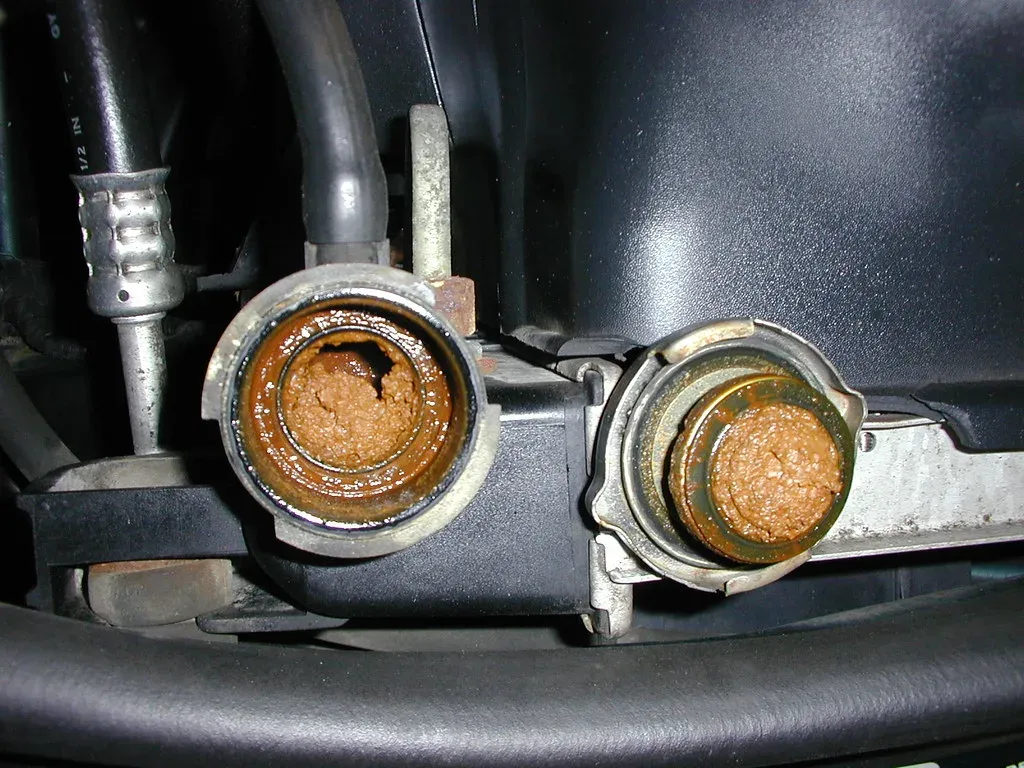
| Coolant looks rusty or sludgy | Inhibitors depleted; mixed coolant types | Sample the coolant; flush if out of spec |
If the machine only started running hot after a wash, the wash may be the cause. That’s the subject of the guide on steam versus pressure washing.
Cleaning the core: what the OEM says
Caterpillar’s maintenance manual for its 279C, 289C and 299C compact track loaders gives specific limits for cleaning radiator and aftercooler cores. The figures are model-specific, so check your own machine’s manual, but they show how gentle the OEM expects the job to be:
- Compressed air is preferred for loose debris, with nozzle pressure below 205 kPa (30 psi). Hold the nozzle about 6 mm (0.25 inch) from the fins, move it parallel to the tubes, and point it opposite to the fan’s airflow.
- Water may be used, but below 275 kPa (40 psi), to soften mud.
- For oil and grease, use a degreaser and steam, then wash with detergent and hot water and rinse.
- Always direct air or water parallel to the fins. Otherwise they can be bent or damaged.
- Check your work by running the engine at high idle to dry the core, then shining a light behind it to see whether it’s clear.
- Don’t spray a rotating fan with high-pressure water.
- Bent fins can be opened with a fin comb.
Check what your pressure washer actually puts out at the nozzle before you point it at a core. The manual also says to adjust cleaning frequency to the operating environment, and it lists radiator core cleaning as a “when required” item for that reason.
The inside: coolant, thermostat, cap
The same Caterpillar schedule shows what the inside maintenance looks like on that machine. It calls for a daily coolant level check, a Level 1 coolant sample every 500 service hours, a Level 2 sample every year, thermostat replacement every 3,000 hours or 2 years, and coolant extender for extended-life coolant every 6,000 hours or 3 years. Your intervals depend on the engine and the coolant type, so use your own manual. The pattern holds, though: check the level often, test the coolant on a schedule, and replace wear parts before they stick.
Practical points:
- Use the coolant type the manual specifies, and don’t mix types.
- Release pressure slowly before opening the cap on a warm system. Wikipedia notes that radiator caps typically hold anywhere from 4 to 30 psi.
- Collect drained coolant. EPA’s vehicle maintenance fact sheet lists antifreeze among the maintenance fluids that can contaminate stormwater if spilled or improperly disposed of.
A dust-driven inspection routine
Calendar intervals don’t fit a machine that works in heavy dust one week and on a paved yard the next. Tie the routine to conditions:
- Daily, in dusty work: coolant level, a quick look at the face of the core and the intake screen, and a check that the fan shroud is intact.
- Weekly or after a dusty stretch: a light-behind-the-core check for blockage in the middle of the core, plus belts and hoses.
- When temperature creeps up under load: clean the core before chasing internal causes.
- On the coolant sampling schedule: test, and act on the results.
- Before summer: a full clean of every core (radiator, charge-air cooler, hydraulic and AC condensers), a coolant test and a pressure-cap check.
When a steam rinse beats a flush
A coolant flush cleans the inside of the system. It does nothing for a core that’s blocked on the outside. When the problem is oily dust packed between the fins, controlled steam is the method the OEM manual itself points to: it softens oil-bound debris so it can be flushed out without the impact force that flattens fins. A flush makes sense when coolant tests or symptoms point inside. A steam rinse makes sense when the core is choked.
Steam radiator rinse for oilfield equipment
Site Safe Solutions offers a steam radiator rinse for vehicles and heavy equipment. It uses controlled steam to break down and flush out debris without the bent fins, weakened seals and leaks that high-pressure rinsing can cause. The same crews handle wider equipment cleaning for mats, trailers, tanks and rigs. Tell the crew what the radiator is on, what symptoms you’re seeing and whether it’s been pressure washed before, and get in touch.