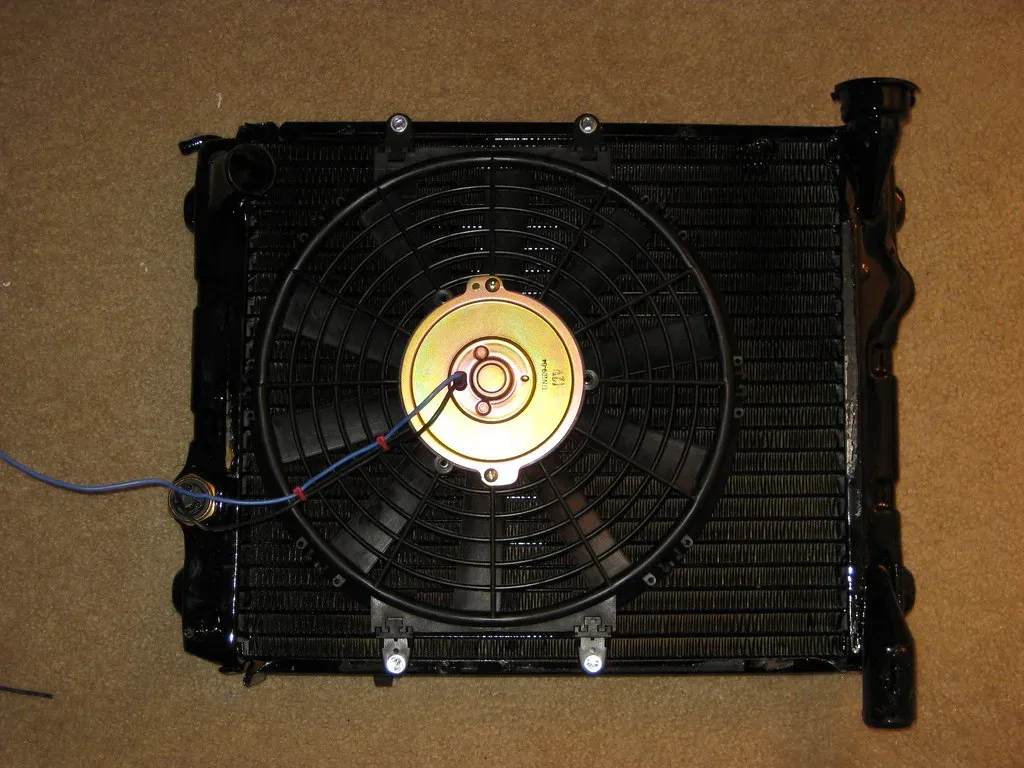
To clean radiator fins without wrecking them, blow loose dust out with low-pressure air from the engine side, aimed straight through the core along the fins, then soften what’s left with low-pressure water, detergent or steam. Keep the stream parallel to the fins and the pressure low. Caterpillar’s manual for one of its loaders caps it at under 30 psi for air and under 40 psi for water. Anything that hits the fins at an angle or at pressure-washer force will fold them over, and a folded fin doesn’t pass air.
The forum threads that rank for this question are mostly about PC water-cooling loops, RVs and sports cars. Equipment working a Permian lease has a different problem: caliche dust, oil mist and grass seed packed into a big core, on a machine that can’t sit in a shop for a day. Here’s how to approach it.
Why fins clog faster on an oilfield location
A radiator works by moving air through a core of thin metal fins. As Wikipedia’s engineering summary of engine radiators puts it, airflow speed through the core is a major influence on how much heat it sheds. Anything that slows the air costs cooling.
On a lease, three things work together. Fine caliche dust gets pulled in by the fan. Oil mist from leaking seals, breathers or nearby work coats the fins and turns that dust into a paste. Seed, chaff and bugs plug the front face. A dry core sheds dust with a little air. An oily one holds it until you break the oil down.
Air Radiators, a manufacturer of heavy-duty radiators, notes in its maintenance bulletin that badly fouled cores can cut cooling airflow enough to push up both coolant and lube oil temperatures. The same bulletin flags external abrasion in earthmoving work, where sand in the air stream wears the fins themselves.
Before you start
Shut the engine down and let it cool. Never work near a turning fan. Caterpillar’s manual specifically warns against cleaning a rotating fan with high-pressure water because the blades can fail.
Then figure out which way air moves through the core. On most trucks the fan pulls air from the grille back toward the engine. On a lot of heavy equipment the radiator sits at the rear, and the airflow can run either way depending on the fan. Cleaning works best from the side the air leaves, pushing debris back out the way it came in. Caterpillar’s procedure says the nozzle should point opposite to the fan’s airflow, and Air Radiators says the same for compressed air.
Finally, look at what’s in there. Dry dust and chaff need air. Mud needs water to soften it. Oily paste needs a degreaser and heat.
Cleaning methods compared by fin-damage risk
| Method | What it removes | Fin-damage risk | How to do it right |
|---|---|---|---|
| Soft brush | Light dust and lint on the front face | Low | Brush the side the air enters with a soft brush. Air Radiators recommends a soft type so the fins don’t deform |
| Compressed air | Loose, dry dust and chaff | Low to moderate | Low pressure, nozzle close to the core, moved slowly along the tubes, blowing against normal airflow. Cat: under 30 psi (205 kPa), nozzle about 1/4 in (6 mm) from the fins |
| Low-pressure water (garden hose or turned-down washer) | Mud and caked dust | Low to moderate | Keep it parallel to the fins and under Cat’s 40 psi (275 kPa) limit. Water softens mud; it doesn’t do much for oil |
| Detergent or degreaser plus hot water | Oily film binding the dust | Low | Apply, let it work, rinse with low-pressure clean water. Cat calls for detergent and hot water, then a thorough rinse |
| Steam | Oil, grease and packed oily dirt | Low | Cat names degreaser and steam for oil and grease. Air Radiators says a low-pressure steam jet (175 kPa) works on stubborn external dirt |
| High-pressure washer at normal settings | Everything, including fins | High | Don’t. Even OEM wording on water says it must be directed parallel to the fins or they bend. A wand set for steel and skids is far past what a core can take |
| Picks, screwdrivers, wire brushes | Stuck debris | High | Don’t use them in the core. Remove debris from the face by hand or with air |
The short version: air for dry, water for mud, detergent or steam for oil, and never a high-pressure wand. The reason pressure washing fails on a core is laid out in our steam versus pressure washing guide, so we won’t repeat it here.
Step by step: cleaning radiator fins on heavy equipment
This sequence follows the Caterpillar procedure for its compact track loaders, which is typical of what OEM manuals ask for. Check your own machine’s operation and maintenance manual, since limits and access steps vary by model.
- Shut down, cool down, open the access doors or tilt the radiator guard so you can reach both faces.
- Blow out loose debris with compressed air under 30 psi. Hold the nozzle about a quarter inch from the fins, keep it parallel to the tubes, and point it against normal airflow. Wear a face shield. Cat warns that air pressure can cause injury.
- If there’s mud, soften it with low-pressure water under 40 psi, again parallel to the fins.
- If there’s oil or grease, use a degreaser and steam, or detergent and hot water, then rinse the core thoroughly with clean water.
- Work from the top of the core down toward the fan, per Cat’s instructions.
- Run the engine at high idle for a bit to help blow debris loose and dry the core, then shut it down.
- Put a light behind the core and look through it. Dark patches are still plugged. Repeat the cleaning where needed.
- Clean the fan, fan hub, guards and any oil cooler or charge-air cooler stacked with the radiator. Cat notes that dirt on the fan can unbalance it, and on some of its models it says to clean the aftercooler core whenever you clean the radiator.
When to straighten fins with a fin comb
After cleaning, check the fins and tubes. Caterpillar’s manual says bent fins can be opened with a “comb”, and notes that fins and tubes can also be worn by abrasive material that passed through the core.
A fin comb is worth using on small patches: a rock hit, a spot where somebody leaned on the core, a corner folded during a clean. Match the comb to the fin spacing, work gently in the direction the fins run, and don’t force it. If large areas are folded flat, the fins are eroded thin, or you see coolant weeping at tubes, combing won’t bring the core back. Air Radiators recommends sending large industrial cores to a properly equipped radiator shop when the right cleaning gear isn’t on hand. Cat also recommends a leak test if parts of the cooling system look damaged.
How often to clean radiator fins in Permian dust
There’s no single interval that fits every machine. Caterpillar’s manual tells operators to adjust cleaning frequency to the effects of the operating environment, and Air Radiators says regular inspection is what determines how often external cleaning is needed.
In practice that means you set the interval by what you find. A machine working a dusty pad in summer, behind haul trucks or near a mowing crew, will plug faster than one parked on a caliche yard. Some practical triggers:
- Look at the core face at every service or fueling stop while you’re getting a feel for how fast it plugs.
- Clean whenever you can’t see light through the core in spots.
- Clean before the hot months and after any job with heavy dust, chaff or an oil leak upstream of the fan.
- Treat a rising coolant temperature under normal load as a cleaning-and-inspection call, and check the fins before you start chasing thermostats and pumps.
What to do with the wash water
The rinse coming off an oily core isn’t clean water. EPA’s stormwater fact sheet on vehicle maintenance and washing notes that outdoor wash water can carry detergent, metals and hydrocarbons into storm drains, and that commercial wash facilities limit the impact because they recycle or treat their water. On a location, clean cores over containment or a wash pad instead of bare ground, and handle the captured water the way your site’s waste plan says. Our equipment cleaning crews use environmentally friendly detergents for this reason.
Steam radiator rinse from Site Safe Solutions
If your cores are packed with oily dust and you’d rather not risk the fins, Site Safe Solutions offers a radiator rinse with steam for trucks, generators and other field equipment. Controlled steam breaks down and flushes out the build-up without bending fins or weakening seals the way high-pressure rinsing can. We work mainly across the Permian Basin. Contact us to set it up alongside your regular maintenance.