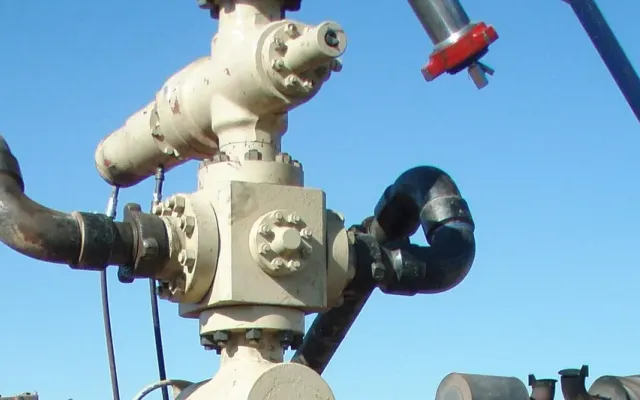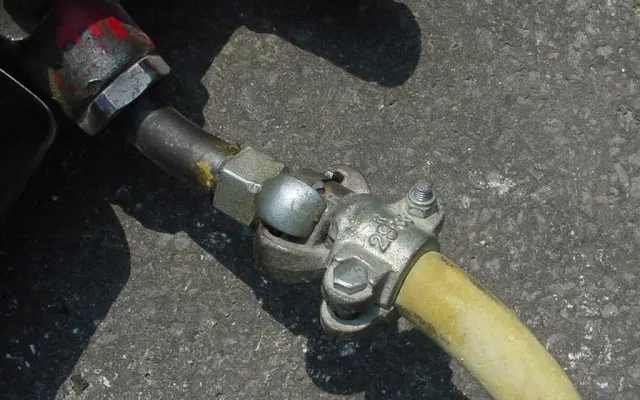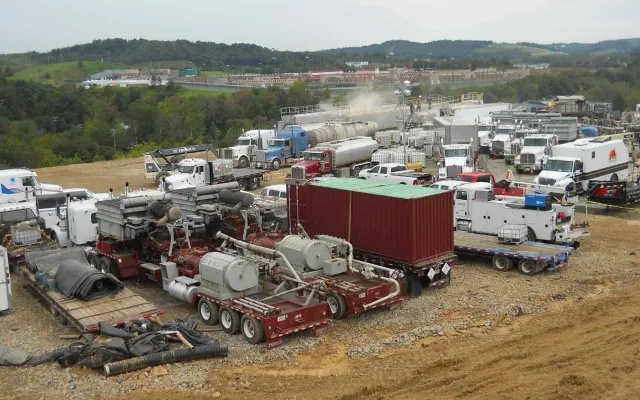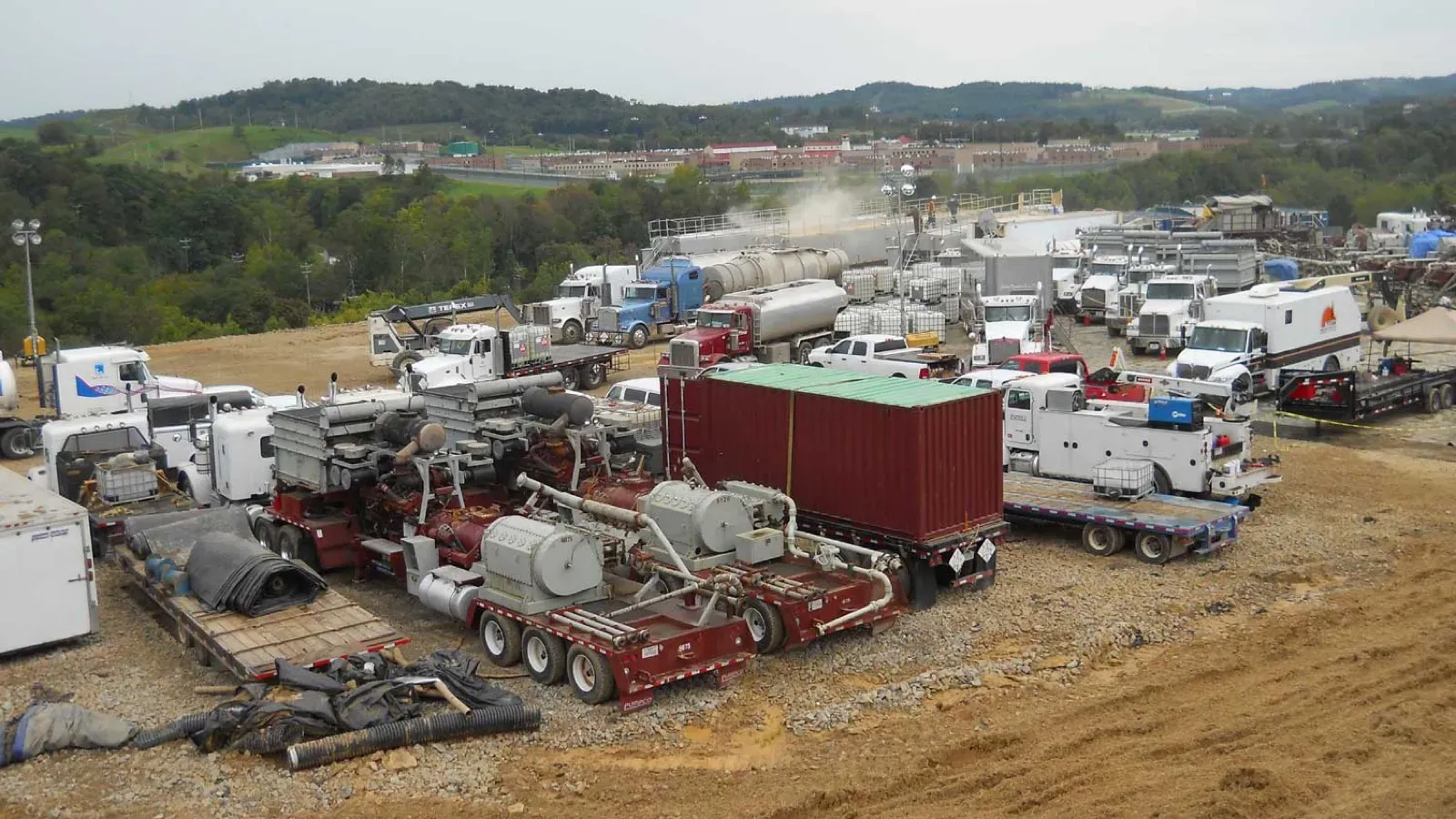
Line of fire hazards are anywhere a person stands in the path of released energy: a load that swings, a vehicle that moves, or a pressurized line that lets go. On frac and workover locations the last one deserves more attention than it gets in generic toolbox talks. A failed connection on a pressurized line can turn a hose or a joint of iron into a moving object in a fraction of a second. The person standing beside it is in the line of fire whether or not they’re working on it.
This guide covers what the federal data says about struck-by deaths in oil and gas, how to set up a red zone around pressurized equipment, how to bleed stored energy before breaking a connection, and where restraints fit. The physics of why a loose line whips is covered separately in why an unrestrained line whips.
What the numbers say about struck-by deaths in oil and gas
Two federal sources frame the problem.
OSHA’s oil and gas extraction hazard page states that three of every five on-site fatalities in the industry result from struck-by, caught-in or caught-between hazards. It lists high-pressure lines among the sources, alongside moving vehicles and falling equipment. On high-pressure lines specifically, OSHA notes that internal erosion can cause leaks or bursts, and that “if connections securing high-pressure lines fail, struck-by hazards might be created.”
NIOSH’s Fatalities in Oil and Gas Extraction (FOG) database, published in CDC’s MMWR, identified 470 worker deaths from 2014 to 2019. Contact injuries, a category that includes struck-by and caught-between, accounted for 21.7 percent, second only to vehicle incidents. Two other findings matter for Permian crews:
- About one third of the fatalities in the database occurred in the Permian Basin.
- About three quarters were among contractors, and about 20 percent involved a worker who was working alone.
Those are the people most often standing near the iron: contract crews, frequently spread thin across a large location.
Where the line of fire runs on a pressurized location
On a frac, flowback or workover site, the line of fire around pressurized equipment runs:
- Along the length of every hose and line, not just at its ends. A failure anywhere along a line can move it sideways.
- In line with every union, valve and swivel, where a connection that parts can send a component straight out.
- Across the discharge side of pumps, where pressure is highest.
- Over walkways and work areas that cross the lines, which are often the shortest route from the trucks to the wellhead.
OSHA’s description fits both cases: the stored energy is released either by the line itself bursting or by a connection failing. IADC Safety Alert 03-16 records a third trigger that crews create themselves. Workers were observed hammering on unions while lines were still under pressure. The alert notes several accidents across the industry, including a fatality, caused by pressurized lines that were improperly connected or hammered on under pressure.
Setting up a red zone for pressure testing and pumping
A red zone, or exclusion zone, is the area around pressurized equipment that only essential people enter, and only when the energy is controlled. The details belong in your company’s procedures and the operator’s site rules. A practical setup covers these points:
- Mark it physically. Use cones, tape or barriers along the lines and around the wellhead and manifold. A zone that exists only on the JSA doesn’t stop anyone walking through.
- Size it to the equipment, not the convenience. Include the full length of pressurized lines and the space a loose line could sweep, not just a circle around the wellhead.
- Control entry. One person authorizes entry during pressure-up and pumping. Everyone else stays out, including visitors and drivers.
- Clear it before pressure-up. Do a head count and a visual check of the zone before any pressure test starts.
- Reroute foot traffic. If the only path to the trucks crosses the iron, move the path or move the trucks.
- Agree on the stop signal. Everyone on location should know who can stop the job and how.
Bleeding stored energy before breaking a connection
The most dangerous moment on a line is often after the job, when someone assumes it’s dead. Trapped pressure between closed valves, gas in a line, or a plug of sand holding pressure behind it can release when a union is loosened.
A point that surprises some crews: OSHA’s lockout/tagout standard, 29 CFR 1910.147, specifically excludes oil and gas well drilling and servicing from its scope. That doesn’t make the principle optional. The standard’s stored-energy requirement is still a good description of what has to happen. After isolation, “all potentially hazardous stored or residual energy shall be relieved, disconnected, restrained, and otherwise rendered safe,” and isolation is verified where energy could build back up.
A field version of that sequence:
- Isolate the section with valves, and confirm which side is still connected to pressure.
- Bleed through a designated bleed-off point to a safe location, not by cracking a union.
- Confirm zero pressure on a gauge you trust, on both sides of the connection.
- Watch for pressure building back up, especially in gas service or sandy lines.
- Keep bodies out of line with the connection while loosening it, even after bleed-off.
- Never hammer a union on a line that hasn’t been verified dead.
Where restraints sit in the hierarchy of controls
Safety programs rank controls from most to least effective: eliminate the hazard, substitute something less hazardous, engineer it out, use administrative controls, and finally rely on PPE. Here’s how that looks for pressurized lines:
| Control level | Example on a pressurized location | Limits |
|---|---|---|
| Elimination / substitution | Hard-piped connections or fewer temporary joints; lower pressure where the process allows | Often not possible on temporary frac and flowback setups |
| Engineering | Correctly matched, inspected iron and hoses; engineered restraint systems that hold a failed line in place | Must be installed correctly, anchored to something that can’t move, and refitted after every line change |
| Administrative | Red zones, entry control, bleed-off procedures, pre-job connection checks | Depends on people following them under time pressure |
| PPE | Hard hats, face shields, hearing protection | Won’t stop a line or a union that lets go |
Restraints sit at the engineering level. They don’t stop a connection from failing. They limit how far a failed line or component can travel, which turns a potential struck-by fatality into a shutdown and a repair. That works only if the restraint is on the line when it fails. Restraint that’s slow to refit tends to be left off during a rushed line change. That’s the argument for modular hardware that’s quick to put back on.
A pre-pressure-up checklist
- Every connection made up, matched and inspected
- Restraints installed on hoses and iron, and anchored to fixed points
- Red zone marked, cleared and controlled
- Walkways rerouted away from lines where possible
- Bleed-off points identified and clear
- Stop-work authority and signal understood by everyone on location
- Head count done before pressure goes on
Restraint for your lines
Site Safe Solutions supplies high-pressure restraint systems for oilfield hoses and iron lines in the Permian Basin. That covers hose systems through custom iron-line restraints, for slick-water, nitrogen, energized fluids and standard pumping. The hardware packages are modular to simplify installation and reduce downtime during line changes. Have the application, working pressures and a rough rig-up layout ready, and get in touch.