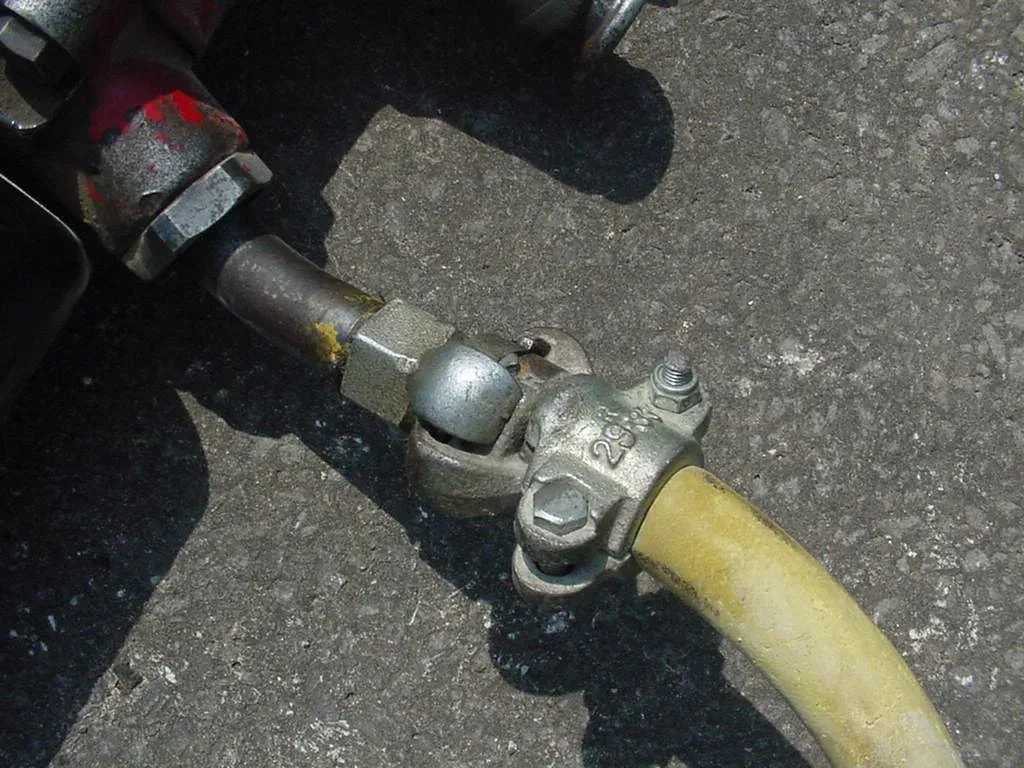
A whip check is a short steel cable or fabric sling with a loop at each end. You stretch it across a hose coupling so that if the coupling lets go under pressure, the hose end stays tethered instead of flailing around the location. It is cheap and it works on compressed-air and low-pressure hose. It does not replace the shutoff device that OSHA’s construction rule actually calls for, and it is not a restraint for high-pressure fluid lines or frac iron.
Below is the federal text word for word, how to size and inspect a whip check, and when you need something heavier.
What does a whip check do?
When a pressurised coupling separates, the air or fluid leaving the open end pushes the hose like a jet. The hose is flexible, so the free end swings in an arc that nobody can predict. It keeps going as long as there is pressure behind it. Our guide on why an unrestrained line whips covers the mechanics.
A whip check limits how far that free end can travel. It does nothing to stop the release. Air still dumps and the hose still jumps. The end just stays within a cable’s length of where it was.
IADC Safety Alert 03-32 shows why that matters. A worker was struck on the head by a compressed-air hose that blew off its fitting, and the injuries proved fatal. The hose was held by a hose clamp with no keeper, chain or sling. The company’s corrective actions called for restraining devices, whip checks among them, on large-diameter or high-pressure compressed-air hoses. They also called for regular inspection of couplings, clamps, keepers and hoses.
What are the OSHA standards for whip checks?
OSHA’s construction standard for pneumatic tools, 29 CFR 1926.302(b), contains the two lines most people mean.
1926.302(b)(1): “Pneumatic power tools shall be secured to the hose or whip by some positive means to prevent the tool from becoming accidentally disconnected.”
1926.302(b)(7): “All hoses exceeding 1/2-inch inside diameter shall have a safety device at the source of supply or branch line to reduce pressure in case of hose failure.”
Read (b)(7) closely. The device sits at the source of supply or the branch line, and its job is to reduce pressure when a hose fails. A whip check does neither. It sits at the coupling and it doesn’t touch pressure. The device that matches the wording is a flow-sensing safety check valve (often called an excess-flow valve) installed where the hose takes off from the compressor, receiver or manifold. A whip check at the coupling is a sensible extra layer. On its own it does not meet the wording of (b)(7).
Paragraph (b)(1) is also not a whip check rule. It requires a positive connection between tool and hose so the tool can’t fall off. A locking coupling can satisfy it, and so can a pin or a hose-to-tool restraint, depending on the setup.
The federal rules that do name a cable or chain at the connection are narrower:
| Rule | What it says | Where it applies |
|---|---|---|
| 29 CFR 1926.302(b)(7) | Hoses over 1/2-in ID need a safety device at the source of supply or branch line to reduce pressure on hose failure | Pneumatic power tools in construction |
| 29 CFR 1926.603(a)(9) | Steam hose to a steam hammer or jet pipe secured to the hammer with chain or cable of at least 1/4-in diameter; air hammer hoses get the same protection | Pile driving |
| 29 CFR 1926.603(a)(10) | “Safety chains, or equivalent means” at each hose connection to stop the line thrashing if the coupling disconnects | Pile driving |
| 30 CFR 56.13021 (MSHA) | Safety chains or other suitable locking devices at connections of high-pressure hose 3/4-in ID or larger where a connection failure would create a hazard, except where automatic shutoff valves are used | Surface metal and nonmetal mines |
Part 1926 is OSHA’s construction standard. Whether a given oilfield task falls under it depends on the work, so ask your safety department which rules your company applies. Many operators and service companies set their own whip check rules in company policy, and those often go further than the federal text.
At what psi is a whip check required?
No federal rule in the table above sets a psi trigger for whip checks. OSHA’s (b)(7) and MSHA’s 56.13021 both key on hose inside diameter (over 1/2 inch and 3/4 inch or larger). Neither one uses pressure. The pressure figures you see online come from company policies and from manufacturers’ ratings for their own products.
The number that does matter is the rating of the whip check you are buying. McMaster-Carr’s listings show most steel-cable whip checks rated to 200 psi maximum. Fabric (nylon or polyester) restraints are rated much higher at small hose IDs, and the rating drops as hose diameter goes up. If the line runs above the whip check’s rating, the whip check is the wrong part.
How do you size a whip check?
Pick the style by connection type first, then size to the hose.
| Style | Ends | Use it for |
|---|---|---|
| Hose-to-hose | Spring-loaded loop each end | Across a coupling between two hose lengths |
| Hose-to-tool | Loop on the hose, choker on the tool | Between a hose and a tool, compressor outlet or fixed fitting |
| Loop and bolt end | Loop on the hose, bolt-on end | Anchoring a hose end to a surface or fixed point |
Then match three things:
- Hose outside diameter. Each whip check covers a range of hose sizes. The loop has to grip the hose body behind the fitting, not slide over the coupling.
- Cable diameter and length. Heavier hose takes a thicker cable. Length should span the coupling with the loops on hose on both sides and minimal slack once stretched out.
- Pressure rating. As above, it has to be at or above the line pressure.
Fit matters as much as the part number. Position the loops on the hose body back from the ferrule, then stretch the cable out so the springs grip and there is as little slack as possible. Slack lets the end build speed before the cable catches it.
IADC Safety Alert 00-24 is about high-pressure rotary and vibrator hoses rather than air hose, but the lesson carries over. Failures most often happen at the transition from the rigid coupling to the flexible hose. The IADC Drilling Manual, as quoted in the alert, places safety clamps 6 to 18 inches inboard of the coupling on rotary hose and 6 to 10 inches on vibrator hose. The alert also warns against tying the safety line to a lifting eye on the coupler. If the hose maker paints bands showing where the clamp goes, use them.
Whip check, safety check valve or engineered restraint?
These are different controls for different jobs. On an air system you often want two of them together.
| Control | What it does | Good for | Not for |
|---|---|---|---|
| Whip check (cable or fabric) | Tethers the hose end at a coupling so it can’t travel far | Compressed air, water and low-pressure hose within its rating | High-pressure fluid lines, frac iron, anything above its rating |
| Safety check / excess-flow valve | Senses a surge in flow at the supply and shuts it off | Meeting the “safety device at the source” wording in 1926.302(b)(7) on air lines | Stopping the motion of a hose that is already loose |
| Locking or pinned coupling | Stops the coupling coming apart in the first place | Hose-to-tool connections, (b)(1) “positive means” | A hose that bursts rather than uncouples |
| Engineered high-pressure restraint | Rated sling or restraint system anchored to fixed points, designed for the line’s pressure and energy | Treating iron, high-pressure hose, slick-water, nitrogen and energized fluid jobs | Being improvised on the day |
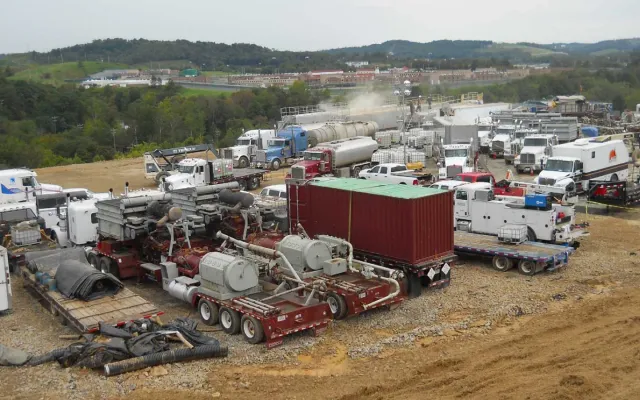
Why a whip check isn’t a restraint for frac iron
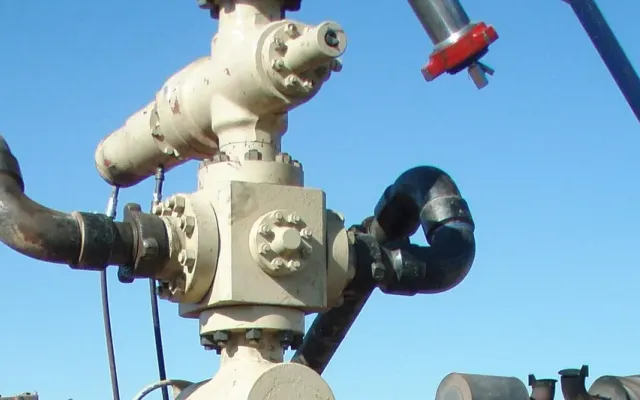
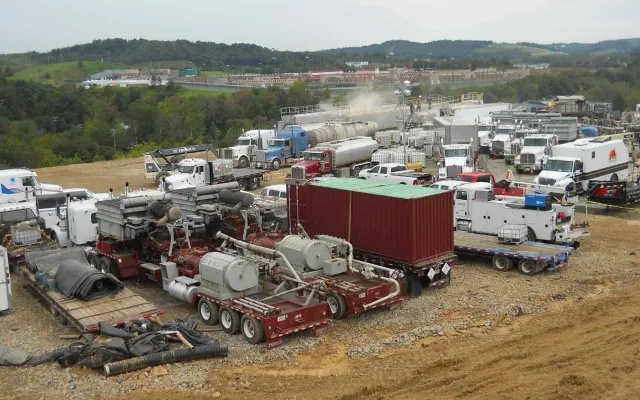
On a frac or high-pressure pumping job the stored energy is in a different class. Pressures run far beyond a typical whip check’s rating. The lines are often heavy iron rather than hose, and the fluid can be nitrogen or an energized mix. A cable sized for an air hose coupling will part.
High-pressure lines need restraints rated for that pressure and anchored to something that will actually hold. A restraint tied to a skid that can slide just moves the failure point. In January 2026 API released Standard 16FI, Frac Iron Guidelines and Requirements, which covers the design, manufacture and use of temporary high-pressure frac equipment. That is the place to start reading if you run iron.
How to inspect and retire whip checks
Make it part of the rig-up walk, not a separate audit. Pull a whip check from service if you see:
- Broken, frayed or birdcaged strands, or kinks in a steel cable
- Cuts, abrasion, chemical staining or UV-faded, stiff fabric in a webbing restraint
- Crushed or opened loops, or springs that no longer grip the hose
- Corrosion at the swaged sleeves or ferrules
- A missing or unreadable tag where your policy calls for one
- Any sign it has already caught a failure. Treat it as spent and replace it.
Also check that the right style is on the right connection, and that the loops sit on the hose body rather than wrapped around the fitting.
Restraint for the lines a whip check can’t handle
Whip checks belong on air and low-pressure hose. For high-pressure hose and iron, Site Safe Solutions supplies hose and high-pressure iron line restraint systems for slick-water, nitrogen, energized fluid and standard pumping jobs. The modular hardware is built to go back on quickly after a line change. If you have lines on location that you can’t confirm are restrained, get in touch and we can talk through the layout.