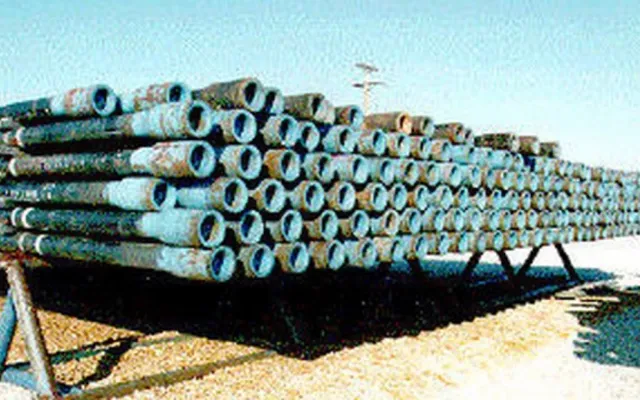
OCTG stands for oil country tubular goods. It is the steel pipe that goes into a well: casing, tubing and drill pipe, plus the pup joints and couplings that go with them. Casing lines the hole and stays there. Tubing is the string you produce through and pull when the well needs work. Drill pipe turns the bit while the hole is being made.
Most pages that rank for “OCTG” are written by mills selling pipe. They stop at the grade chart. For an operator or company man, the more useful questions come after delivery. Is this new pipe what we ordered? And when the tubing comes out of the hole, which joints are fit to go back in?
What does OCTG include?
| Product | What it does | Stays in the well? |
|---|---|---|
| Casing | Lines the borehole, holds back the formation and isolates zones once cemented | Yes, cemented in place |
| Tubing | Carries oil, gas and water from the producing zone to surface, inside the casing | No, pulled and rerun during workovers |
| Drill pipe | Rotates the bit and carries drilling fluid down to it while drilling | No, comes out when drilling ends |
| Pup joints | Short lengths used to space out a string or place tools at a precise depth | Depends on the string |
| Couplings and accessories | Join the threaded joints together | With the string |
Line pipe used in surface gathering systems is a separate product family under its own specifications. It is not part of OCTG.
Tubing vs casing: what’s the difference?
Casing is structural. It is cemented in, it holds the hole open and it keeps zones apart. Once it is set, nobody expects to pull it.
Tubing is the production conduit. It hangs inside the casing and carries fluid to surface. On rod-pumped wells, which are common across the Permian, it also houses the sucker rods. That is why tubing is the OCTG product that sees repeated handling. It gets pulled for pump changes, rod parts and leaks, then laid down, inspected and rerun. It wears from the inside where rods rub, and it corrodes from produced fluids.
API 5CT grades, briefly
Casing and tubing are made to API Specification 5CT (ISO 11960 is the matching international standard). 5CT sets the technical delivery conditions for casing, tubing, pup joints, coupling stock and accessory material. The 10th edition (December 2018) is the version supplemented by IOGP’s S-735.
Grades are a letter and a number, such as H40, J55, K55, N80, L80, C90, R95, T95, C110, P110 and Q125, along with variants such as L80 13Cr. Grade choice depends on load, depth and the corrosion and sour-gas environment, and that decision belongs to the completion engineer. For our purposes the point is simple. The grade is stamped and stencilled on each joint, and field inspection checks that what showed up matches the order.
What standards cover inspection after delivery?
Three API documents do most of the work once pipe leaves the mill:
| Document | What it covers |
|---|---|
| API RP 5A5, Field Inspection of New Casing, Tubing, and Plain-End Drill Pipe | Field inspection and testing of new OCTG: inspector qualification, inspection methods, calibration of equipment, evaluation of imperfections and marking of inspected pipe |
| API RP 5C1, Care and Use of Casing and Tubing | Use, transportation, storage, handling and reconditioning of casing and tubing |
| API Spec 5B | Threading, gauging and thread inspection, including thread measurements and master gauges |
RP 5A5 also matters for marking. The IADC Lexicon defines the OCTG “colour code” as paint band identification of OCTG classification under the applicable specifications, and it cites RP 5A5 as its source.
How is new tubing inspected in the field?
New pipe has not seen a well, but it has been shipped, offloaded and stored, and mills are not perfect. A typical field inspection on new tubing or casing works through these steps:
- Paperwork and markings. Check grade, weight, connection and length against the order and the mill certificate.
- Visual and thread inspection. Look at pin and box threads, seal areas and coupling make-up for handling damage.
- Drift. A drift mandrel is passed through each length to confirm the internal diameter is clear for the tools that will run through it. Drifting is done at the mill and again in the field.
- Full-length non-destructive inspection where the job justifies it. Electromagnetic methods scan the whole body for imperfections and wall variation.
Used tubing: how it gets graded
Used tubing is where inspection pays for itself. Once a string comes out, every joint has a different history. The joints near the pump may be badly rod-worn while the joints higher up are nearly new. Averages hide the worst joint, and the worst joint is the one that fails.
The used-pipe market sorts joints by paint band. Each joint gets a coloured band (yellow, blue, green or red are common) according to how much wall loss inspection found. Red is generally scrap. The exact wall-loss thresholds for each colour are a commercial convention, not one universal rule, and they differ between buyers and inspection companies. Put the wall-loss limit you will accept on the work order instead of relying on a colour name.
A band also tells you only what the inspection found. It does not tell you that the threads, drift and couplings are ready to run.
New vs used tubing: which inspection does what?
| Method | What it finds | New pipe | Used pipe |
|---|---|---|---|
| Visual and thread inspection | Handling damage, thread and seal damage, wrong markings | Always | Always |
| Drift | ID restrictions, dents, bends, scale | Standard | Standard, especially where scale is common |
| Full-length electromagnetic (EMI / MFL) | Wall loss, pitting, rod wear, body imperfections along the whole joint | Where the job or spec calls for it | The main tool for classifying joints |
| Ultrasonic wall measurement | Wall thickness at specific points | Spot checks and prove-ups | Confirming indications found by EMI |
The physics behind full-length electromagnetic inspection is the same family as magnetic flux leakage. The steel is magnetised, and where metal is missing the field “leaks” out of the wall where sensors pick it up. That is how corrosion, pitting and wall loss show up without cutting the pipe.
Where EMI fits for a Permian well
On a workover, the tubing is already on surface. That is the cheapest moment to find out which joints are worn. Running a full-length scan as the string comes out turns a guess into a joint-by-joint record. You rerun the good joints, lay down the bad ones, and keep a trace you can compare against next time. We cover what EMI tubing inspection finds and why the worst joint matters more than the average in its own guide, so we won’t repeat it here.
Getting tubing inspected on the lease
Site Safe Solutions provides non-contact EMI tubing inspection at the wellhead or on the lease. It reads wall loss, rod wear and corrosion and keeps digital trace records for each run. If you have a string coming out and want to know which joints are fit to rerun, contact us to set it up.