A rod pump wears its own tubing. The sucker rod string moves up and down inside the tubing on every stroke. Wherever the rods rub the tubing wall, they cut a groove that eventually becomes a hole, and the well goes down for a tubing job. The wear is almost never even. It concentrates where the rods buckle, where the hole is deviated, or where the tubing isn’t held in tension. Anchors, rotators and rod guides each address part of the problem. And because a string fails at its worst joint, finding those few joints matters more than knowing the average.
How a rod pump works, in one minute
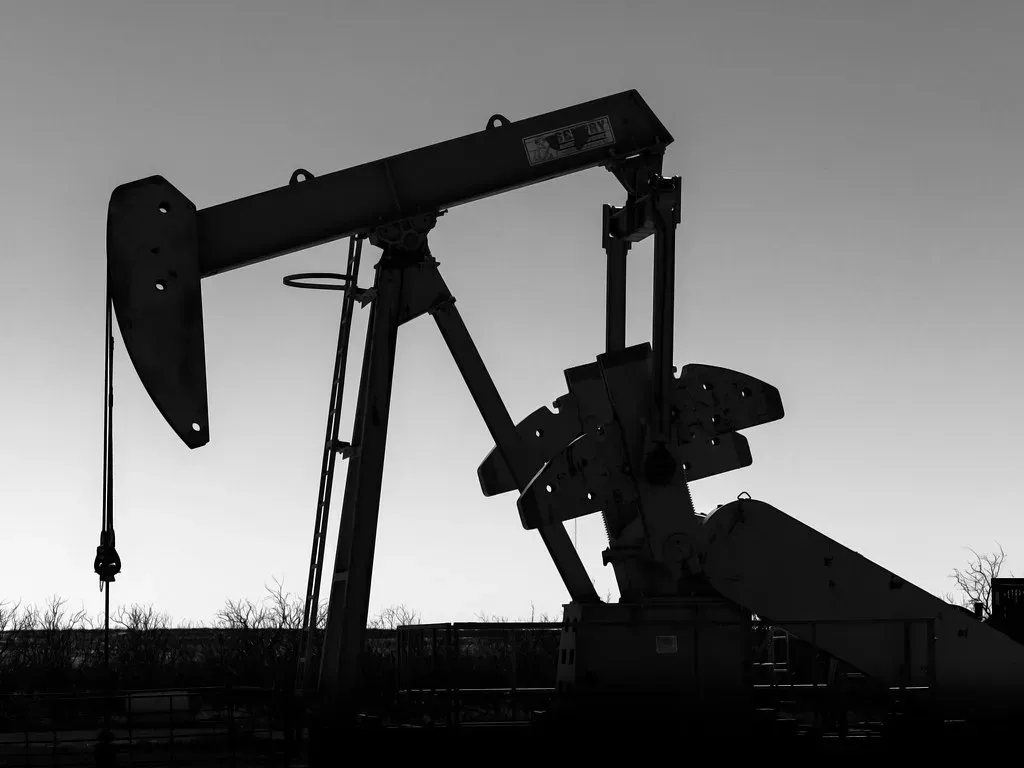
On a beam-pumped well, the pumpjack converts the motor’s rotary motion into the up-and-down motion of the polished rod at the surface. Below the polished rod hangs the string of sucker rods. It runs down inside the production tubing to the downhole pump, which usually sits near the bottom of the well.
The pump has two check valves. On the upstroke, the traveling valve closes and the standing valve opens, so the plunger lifts the fluid above it and new fluid enters the barrel. On the downstroke, the traveling valve opens and the standing valve closes, so the plunger drops back through the fluid. Depending on pump size, each stroke delivers roughly 1.5 to 10.5 US gallons.
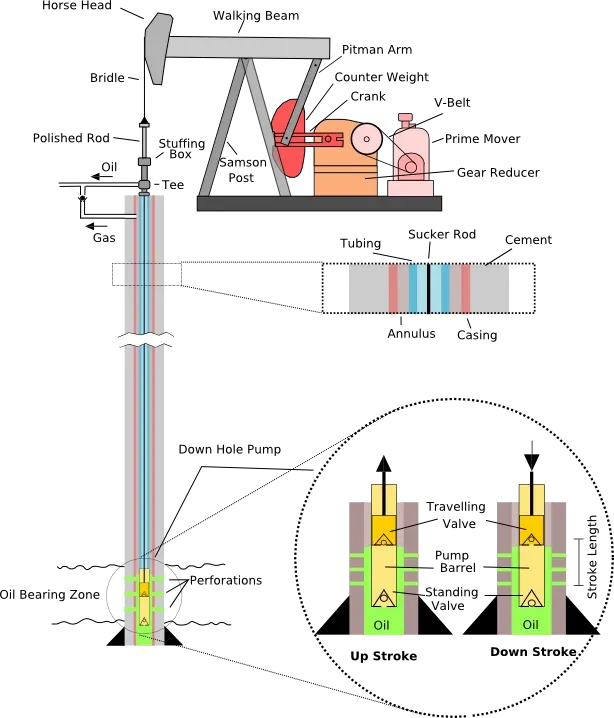 Rod pump components. Diagram: TastyCakes, CC BY 3.0.
A well running all day makes thousands of strokes. Any point where a rod or coupling touches the tubing gets rubbed thousands of times a day.
Why rods cut tubing
Rod-on-tubing contact
Tubing leaks in rod-pumped wells are dominated by rod cutting: wear of the tubing ID from continuous reciprocating contact with the rod string. Couplings are the usual culprit, since they’re the widest part of the string and carry the side load.
Rod buckling on the downstroke
Sucker rods are built to carry big tensile loads and bend easily under compression. On the downstroke, friction in the pump, friction between rods and tubing, and the drag of fluid can push the lower part of the rod string into compression. When that happens, the rods buckle just above the pump and lean against the tubing wall. That’s why wear is often worst in the bottom few joints.
Tubing breathing and buckling
Unanchored tubing moves too. Kent’s Southwestern Petroleum Short Course paper explains that in an unanchored string, “a portion of the fluid load in the tubing is alternately transferred between the tubing and the sucker rods during the pumping cycle.” The tubing stretches and relaxes with every stroke and can buckle in a helix in the casing. The rods then ride against the inside of the curve. The classic SPE paper by Lubinski and Blenkarn, Buckling of Tubing in Pumping Wells, Its Effects and Means for Controlling It, set out this problem decades ago.
Deviation
Many modern wells aren’t vertical. Where the hole doglegs or builds angle, gravity and tension pull the rods to one side of the tubing, and wear concentrates on that side over a short span.
Fixes, and what each one actually does
| Cause | Fix | What it does | Watch out for |
|---|---|---|---|
| Tubing breathing and buckling | Tubing anchor (anchor-catcher) set in tension | Holds the bottom of the tubing to the casing so the string can be landed in tension and doesn’t move each stroke | Kent’s paper notes results have often been disappointing. An anchor only helps if it’s set and the tension is right |
| Wear concentrated on one side of the tubing | Tubing rotator | Turns the tubing slowly so rod wear spreads around the full circumference instead of grooving one side | Spreads wear rather than stopping it. Joints still thin over time |
| Rod contact in deviated sections | Rod guides | Keep rod couplings and body off the tubing wall at contact points | Spacing has to match the well trajectory. Too many guides add polished rod load, and too few or badly spaced guides don’t stop the wear |
| Rod buckling above the pump | Rod string design (for example, weight at the bottom of the string) and pumping speed | Keeps more of the string in tension on the downstroke | A design change needs load and dynamometer data, not guesswork |
Two points from the industry literature are worth repeating. First, rotators have a West Texas history. An industry report indexed by the US Department of Energy’s OSTI describes tubing rotators reducing tubing failures in West Texas waterflood rod-pumped wells, where rod cutting was the most common tubing failure. Second, rod guides aren’t a “more is better” fix. A paper on directional wells notes that guide spacing has to integrate hole trajectory, rod string properties and economics.
Why the worst joint sets string life
A tubing string doesn’t fail on average. It fails at one joint, usually one with a groove worn through the wall where the rods have been riding. You can have a string where most joints are close to new and three joints near the pump are nearly through. Run that string back in and the next tubing leak is already scheduled.
That’s the practical case for grading tubing joint by joint when it comes out of a rod-pumped well:
- Find the worn joints and their positions. If the worst wear is in the bottom joints, it points to rod buckling above the pump. If it’s at a specific depth, check the deviation survey for a dogleg there.
- Separate good joints from bad. Rerun the sound pipe and lay down the joints that won’t make another run.
- Track it over time. Compare wear location and severity from one pull to the next. That shows whether an anchor, rotator or guide change worked.
Electromagnetic inspection (EMI) does this on tubing as it’s pulled. It detects wall loss, rod wear and corrosion along each joint. For what an EMI scan picks up and how the results are graded, see what EMI tubing inspection finds.
Surface signs worth watching
Most of this happens out of sight, but the surface gives clues:
- Dynamometer cards that show compression or fluid pound on the downstroke
- Production falling off with no change in fluid level, which can point to a tubing leak
- Repeat failures at the same depth across pulls
- Polished rod stuffing box leaks. These aren’t a downhole wear issue, but they’re a release point at the wellhead, and 40 CFR 112.9(d)(1) puts “pumping well polish rod stuffing boxes” on the list of items to inspect regularly at SPCC-covered production sites
EMI tubing inspection in the Permian
Site Safe Solutions runs EMI tubing inspection in the Permian Basin. It uses non-contact magnetic methods to detect wall loss, rod wear, corrosion and other defects in tubing, and the company states it is the only provider in the Permian with ACE-Making technology. If you have a rod-pumped well coming out of the hole with a history of tubing leaks, tell us the well, the string and when it’s being pulled.