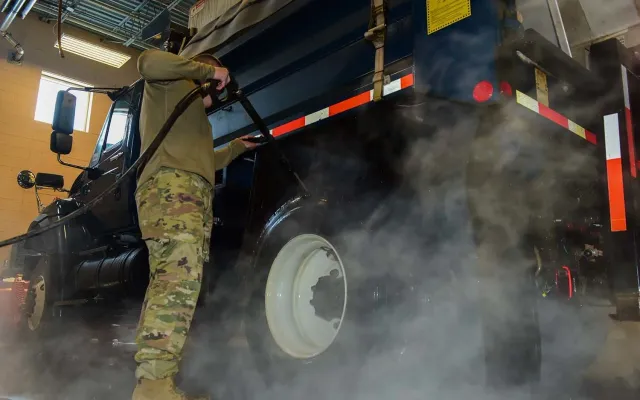
The best heavy equipment degreaser for oilfield work is the mildest product that cuts the soil you actually have, separates cleanly from oil in your wash water, and won’t eat aluminum or turn a routine rig wash into a waste problem. On a Texas lease that last point matters more than the label’s cleaning claims. The Railroad Commission’s waste guidance treats rigwash as exempt oilfield waste, but caustic or acid cleaners and waste solvents are nonexempt. Pick the wrong product and the wash water may need a hazardous waste determination before it goes anywhere.
Three kinds of degreaser you’ll be offered
Most heavy-duty degreasers sold for trucks, rigs and yellow iron fall into three groups. The table compares them on the points that matter in a wash bay or on location.
| Water-based alkaline (caustic) | Solvent-based | Citrus or “biodegradable” water-based | |
|---|---|---|---|
| What it does well | Heavy grease, baked-on oil, drilling mud film | Fast on heavy grease and tar, little water needed | Lighter oil and road film, general wash |
| Main hazard to people | Eye and skin burns from strong alkali | Flammability and vapors, depending on the solvent | Varies by formula, so read the SDS |
| Hazard to the equipment | Strong alkali reacts with aluminum, tin and zinc | Check the label for rubber, paint and seal compatibility | Check the label for metal and paint compatibility |
| Waste question | Corrosive if pH is 12.5 or higher | Ignitable if flash point is under 140°F; some spent solvents are listed hazardous waste | Depends on the formula and what it picked up |
| Oil-water separator | Ask whether it’s quick-break | Spent solvent ends up in the sump with the oil | Ask whether it’s quick-break |
The flash point and pH thresholds in that table are the RCRA hazardous waste characteristics as the RRC summarizes them: ignitable liquids have a flash point below 140°F, and corrosive aqueous wastes have a pH at or below 2.0 or at or above 12.5. The guidance names “certain degreasers” and “certain acid or caustic cleaning wastes” as examples.
Caustic degreasers and aluminum
Caustic degreasers are typically built on sodium hydroxide (caustic soda) or similar alkalis. NIOSH’s Pocket Guide lists sodium hydroxide’s incompatibilities as including “metals such as aluminum, tin & zinc.” On heavy equipment that means aluminum radiator and cooler cores, aluminum housings and galvanized parts.
The practical rules:
- Keep strong caustic off aluminum cores. Use a product the manufacturer rates as aluminum-safe, or leave cooling cores to a different method.
- Don’t let caustic dwell and dry in the sun. On a hot Permian afternoon, a product applied at the far end of a trailer can sit far longer than the label intends before the rinse reaches it.
- Rinse thoroughly. Residue left in seams and crevices keeps working on paint and metal.
Radiators deserve their own note. High-pressure water bends fins, and a fin that’s flat passes no air. Strong chemistry on an aluminum core adds a second way to damage it. Our steam radiator rinse uses controlled steam for that reason.
Emulsifying vs quick-break degreaser in an oil-water separator
An oil-water separator works by giving oil droplets time to float out of the water. Some degreasers do the opposite on purpose: they emulsify the oil, holding it in tiny droplets spread through the water so it rinses away. That’s great on the truck and bad in the separator, because emulsified oil goes straight through.
EPA’s stormwater fact sheet on municipal vehicle and equipment washing (2021) puts it in one line. If you use an oil-water separator for pretreatment, “source quick-break degreasers and monitor the oil/water separator output for effectiveness.” The same fact sheet says to avoid detergents where you can and, where you can’t, to use “phosphate-free, non-toxic, biodegradable soap.” EPA’s 2023 vehicle maintenance and washing fact sheet repeats the advice to use biodegradable, phosphate-free, water-based detergents and to limit how much you use.
A quick-break product releases the oil once the wash water sits still, so the separator can do its job. If your separator output has a sheen or a milky look after you switched products, the new degreaser is the first suspect.
“Biodegradable” on a label doesn’t settle that question. A product can break down in the environment and still emulsify oil in your sump. Ask the supplier whether it’s quick-break, and test it in your own wash water.
Where the wash water goes in Texas
Oilfield wash water has a regulatory status that depends on what went into it. The RRC’s waste minimization guidance, Chapter 2 on hazardous oil and gas waste determination, lists “rigwash” among wastes exempt from RCRA hazardous waste rules. It lists “waste solvents” and “caustic or acid cleaners” as nonexempt.
The guidance’s own example is about degreasing. A spent paraffin solvent recovered from a well is exempt. “If that same solvent is used to degrease surface equipment,” the spent solvent is not unique to oil and gas production, so it’s nonexempt and someone has to make a hazardous waste determination. The guidance also names spent carbon tetrachloride used as a degreaser on surface equipment as listed hazardous waste F001.
Mixing streams can change the status of everything in the pit. Per the same guidance:
- Nonhazardous wash water from rinsing road dust off vehicles, mixed into a pit of exempt drilling waste, leaves the pit nonhazardous.
- Nonexempt caustic soda mixed into exempt waste makes the whole mixture a nonexempt hazardous waste if the result is corrosive.
Under the RRC’s rules you have to determine whether any waste you generate is hazardous oil and gas waste, and keep a record of that determination for three years, according to the guidance. A mild, quick-break, non-corrosive degreaser used at label dilution keeps that determination simple. Leftover concentrate poured into a wash pit does not.
The physical side matters too. Wash water should land on a pad or inside containment, not on caliche. Our guide to wash racks for oilfield equipment covers slope, drains and separators.
Safety rules that come with the drum
Every degreaser on a truck or in a shop comes with OSHA paperwork obligations, and some come with first-aid ones.
- Under the Hazard Communication standard, 29 CFR 1910.1200(g)(8), the employer keeps an SDS for each hazardous chemical and makes sure it’s “readily accessible during each work shift” to employees in their work area. Electronic access is allowed if there are no barriers.
- 1910.1200(h)(1) requires training on hazardous chemicals at initial assignment and whenever a new chemical hazard is introduced. Switching to a stronger degreaser counts.
- If the product is corrosive, 29 CFR 1910.151(c) requires suitable facilities for quick drenching or flushing of the eyes and body “within the work area for immediate emergency use.” NIOSH’s first aid for sodium hydroxide is to irrigate the eyes and flush the skin with water immediately.
Then add the pressure washer’s own hazards on top: injection injuries, eye protection and noise.
Before you buy a drum
Run through this with the supplier or the SDS in hand:
- What’s the pH at use dilution? Is the concentrate corrosive?
- Is it solvent-based? What’s the flash point?
- Is it rated safe for aluminum, and for paint and rubber?
- Is it quick-break? Will the supplier show results with an oil-water separator?
- Is it phosphate-free and biodegradable?
- Which PPE does the SDS call for, and do you have drench facilities where it’s mixed and sprayed?
- Where does the rinse water go, and does the product change how that water is classified?
- Hot or cold water? Some products only work as labeled within a temperature range.
If the honest answer on soil type is light road film, you probably don’t need the strongest product on the shelf. Pressure, heat and a mild detergent handle a lot of routine wash work. Save the aggressive chemistry for the jobs that need it, and keep it away from cores and seals.
Equipment cleaning in the Permian Basin
Site Safe Solutions provides equipment cleaning for mats, trailers, tanks and rigs, using pressure washing with environmentally friendly detergents to remove oil residue, drilling sludge and contaminants, and high-temperature, low-volume steam for radiator systems. The wash water is kept on a pad or in containment so oil residue doesn’t run onto the ground. If you want equipment cleaned without picking and managing degreasers yourself, tell us what needs cleaning.