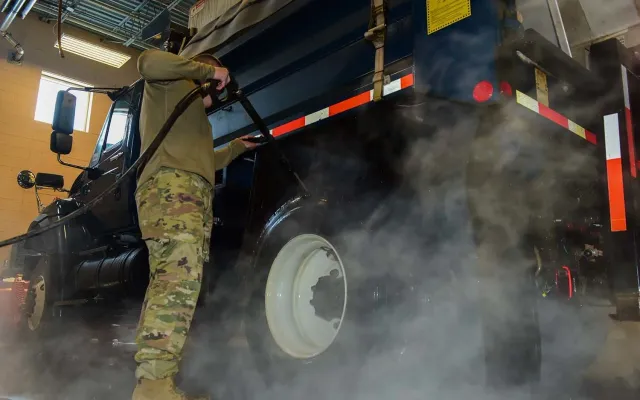
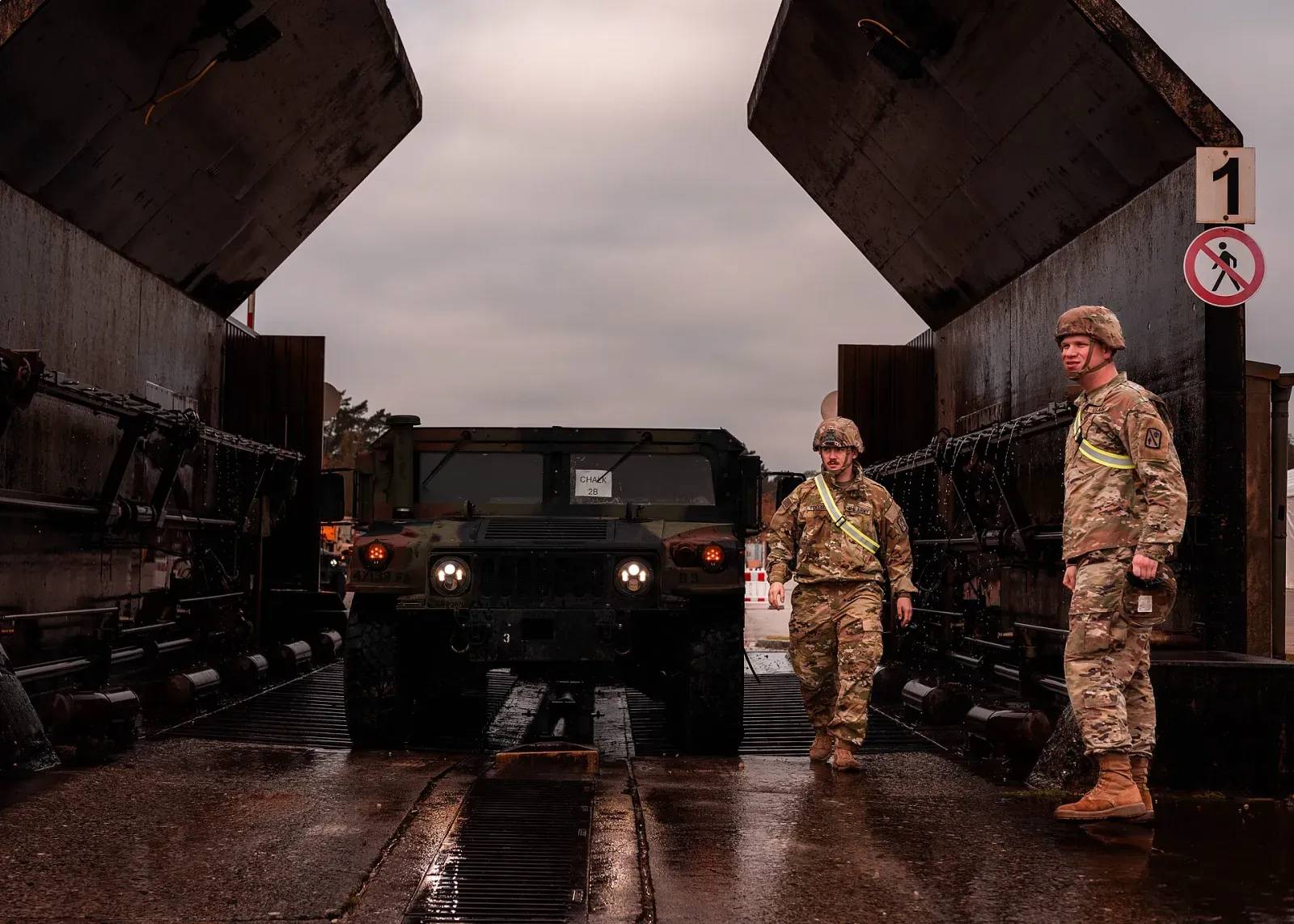
A wash rack is a fixed, paved spot where trucks, trailers, mats and equipment get washed, built so that every drop of wash water drains to one collection point instead of soaking into the yard. In oilfield yards that water carries mud, oil, grease and whatever came off the lease, so the drainage and treatment side of the rack matters more than the hoses. A rack that works has three things: a sloped slab with curbs, a trench drain that keeps solids moving, and a settling basin or separator that takes the oil and grit out before the water goes anywhere else.
This guide is about permanent racks at yards and shops. If you need to wash on location without a slab, read portable wash bays for the oilfield instead.
What a wash rack is (and how it differs from a wash bay)
People use the two terms loosely. EPA’s stormwater fact sheet on vehicle and equipment washing describes wash areas, “sometimes called wash racks,” as designated areas such as gratings, raised platforms or bermed pads that have a drainage system to contain and collect the wash water. In practice:
| Fixed wash rack | Portable wash bay or lined pad | |
|---|---|---|
| Surface | Concrete slab, sometimes steel grating over a pit | Containment mat or liner with raised or drive-over walls |
| Where water goes | Trench drain to a sediment basin, separator, then sewer, recycle tank or haul-off | Sump in the mat, pumped to a tank or vac truck |
| Best for | A yard or shop that washes most days | Washing on a lease, short jobs, sites that change |
| Weak points | Clogged trenches, a separator nobody cleans, cracked slab joints | Punctured liners, overtopped walls, sumps left full |
The most detailed public design reference for the drainage side is the Department of Defense manual for military wash racks, UFC 4-214-03 (Central Vehicle Wash Facilities, 2018). Oilfield yards are smaller, but mud and oil behave the same way in a trench.
Slope, curbs and trench drains
UFC 4-214-03 calls for paved areas sloped toward a grated trench drain and concrete curbing at pavement-to-soil edges where runoff has to be contained. It also says a 2 to 3 percent fall across the site is desirable so the water can reach treatment by gravity.
The trench is the part that clogs. Sand, drilling mud and frac sand drop out as soon as the water slows down. The UFC numbers make a good target:
- Trench slope of at least 2 percent.
- Flow velocity of at least 5 feet per second in the collection system, so solids keep moving.
- Grate openings at least 1 inch wide so gravel passes through instead of bridging on top.
- Grates heavy enough for the vehicle loads and easy to lift out for cleaning.
- A cleanup hydrant near the rack (the manual uses 25 gpm) so a hand can push the slab clean toward the trench after the wash.
A flat trench that gets hosed out once a month will be full of mud in a week. If your rack keeps backing up, check the trench grade before you blame the pump.
Settle first, then separate the oil
UFC 4-214-03 states that all wash water must get primary treatment: a sediment basin that lets most of the solids settle and lets free oil and grease float off. The basin in the manual has an oil skimmer, and free oil is removed in that basin before any pumping.
The manual explains why the order matters: that if wash water is pumped before primary treatment, the oil in it emulsifies and becomes harder to remove. So the rule of thumb is gravity from the slab to the settling basin, and pumps only after the oil has had a chance to rise.
For a smaller yard, the same idea usually looks like this:
- Trench drain to a sand trap or settling pit that someone can clean out with a loader or vac truck.
- An oil-water separator downstream of the trap.
- A sample point, then discharge to wherever the water is allowed to go, a holding tank, or a recycle loop back to the pressure washers.
Oil-water separators and soap
Detergent choice decides whether a separator works. EPA’s fact sheet says to avoid detergents where you can, and if you need one, use a phosphate-free, biodegradable soap. Where an oil-water separator pretreats water before it goes to a sewer, the sheet says to buy quick-break degreasers and monitor what comes out of the separator. A strong emulsifying degreaser keeps oil suspended in the water, and a gravity separator can’t pull out oil that never floats.
Other things that keep a separator working:
- Pump the oil and sludge out on a schedule, not when it overflows.
- Don’t route rainwater from the whole yard into it. EPA recommends covering the wash area when it isn’t in use to keep rain out.
- Keep spill kits at the rack. EPA’s sheet recommends mounting them near wash racks.
Does an oil-water separator need SPCC containment?
Sometimes. The federal SPCC rule exempts a facility or part of one “used exclusively for wastewater treatment and not used to satisfy any requirement of this part” (40 CFR 112.1(d)(6)). The same paragraph says the recovery or recycling of oil is not wastewater treatment. So a separator that only treats wash water may be exempt, but the tank its recovered oil goes into is not, and a separator that you count as spill control is not exempt either. Have whoever writes your SPCC plan look at the rack.
Where the wash water can go
Wash water usually ends up in one of three places, depending on where the yard is:
- Sanitary sewer. EPA says to get the sewer authority’s permission first, because wash water can carry pretreatment requirements, and those usually mean a separator or filtration ahead of the connection.
- Recycle. UFC 4-214-03 says vehicle wash water should be recycled where feasible, with makeup water added for what leaves on wet vehicles and evaporates. Recycling cuts both water bills and discharge paperwork, but it needs filtration and someone to look after it.
- Haul-off. Water is collected in a sump or tank and trucked to a disposal facility. Where a yard has no sewer connection, this is usually the answer.
Never send it to a storm drain, ditch or bar ditch. EPA’s fact sheet lists sediment, detergents, oils, grease and heavy metals in vehicle wash water, and an oilfield rack adds whatever was on the equipment from the lease.
Texas: earthen pits at a yard
If your rack drains to an unlined earthen pit, look at the Texas Railroad Commission’s Chapter 4 waste rules, which took effect July 1, 2025. Under 16 TAC §4.113, an operator can run only certain pit types without a permit: reserve, mud circulation, completion/workover, makeup water, fresh mining water, water condensate and produced water recycling pits. By July 1, 2026, other unpermitted pits not authorized by that section had to be permitted or closed. A yard pit collecting oily wash residue from oilfield equipment isn’t on that authorized list, so talk to your RRC district office before you dig one. A tank or a concrete sump you pump out is usually the simpler route.
Running a wash rack day to day
The design gets you a working rack. The routine keeps it working:
- Wash from the top down, so dirty water runs over surfaces you haven’t cleaned yet.
- Knock off caked mud with a scraper or low-pressure rinse before the pressure washer, so the trench takes less sand.
- Hose the slab toward the trench at the end of every shift.
- Pull trench grates and clean the sand trap on a fixed day each week. Busy racks need it more often.
- Look at the curbs and slab edges for cracks where water escapes. EPA’s sheet calls for checking around the rack for leaks, overspray and damaged berms.
- Don’t pressure wash radiators on the rack with the same wand. High pressure flattens fins. Our steam versus pressure washing guide covers which surfaces take which method.
What a wash rack won’t fix
A slab with no curbs, a separator full of sludge or a sump that overflows into the yard still lets wash water out. If you don’t wash often enough to justify the upkeep, a contractor washing on a lined pad and hauling the water off may cost less than building and maintaining a rack.
Equipment cleaning in the Permian Basin
Site Safe Solutions provides equipment cleaning in the Permian Basin and West Texas: pressure washing with environmentally friendly detergents for mats, trailers, tanks and rigs, and high-temperature, low-volume steam for radiator systems. We also install containment systems that keep wash water on the liner when the cleaning happens on location. If you have equipment coming off a job, tell us what needs cleaning and where it is.