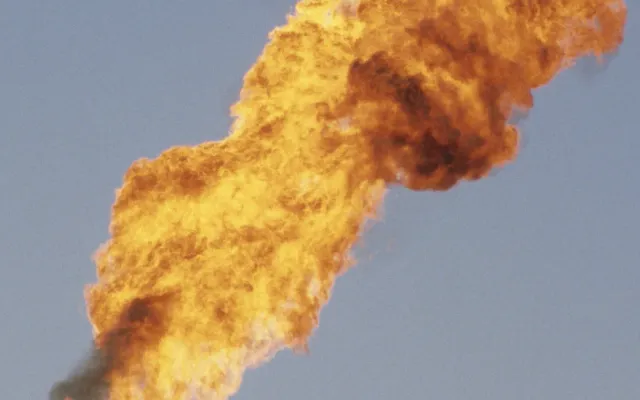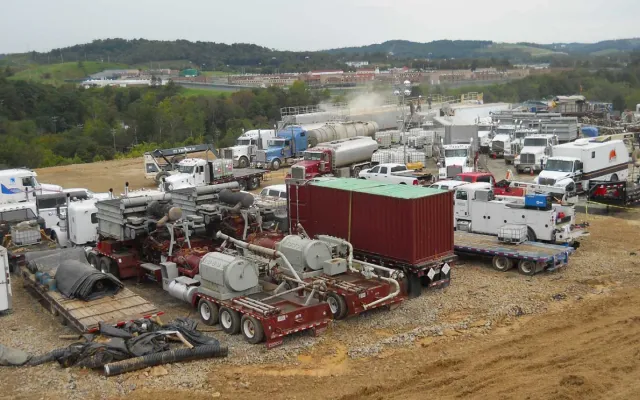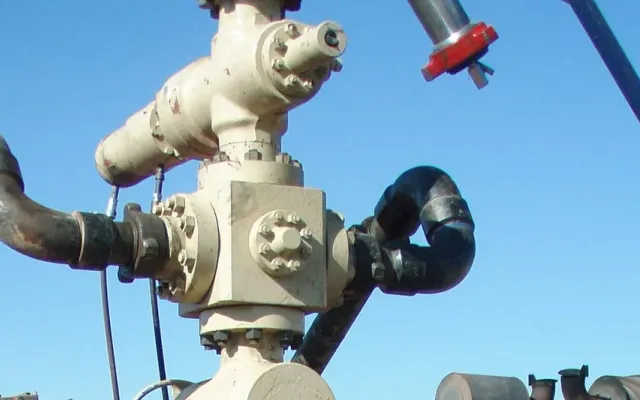
Hydrostatic pressure testing means filling a line or vessel with water, raising it above its operating pressure, and holding it there to prove it doesn’t leak or fail. Water stores far less energy than compressed air or gas, so a failure on test releases less. It can still hurt someone: when a test cap, gasket or hose lets go, the hose whips and the water jet hits whoever is close. The test also leaves a tank of water that has to go somewhere. Plan for both before any pressure goes on.
What is hydrostatic pressure testing?
PHMSA, the federal pipeline safety regulator, describes a hydrostatic test as a pressure test that uses non-flowing water as the test medium. The pipe is pressurized above its normal operating pressure and held there for a set time to check for leaks. If a pipeline passes, PHMSA’s fact sheet says it can be assumed that no hazardous defects are present in the tested pipe. Operators use the test after construction, before a line goes into service, and as a periodic integrity check where inline inspection tools won’t work.
The same basic method shows up all over the oilfield. New flowlines get tested before startup. So do gathering lines, rebuilt manifolds, tanks and pressure vessels after repairs. The code that sets the pressure and the hold time depends on what the piping is and who regulates it.
Why water instead of air
Compressed gas stores much more energy than compressed water at the same pressure, which is why water is the default. PHMSA notes that pneumatic tests, using air or nitrogen, are rarely run above 100 psig for that reason. SLAC National Accelerator Laboratory’s pressure test procedure makes hydrostatic testing its default. A pneumatic test there needs written justification, a piping schematic and a pressure relief valve.
| Hydrostatic test | Pneumatic test | |
|---|---|---|
| Test medium | Water (non-flowing) | Air, nitrogen or another non-flammable, non-toxic gas |
| Stored energy at a given pressure | Much lower | Much higher |
| Typical use | Default for pipelines, piping and vessels | Systems that can’t be filled with water, or where traces of water can’t be tolerated |
| Main hazards | Water jet and line movement at a failed fitting; disposing of the test water | Violent release if anything fails; flying parts |
| Leak finding | Pressure drop, visual walkdown | Pressure drop, soap solution on joints |
A water test can still kill. A NIOSH-funded Oklahoma FACE investigation describes a worker killed in 1999 when a gasket failed during a hydrostatic test of a heat exchanger coil. The water jet hit him in the chest and knocked him about 20 feet off the end of a loading dock. He was on a stepladder closing a valve on the test line, right beside the weak point.
Test pressures and hold times
The test pressure and hold time come from the code the system was built to.
| System | Test pressure | Hold time | Source |
|---|---|---|---|
| Hazardous liquid pipeline (crude, products) | At least 125% of maximum operating pressure | At least 4 continuous hours | 49 CFR 195.304 |
| Same, if the pipe can’t be visually checked for leaks | Plus at least 110% of MOP | An additional 4 continuous hours | 49 CFR 195.304 |
| Optional spike test (liquid lines) | 139% of MOP | About half an hour | PHMSA fact sheet |
| Natural gas pipelines | Set by class location and stress level | Varies | 49 CFR Part 192, Subpart J |
| Process piping built to ASME B31.3 | 1.5 times design pressure | SLAC’s procedure uses 30 minutes | SLAC table, citing B31.3 para. 345.4 |
Flowlines, gathering lines and facility piping in Texas may fall under different rules depending on what they carry and where they run, so check the design basis and your company’s procedure for the line in front of you. The test pressure has to stay below the rating of every component inside the test boundary. That includes valves, hoses, test caps and blinds that were never meant to see it.
Where tests actually fail
Two published incidents show where a test can go wrong.
IADC Safety Alert 06-11 describes a pressure test on the choke and kill line of a subsea stack. At 14,000 psi the internal threads in a locking ring stripped. The load went to four 3/4-inch studs, which also failed, and the high-pressure hose blew off the test cap. That ring’s design test pressure was 22,000 psi, so it failed well under its rating. The fix in the alert was a risk assessment and barricading the hazard area before every test.
In the Oklahoma case it was a gasket at the flange where the test line met the coil manifold, with a worker standing beside it. Both failures were at connections, so give the most attention to test caps, blinds, gaskets, hoses from the test pump and every union in the temporary rig-up.
How to set up a hydrotest safely
SLAC’s written procedure is a good template, and most of it carries straight over to a lease road. Pulled together with the FACE and IADC findings, the steps look like this:
- Write the test plan. Test pressure, hold time, boundaries, who’s in charge, and where the water goes when it’s done. One plan can cover several similar tests, but SLAC requires a separate test record for each one.
- Check the gauge. SLAC requires a gauge calibrated within the previous 12 months and sized so the test pressure sits in the middle third of its range. Put it where it can be read from outside the hazard area.
- Deal with relief devices. Remove relief valves that would lift below the test pressure, or clamp them as the procedure allows, and put them back afterward.
- Close the boundaries properly. SLAC recommends blind flanges or caps instead of closed valves where possible, which also keeps the valves from being damaged. Check that plugs, blinds and caps are rated for the test and free of defects.
- Fill and vent. Get as much air out as practical before pressurizing. Trapped air is compressed gas, with the stored energy that comes with it.
- Set the exclusion zone. Clear everyone not running the test. Put up barricades and signs. Both IADC 06-11 and the FACE report call for barriers around the hazard area.
- Restrain the temporary lines. Hoses from the test pump and any temporary iron should be restrained and anchored so a failed connection can’t swing.
- Pressurize and hold. Watch the gauge from a distance, never go over the test pressure, and record any drop.
- Keep people out while pressure is rising. Walk the line for leaks only when and how the test plan allows.
- Bleed down before breaking anything. Then deal with the water as the plan says.
Item 7 is easy to skip because the test lines are temporary and the job is short. The hose from a test pump carries the full test pressure. If it comes off a test cap, as in IADC 06-11, it whips the same way a production line would. Our line of fire article covers exclusion zones in more depth, and why an unrestrained line whips explains the mechanics.
What happens to the test water
PHMSA notes that operators displace hydrocarbons with water for a test to cut the environmental damage if the line leaks or ruptures. On a line that has been in service, the water that comes back out can carry oil, solids and whatever was in the pipe. It’s a waste stream.
In Texas, Water Code section 26.131 puts the Railroad Commission in charge of waste from oil and gas exploration, production and transportation. The same section says hydrostatic test water from those activities can be permitted for discharge into water in the state only once the state’s water quality commission holds federal NPDES authority for those discharges. That change came with House Bill 2771. The Railroad Commission’s own permit page says it still issues minor permits for discharging hydrostatic test water to land surface, and that surface-water discharges no longer go through its application. Before any water leaves the location, find out which agency the discharge falls under and whether a permit is needed.
Frac tanks or other storage holding test water need the same secondary containment as any other tank of oily fluid. The transfer hoses between the line, the test pump and the tanks need mats or liners under the connections, because that’s where drips happen.
Restraints and containment for test days
Site Safe Solutions runs automated hydro-testing trucks for tubing tests on workover jobs, built with E-stops, dual mechanical pop-offs and a pressure light the rig crew can see. We also install high-pressure restraint systems on hoses and iron, including the temporary lines from test pumps, and we set up containment systems and Fast Mats for tanks and transfer points in the Permian Basin. If you have a test coming up, tell us the line, the rig-up and where the water will be held, and we’ll plan the test setup, restraints and containment around it.