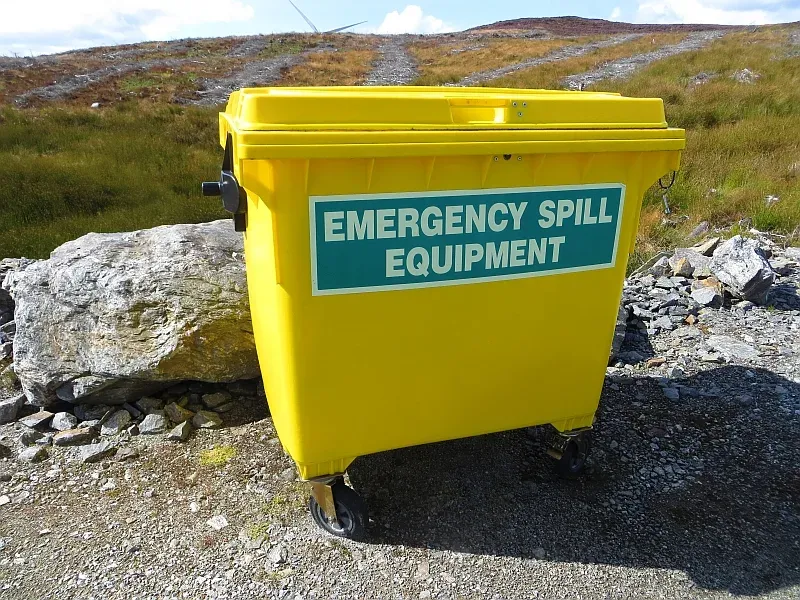
A good oilfield spill kit holds oil-only sorbent pads, socks and a boom, loose absorbent, a non-metallic shovel, heavy bags or a lidded drum for used sorbent, and the gloves and eye protection the crew needs to use it. Capacity is where most kits fall short. EPA’s SPCC inspector guidance says most commercial spill kits are built for about 150 gallons of oil or less. In Texas, a crude spill only becomes reportable to the Railroad Commission above five barrels, which is 210 gallons. A standard kit is sized for the drip at a hose connection, not for a release big enough to report.
This guide covers what goes in a kit for a well site or tank battery, how much sorbent a real spill takes, and where federal and Texas rules expect a kit and where they expect containment.
Spill kit contents for an oilfield location
Washington State’s industrial stormwater permit is one of the few rules that spells out minimum spill kit contents, so it’s a useful baseline even outside Washington. It requires a kit within 25 feet of fueling and used-oil transfer points, holding at least:
- oil absorbents capable of absorbing 15 gallons of fuel, or the volume in the site’s SPCC Plan if that’s larger;
- a storm drain plug or cover kit;
- a non-water containment boom at least 10 feet long with a 12-gallon absorbent capacity;
- a non-metallic shovel;
- two 5-gallon buckets with lids.
For a Permian lease, adapt that list to the ground and the fluids.
| Item | Why it’s in a lease kit |
|---|---|
| Oil-only (white) pads and pillows | They take up oil and leave water behind, so they keep working on a wet pad or in rain |
| Oil-only socks, about 3 in diameter | To ring a drip or a small pool on caliche before it spreads |
| A boom, 5 to 10 in diameter | For a release that’s heading for a bar ditch, culvert or draw |
| Loose granular absorbent | For oil worked into gravel and for slick spots on the pad |
| Non-metallic shovel | To pick up oily soil and spent granules |
| Heavy bags and a lidded drum or bucket | To keep used sorbent off the ground until it’s disposed of |
| Nitrile gloves, goggles, a disposable suit | Minimum PPE for handling crude and hydrocarbon-soaked sorbent |
| Culvert or drain cover | Only if the location drains into one |
The colors are a near-universal convention. The Washington Stormwater Center explains it this way: white is oil-only, gray or black is universal, and yellow is for hazardous chemicals such as strong acids and bases. Universal pads soak up water as well as oil. That makes them a poor fit for oil floating on rainwater, because the water uses up capacity the oil needed.
Oil-only vs universal pads on a lease with produced water
Most lease spills are a mix of oil and produced water. An oil-only pad will pick up the oil and leave the salt water. That’s what you want when the goal is to get oil off standing water. It also means the brine is still on the ground after the pads come up.
Brine is the part that kills vegetation and moves into soil, and sorbent pads aren’t the tool for it in any real volume. On a produced water release, the kit buys time until a vac truck arrives, and containment does the real work. Our guide to produced water spills in the Permian covers why brine is harder to clean up than oil.
Stock oil-only as the bulk of the kit, with a few universal pads for coolant and hydraulic leaks.
How much does a spill kit actually absorb?
EPA’s SPCC guidance for regional inspectors runs the numbers. Each “high-capacity” 20 by 20 inch sorbent pad absorbs less than 0.7 gallons of oil. A 600-gallon release would take more than 900 of those pads, or nine sorbent blankets, each 38 inches by 144 feet and weighing about 40 pounds. EPA’s point is that deploying that much material fast is hard to pull off, “particularly if only a few individuals are present when the discharge occurs.”
Here’s how common oilfield volumes compare with a kit.
| Release | Gallons | Pads at 0.7 gal each (minimum) |
|---|---|---|
| A typical commercial spill kit’s design volume (EPA) | about 150 | 215 or more |
| RRC reporting threshold for crude, more than 5 bbl | over 210 | 300 or more |
| EPA’s worked example | 600 | 900 or more |
| One 400-barrel stock tank | 16,800 | 24,000 or more |
A barrel is 42 US gallons. EPA also warns that rain cuts sorbent capacity, and that sorbents and portable barriers “are typically not engineered for long-term deployment,” since sun, cold and precipitation all degrade them. A kit that’s sat in the back of a truck through a West Texas summer may not be at full strength.
Is a spill kit enough under the SPCC rule?
For some equipment it can be. For tanks it isn’t.
The general secondary containment rule, 40 CFR 112.7(c), lets containment be “either active or passive in design.” For onshore facilities, sorbent materials are on its list of acceptable methods, alongside dikes and berms, curbing, drip pans, sumps and the rest. It also says you only need to address “the typical failure mode, and the most likely quantity of oil that would be discharged.” That’s why a kit can be the planned containment for a transfer hose or a small piece of equipment, as long as it can hold the volume your SPCC Plan says is most likely.
EPA’s inspector guidance adds conditions. Sorbent material “should be readily available so that it can be used immediately after a spill occurs but before it can spread,” and a spill kit “should be sized, however, to effectively contain the volume of oil that could be discharged.” A kit locked in a connex at the yard doesn’t meet that test for a release on location.
Tank batteries fall under a different rule. Section 112.9(c)(2) requires tank battery, separation and treating installations to have “a secondary means of containment for the entire capacity of the largest single container and sufficient freeboard to contain precipitation.” No spill kit holds a stock tank. That’s a lined berm or a secondary containment system. Drilling and workover locations have their own requirement in 112.10(c): “catchment basins or diversion structures to intercept and contain discharges of fuel, crude oil, or oily drilling fluids.”
EPA’s guidance also describes kits and containment working together. Where a berm around a transfer area is left open on one side for access, sorbent material at the opening can stop a small release from getting out. On most leases, that’s where a kit belongs: at the openings in containment, as backup.
What Texas requires once oil is on the ground
When crude oil reaches soil on a Texas lease, Statewide Rule 91 (16 TAC §3.91) sets the order of work. Its first step: “all free oil must be removed immediately for reclamation or disposal,” to keep oil from soaking deeper into the ground. The spill kit is for this first step. Pads, socks and granules get the free oil up while the vac truck is on its way.
After that, the cleanup becomes a soil job. Rule 91 requires the contaminated area to be delineated and cleaned up. Spills over five barrels of crude go to the RRC district office under Rule 20 and on a Form H-8, and spills over 25 barrels need a final report when cleanup is done. Our guide to oil contaminated soil and Rule 91 walks through the cleanup levels and deadlines. Bag used sorbent and oily soil, keep them on plastic or in a drum, and confirm disposal with the receiving facility.
A note on training: OSHA’s HAZWOPER standard, 29 CFR 1910.120, says responses to “incidental releases” that “can be absorbed, neutralized, or otherwise controlled at the time of release by employees in the immediate release area” aren’t emergency responses under that standard. Your safety department decides where that line falls for your crews.
Where to keep the kit, and how to check it
- At every point where oil gets transferred: the load line, the fuel tank on a generator, the frac or flowback manifold.
- On every service truck that hauls or transfers fluid.
- Restocked after every use, even a small one. A half-used kit is the one that runs out on the next spill.
- Checked on the same schedule as your SPCC inspections. If your Plan counts the kit as containment, the volume of sorbent on site has to match what the Plan says.
Containment that’s down before the leak
A spill kit picks oil up after it’s out. Containment keeps it off the ground in the first place. Site Safe Solutions builds and installs containment systems for Permian well pads and production sites: modular drive-over containment, primary containment pads laid out to the site, and high-wall systems for big volumes or steep ground. For a single piece of equipment, a service truck or a small fluid transfer, our Fast Mats are drive-over containment mats sized to the job that go down without a full pad build-out. See also the first hour of a spill. If you’re sorting out which spots on your lease need a kit and which need containment, tell us what’s on the pad.