A frac pond is a large lined pit or impoundment that holds water for hydraulic fracturing, either fresh or brackish makeup water or produced water being recycled for the next frac. In the Permian Basin the volumes are big enough that pits make sense: the USGS found that hydraulic fracturing water use per well in the Permian rose from 0.6 million gallons in 2010 to 5.4 million gallons in 2015. What you’re allowed to put in a frac pond, and how it has to be lined, depends on which side of the state line it sits. Texas rewrote its pit rules effective July 1, 2025, so pits that were legal under the old Rule 8 now have registration and, for produced water, bonding deadlines.
What a frac pond holds
The industry uses “frac pond” for two different things, and the regulators treat them very differently.
A freshwater frac pond holds makeup water: fresh or brackish water that gets blended into the frac fluid. In Texas this is a makeup water pit, defined in 16 TAC §4.110 as a pit used with a drilling rig, completion operations or a workover to store water used to make up drilling or completion fluid.
A produced water frac pond holds water that came back out of a well (produced water and flowback) so it can be treated and reused in the next frac instead of going down a disposal well. Texas now calls this a produced water recycling pit. Before July 1, 2025 the same pit was a non-commercial fluid recycling pit under Rule 8.
Texas §4.114 says plainly that produced water shall not be placed in a makeup water pit. If a crew starts dumping flowback into the fresh pond to save a truck run, the pit becomes something it isn’t authorized to be.
Texas: the Chapter 4 pit rules that took effect July 1, 2025
The Railroad Commission moved its pit rules out of Statewide Rule 8 and into a new Chapter 4, Subchapter A. Under §4.113, an operator can still run reserve pits, mud circulation pits, completion/workover pits, makeup water pits, fresh mining water pits, water condensate pits and produced water recycling pits without a permit, as long as each one meets the rule. Those are “authorized pits.” What changed is the paperwork and, for recycling pits, the construction standard.
Every authorized pit now has to be registered with the Commission:
- New pits register before they’re used.
- Pits that existed on July 1, 2025 had one year to register or close.
- Registration covers the pit type, location (lease and number or drilling permit, plus latitude and longitude in NAD 83), dimensions, capacity in barrels and the expected depth to groundwater from the bottom of the pit.
Every authorized pit also has to be outside the 100-year floodplain unless the district director approves otherwise. If anything gets out, the operator has to take steps to stop the release and report it to the district office within 24 hours of finding it.
Makeup water pits (Schedule A)
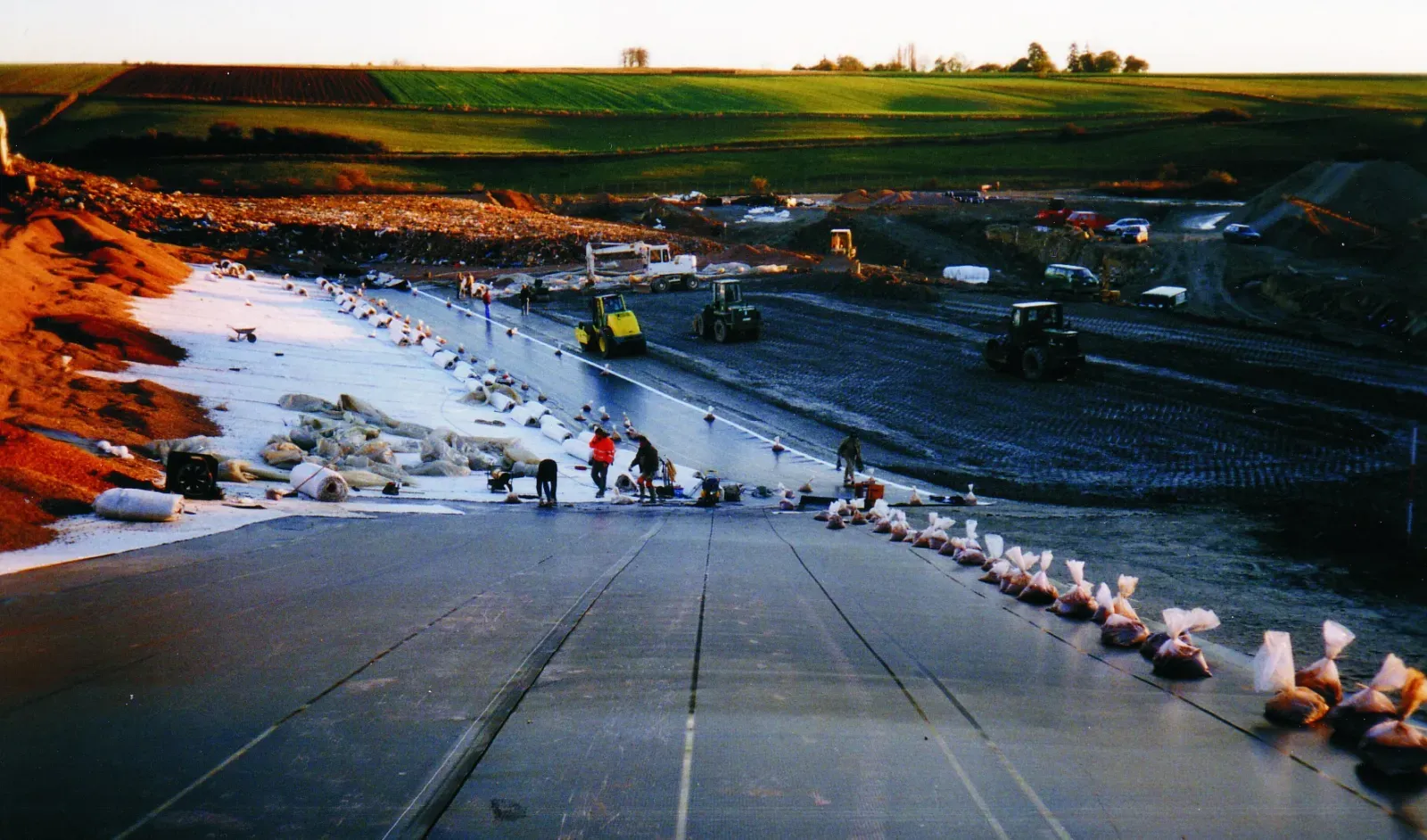
A freshwater frac pond falls under Schedule A in §4.114. The construction standard is short. The pit has to keep its contents out of the soil, groundwater and surface water around it. It has to be lined if the water carries more than 3,000 mg/L total dissolved solids, or if groundwater sits within 50 feet of the pit bottom. Any required liner, natural or synthetic, needs a hydraulic conductivity of 1.0 × 10⁻⁷ cm/sec or less.
That 3,000 mg/L TDS trigger catches a lot of Permian water. Brackish water used for fracs can exceed it, so check the water analysis before you decide a makeup pit doesn’t need a liner.
Makeup water pits with chlorides of 6,100 mg/L or less have to be dewatered, backfilled and compacted within one year after drilling operations stop.
Produced water recycling pits (Schedule B)
Recycling pits get the full treatment in §4.115. Its requirements, roughly in the order a project runs into them:
| Requirement | Texas §4.115 |
|---|---|
| Location | Not within 300 ft of surface water, 300 ft of a domestic or irrigation well (other than one supplying the operation), 500 ft of a public water system well or intake, or 500 ft of a public area; not in a 100-year floodplain or on a barrier island or beach |
| Capacity | Enough for the stored volume plus 2 ft of freeboard plus the rain from a 25-year, 24-hour storm |
| Run-on | Berm, ditch or grading so surface water can’t flow in |
| Slopes | No steeper than 3H:1V unless the district director approves an alternative |
| Liner coverage | The whole pit including the dike or berm, anchored or keyed into native ground |
| Natural liner | Only for a pit with an active life under one year; at least 2 ft of compacted fat clay in 6-inch lifts at 95% standard Proctor (ASTM D698), 1.0 × 10⁻⁷ cm/sec or less |
| Synthetic liner | Breaking strength 40 lb/in (ASTM D882); puncture resistance at least 15 lbf (ASTM D4833); geotextile underneath where needed |
| Seams | Run up and down the slope, not across; factory seams where possible; 4 to 6 in overlap before field seaming; seam strength at least 15 lb/in (ASTM D751 or D6392); welded and tested by qualified personnel |
| Leak monitoring | Empty and inspect the liner at least once a year, or install a double liner with leak detection checked monthly |
| Operation | No free oil on the pit; nothing in the pit that could puncture or tear the liner |
| Financial security | Bond, letter of credit or cash filed when the pit is registered |
With a double liner, the primary liner counts as failed when flow into the leak detection layer exceeds the calculated action leakage rate or 1,000 gallons per acre per day, whichever is larger. And the operator has to keep records showing liner integrity and produce them when the Commission asks.
Financial security is new for these pits. An operator with five or fewer recycling pits files $1.00 per barrel of total pit capacity. An operator with more than five files either the greater of $1.00 per barrel on 10% of total capacity or $1,000,000, or $200,000 per pit capped at $5,000,000. Old non-commercial fluid recycling pits had until January 1, 2026 to register as produced water recycling pits and file security, or close.
New Mexico side of the Permian: recycling containments
In southeast New Mexico, the Oil Conservation Division rules for produced water recycling containments (19.15.34 NMAC) are more prescriptive about liner materials than Texas:
| Texas produced water recycling pit (16 TAC §4.115) | New Mexico recycling containment (19.15.34.12-.13 NMAC) | |
|---|---|---|
| Liners | Single liner with an annual empty-and-inspect, or double liner with leak detection | Primary and secondary liner with leak detection, always |
| Liner material | Performance specs (40 lb/in breaking, 15 lbf puncture) | Primary: 30-mil flexible PVC, 45-mil string-reinforced LLDPE or 60-mil HDPE; secondary: 30-mil string-reinforced LLDPE or equivalent, 1 × 10⁻⁹ cm/sec or less |
| Leak detection layer | Not specified by material | 200-mil geonet or 2 ft of compacted soil at 1 × 10⁻⁵ cm/sec or greater |
| Slopes | 3H:1V or flatter | Inside no steeper than 2H:1V, outside no steeper than 3H:1V |
| Freeboard | 2 ft plus a 25-year, 24-hour storm | At least 3 ft |
| Inspection | Operator’s inspection program; monthly leak detection check if double lined | Containment and leak detection inspected weekly while holding fluid, with a log |
| Other | Financial security at registration | 4-ft fence with four barbed strands, netting or screening for wildlife, anchor trench at least 18 in deep |
In New Mexico, horizontal seams aren’t allowed within five feet of the slope’s toe. Discharge and suction lines can’t penetrate the liner, and hoses go in through a header or diverter that keeps fluid jets and pipe handling off the liner. If the primary liner is damaged below the waterline, the operator has 48 hours to pull the fluid down below the damage and has to notify the district office.
Where frac pond liners actually fail
Both states’ rules aim at the same weak spots:
- Hose and pipe entry. Suction and discharge points chafe and tear the liner. New Mexico requires a header or diverter for exactly this reason.
- Seams across the slope. Both states want seams running up and down the slope.
- The subgrade. Rocks and caliche under the liner punch through when the pond fills. Both rules call for a smooth, firm base and geotextile where needed.
- Equipment inside the pit. Texas forbids anything in a lined pit that could puncture or tear it.
- Sun. A pond that’s drawn down exposes liner to UV and heat. Our article on HDPE UV resistance in Texas sun covers how much that matters for different liner materials.
A frac pond that loses produced water is a produced water spill, with the soil and reporting problems that come with brine. Produced water spills in the Permian explains why brine is harder on land than oil.
Frac pond vs above-ground tanks
Some operators store frac water in above-ground or modular lined tanks instead of digging a pit, which skips the earthwork and the backfill at closure. The liner question doesn’t go away, because a modular tank sits on a liner that wears at the same seams, penetrations and rough ground.
Liners and containment from Site Safe Solutions
Site Safe Solutions specifies and installs containment liners for oilfield sites, including HDPE primary containment and high-wall systems, with factory-trained crews. The company has also supplied, repaired and installed water impoundment liners. If you’re planning a frac pond, re-lining an old one or need a damaged liner repaired, send us the pit size, what it will hold and where it is.