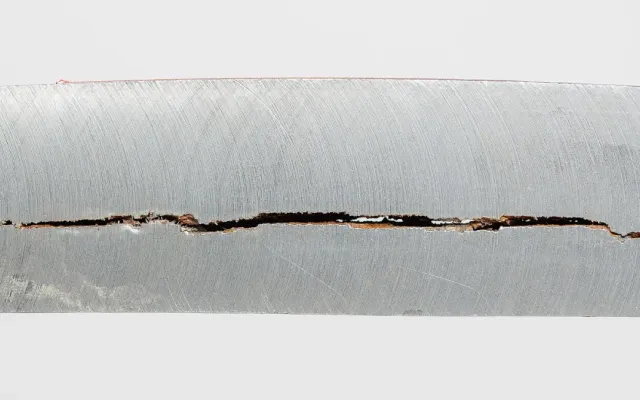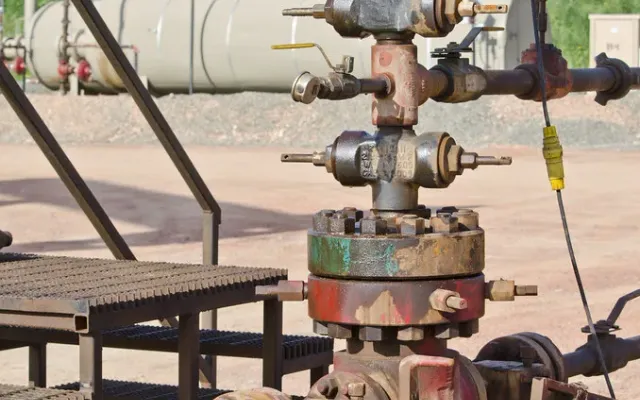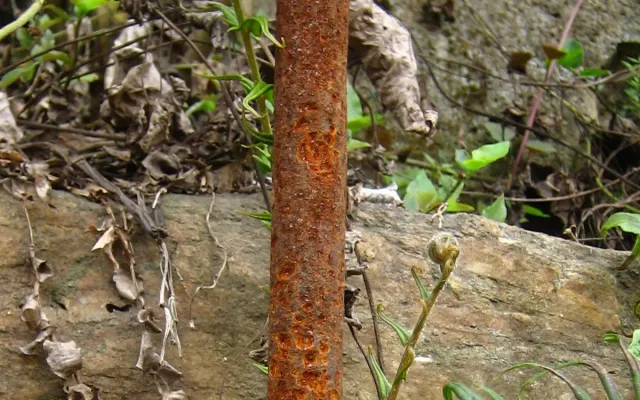
Stress corrosion cracking (SCC) is cracking caused by a tensile stress and a specific corrosive environment acting on a susceptible metal at the same time. Take away any one of the three and it doesn’t happen. It removes very little metal, so a part can look clean and still be full of fine cracks. In oil and gas the versions that matter are chloride cracking of stainless steel in hot produced water, sulfide stress cracking in sour wells, hydrogen-assisted cracking of hard bolts, and external cracking of buried gas lines.
What is stress corrosion cracking?
Wikipedia defines SCC as “the growth of crack formation in a corrosive environment” and says it can cause sudden failure of normally ductile alloys under tensile stress, especially at elevated temperature. The same entry says SCC is chemically specific: an alloy cracks only in a small number of environments. And the environment that causes it is often only mildly corrosive to that metal, so parts with severe SCC “can appear bright and shiny, while being filled with microscopic cracks.”
SPE’s PetroWiki adds the oilfield view. SCC happens only when the metal is under stress in the presence of a corrodant, metal loss is generally small, high-strength steels are more susceptible than low-strength alloys, and SCC “is often preceded by pitting.” That last point is the link to ordinary corrosion inspection, covered further down.
The three conditions, with field examples
| Condition | What counts | Oilfield examples |
|---|---|---|
| Susceptible material | An alloy that cracks in that environment; harder and stronger steel is more at risk | Austenitic stainless (304, 316) fittings and vessel parts; high-strength tubing; hardened bolting |
| Tensile stress | Applied load, or residual stress from welding, forming or cold work | Internal pressure, bolt preload, hanging string weight, welds that weren’t stress relieved |
| Specific environment | The chemical that cracks that alloy, often at a certain temperature | Chlorides in hot produced water; wet H2S; carbonate groundwater against pipe |
CRP, a UK maker of lined pipe, lists the stress sources for stainless: residual stress from welds and cold work, assembly stress from bolts and studs, and stress from contained pressure. Wikipedia notes residual stress can be relieved by annealing or other surface treatments.
Types of stress corrosion cracking in oil and gas
| Type | Material | Environment | Source |
|---|---|---|---|
| Chloride SCC | Austenitic stainless (304, 316) | Chlorides, roughly 120-150°F and up | Wikipedia, CRP, PetroWiki |
| Sulfide stress cracking | Hard carbon and low-alloy steel | Wet H2S | PetroWiki, NACE MR0175 |
| Hydrogen-induced SCC | High-strength bolting | Hydrogen from plating, corrosion or cathodic protection | BSEE QC-FIT 2014 |
| High-pH SCC | Pipeline steel | Carbonate/bicarbonate groundwater at a coating defect, above 100°F | PHMSA |
| Near-neutral pH SCC | Pipeline steel | Groundwater with dissolved CO2, weak cathodic protection, coating defects | PHMSA |
| Caustic SCC | Mild steel | Alkali (boiler cracking) and nitrates | Wikipedia |
Chloride stress corrosion cracking of stainless steel
Wikipedia says chlorides limit austenitic stainless steel for water with more than a few parts per million of chloride at temperatures above 50°C (122°F). PetroWiki says 304 and 316 are both susceptible above 150°F and that 304 is less resistant than 316. CRP puts the susceptible range at 60-100°C (140-212°F) and says cautious users treat anything between 50°C and 120°C (122-248°F) as at risk.
Now look at what Permian produced water carries. The Bureau of Economic Geology at UT Austin, citing the Texas Produced Water Consortium’s 2024 report, puts median salinity at about 50,000-90,000 ppm in the southern Delaware Basin and about 110,000-170,000 mg/L across the rest of the Permian. Salinity isn’t the same number as chloride, but even a fraction of that salt is far past the few-ppm level in Wikipedia’s warning. Any stainless part that sees produced water and heat, such as a fitting downstream of a heater treater or a hot water transfer line, sits in the zone the sources warn about.
For stainless fasteners, CRP reports that several of its customers switched to carbon steel bolting, because carbon steel doesn’t suffer chloride SCC and its bulk corrosion is easy to see. Corrosion-resistant alloys used downhole have their own limits. PetroWiki says high chloride, especially at high temperature, destroys the passivity of 13Cr tubing and can lead to pitting and crevice corrosion, and that chloride, stress and dissolved oxygen together can crack duplex.
Sulfide stress cracking and hydrogen-assisted SCC
PetroWiki calls sulfide stress cracking a subclass of SCC. H2S drives hydrogen into hard steel and it cracks below its yield strength. Our NACE MR0175 guide covers the 0.05 psia sour trigger and the 22 HRC hardness limit.
Hydrogen can drive SCC without H2S too. BSEE’s 2014 investigation of the bolts that let a riser package separate from a blowout preventer in the Gulf of Mexico found they failed “primarily” from hydrogen-induced stress corrosion cracking due to hydrogen embrittlement. The bolts were 34-38 HRC and hadn’t been baked after zinc plating.
Pipeline SCC: high pH and near-neutral pH
PHMSA’s fact sheet describes SCC on pipelines as clusters, or colonies, of cracks on the outside of the pipe. High-pH SCC typically shows up within 15 miles downstream of compressor or pump stations, where the product may be hotter than 100°F, and needs carbonate/bicarbonate groundwater touching the pipe through a coating defect. Near-neutral pH SCC needs a coating defect plus inadequate cathodic protection, with groundwater carrying dissolved CO2, usually from decaying organic matter in the soil.
PHMSA says most pipeline SCC incidents are on natural gas lines because they run hotter, and that SCC accounts for about 1 percent of incidents reported to its Office of Pipeline Safety. Cracks grow and link up until they reach a critical size, unless the section is repaired, replaced or run at lower pressure. PHMSA also points out that SCC weakens pipe enough that other damage, like an overpressure or a third-party hit, is more likely to cause a failure.
How stress corrosion cracking is found
SCC is hard to see because so little metal is lost. Wikipedia says that is why it often goes undetected before failure. CRP adds that its cracks branch like a tree and grow much faster than typical fatigue cracks.
| Method | What it shows | Limits |
|---|---|---|
| Visual | Rust staining that can point to pitting where SCC starts (CRP) | Fine cracks are usually invisible |
| Dye penetrant | Surface-breaking cracks (CRP) | No depth information |
| Eddy current | Cracks with a depth indication (CRP) | CRP says accurate to about 2 mm, with indications to about 6 mm that get less accurate with depth |
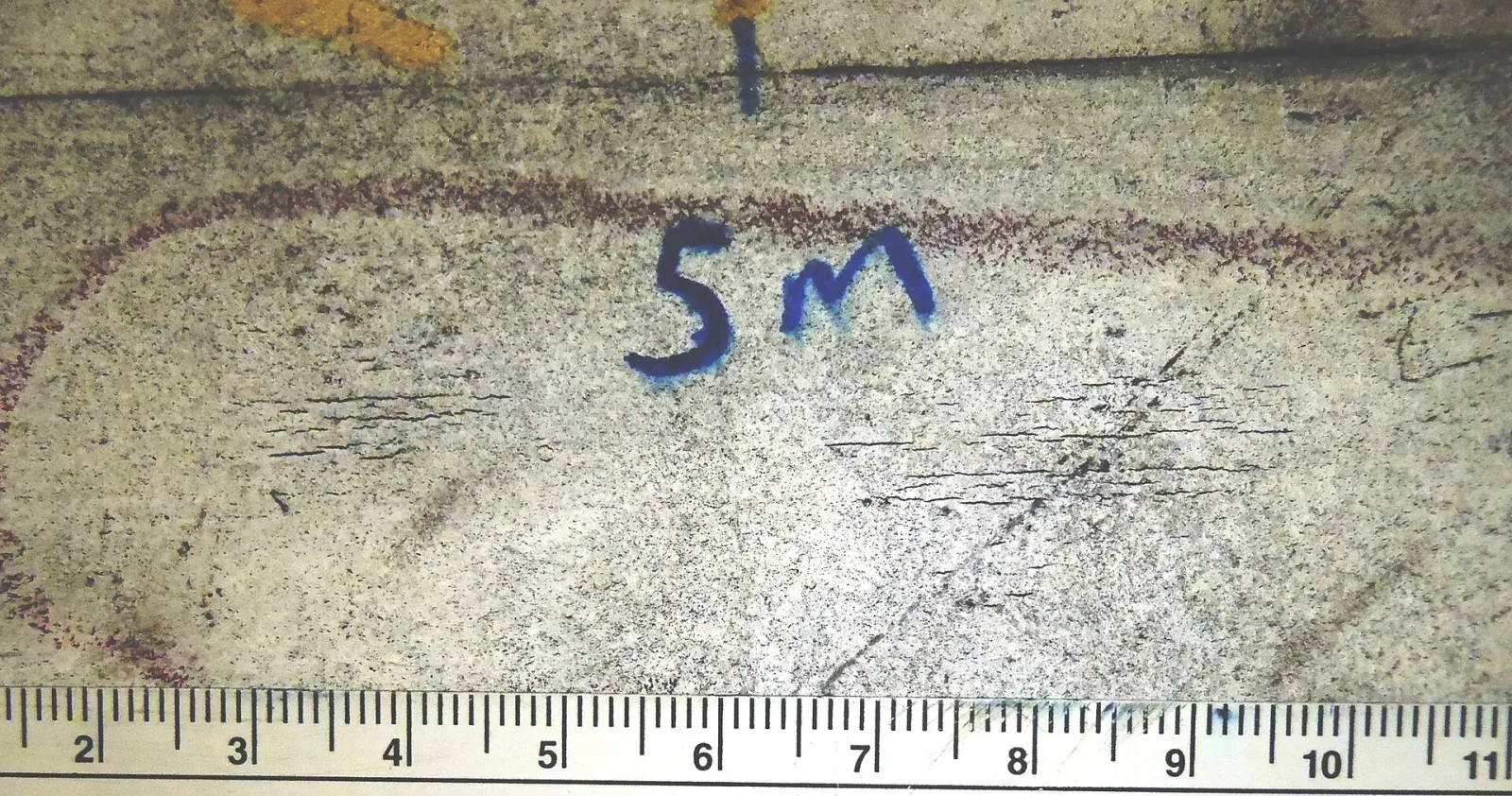
| Magnetic particle | Crack colonies on magnetic steel, such as pipeline surfaces | The surface must be cleaned and prepared |
| Radiography and ultrasonic | Many other defects | CRP says they aren’t useful for very fine stress corrosion cracks |
The photo with this article shows magnetic particle inspection on a pipeline: the surface was painted white, magnetized and sprayed with particles, and two crack clusters showed up that couldn’t be seen before.
For thick-walled stainless, CRP notes SCC usually leaks before it breaks, because the crack goes through the wall first. It also warns that lined equipment is unlikely to show a leak, so the failure there can still be sudden.
How to prevent stress corrosion cracking
Prevention comes down to removing one of the three conditions.
- Pick an alloy that doesn’t crack in that environment. For stainless in hot produced water, check the chloride and temperature limits before you buy. For sour service, buy to NACE MR0175.
- Stress-relieve welds and cold-worked parts where the spec calls for it, and don’t over-torque stainless bolting.
- Keep the temperature down where you can, keep oxygen out of produced water systems, and keep chlorides off stressed stainless, including from spills and wash water.
- On buried pipe, PHMSA says shot-peening plus fusion bonded epoxy protects pipe from SCC, and annual cathodic protection surveys help find disbonded coating.
- Look for cracks with methods that can find them, on a schedule, where the three conditions meet.
Where tubing inspection fits
PetroWiki says SCC is often preceded by pitting, and CRP says it usually starts at a pit about 1 mm across. EMI tubing inspection reports wall loss, rod wear, corrosion and other defects along each joint. Pitting and corrosion trending up on a string mean the environment is attacking the steel, and that’s the same environment that drives cracking in susceptible grades. Our guide to pitting corrosion in oilfield tubing covers how pits are found and measured.
EMI tubing inspection in the Permian Basin
Site Safe Solutions runs EMI tubing inspection at the wellhead or on the lease. The non-contact scan checks each joint for wall loss, rod wear, corrosion and other defects and produces digital trace records, so repeat scans of the same string show how fast it’s degrading. The company also installs high-pressure restraint systems for iron and hose lines. If you’re pulling tubing from a hot, salty or sour well, send us the size and joint count and we’ll scan it while it’s on surface.