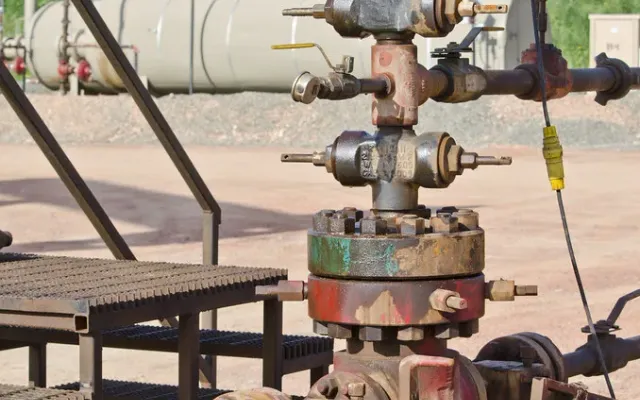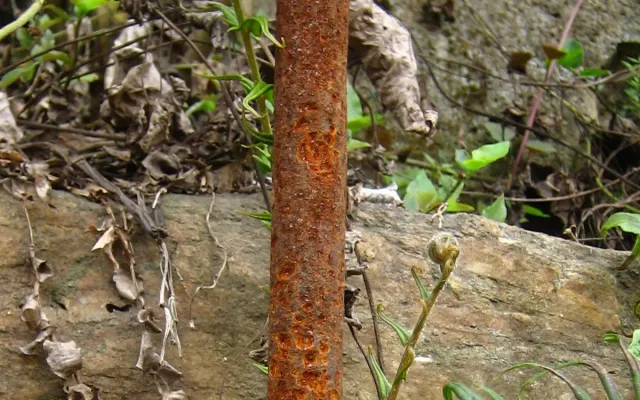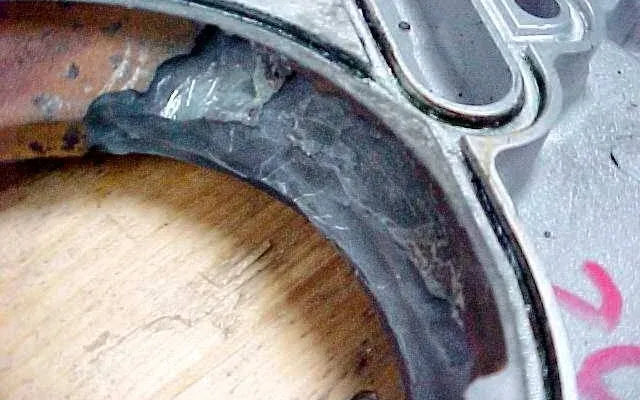
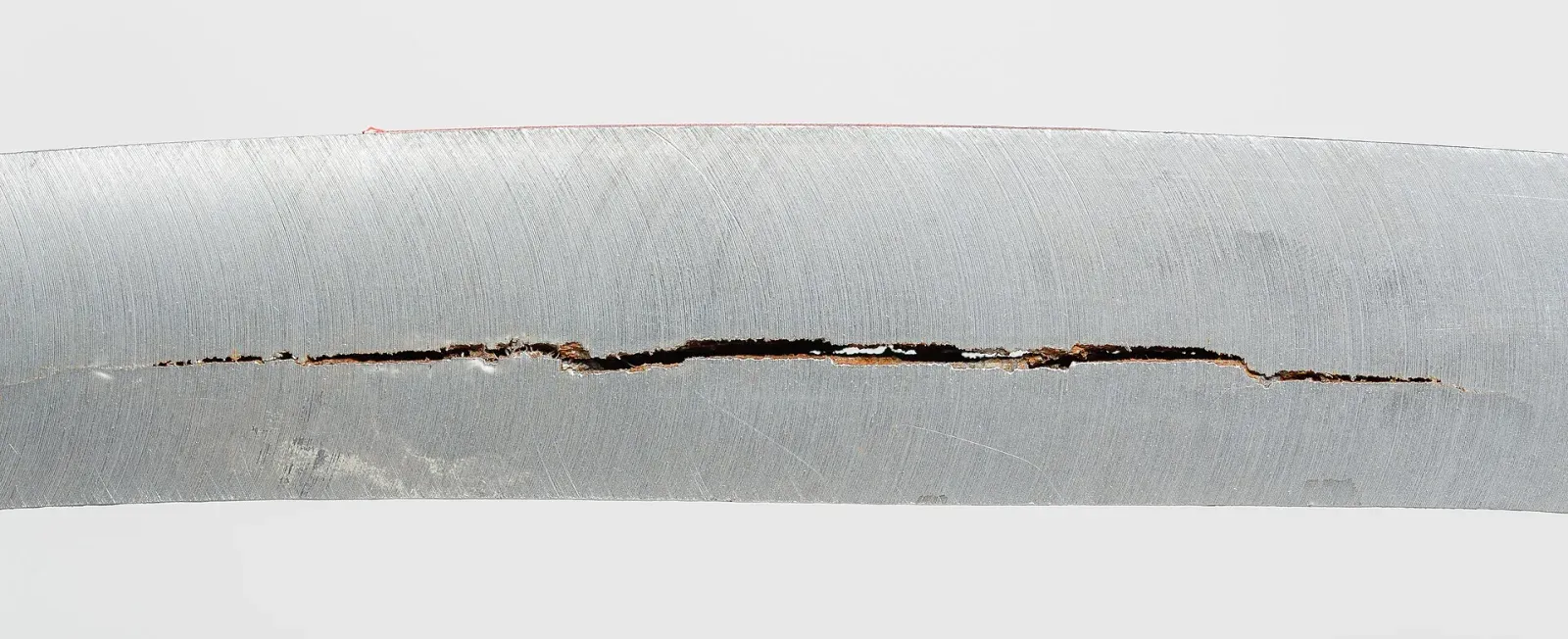
Hydrogen embrittlement is what happens when atomic hydrogen gets into steel and the steel loses its ability to stretch before it breaks. A part that should bend and warn you cracks instead, sometimes at loads well under its rating and sometimes weeks after it went into service. In the oilfield the hydrogen comes from sour corrosion, acid, cathodic protection, plating on bolts and welding. The parts most at risk are the hard ones: high-strength tubing, treating iron, and the bolts and studs that hold pressure equipment together.
What is hydrogen embrittlement?
Wikipedia describes it as “a reduction in the ductility of a metal due to absorbed hydrogen.” Hydrogen atoms are small enough to move through solid steel. Once inside, they lower the stress it takes to start a crack and keep it growing.
TWI, the UK welding and materials institute, adds the part that matters in the field: embrittlement usually only becomes a problem when it leads to cracking, and that takes enough stress on the hydrogen-loaded part. The stress can come from service loads, or it can be residual stress left by forming and welding. A bolt torqued to spec, a hammer union made up tight, or a string of tubing hanging in the hole all carry plenty of it.
Two more facts shape where it shows up:
- Temperature. Wikipedia says embrittlement in steel is worst at around room temperature, and TWI says most metals are relatively immune above about 150°C (302°F). Surface iron on a lease runs well below that.
- Strain rate. Wikipedia notes embrittlement increases at lower strain rates, and a bolted joint or a hanging string is loaded slowly and steadily.
What causes hydrogen embrittlement on a lease
Plain hydrogen gas mostly isn’t the problem at surface temperatures. TWI explains that steel absorbs hydrogen as atoms or ions, and that gas molecules only break into atoms at high temperatures. The atoms come from chemical reactions on the steel surface, and an oilfield has plenty of those.
| Source | How the hydrogen gets in | Where you see it |
|---|---|---|
| Sour (H2S) corrosion | Corrosion makes hydrogen atoms on the steel. PetroWiki explains that H2S slows the step where they pair up into gas, so more of them go into the metal | Tubing, line pipe, wellhead and treating iron in sour wells |
| Acid | Wikipedia lists acids used in pickling, etching and cleaning as a hydrogen source | Acid jobs and acid cleaning of iron |
| Cathodic protection | Wikipedia and TWI both name cathodic protection that isn’t controlled properly | Buried lines and tanks with CP; offshore equipment |
| Electroplating | Plating (zinc on bolts, for example) charges the steel with hydrogen unless it’s baked out afterward | Plated bolts, studs and fasteners |
| Welding | Moisture in welding rods puts hydrogen into hot metal. Wikipedia says weld hydrogen cracking can show up more than 24 hours after the weld is finished | Field welds on hardenable steel |
Wikipedia names poorly controlled electroplating and damp welding rods as the most common causes of failure in practice. Sour corrosion is the oilfield’s own version. Wikipedia calls the H2S form, sulfide stress cracking, “a significant problem for the oil and gas industries.” Our guide to NACE MR0175 covers the sour-service rules in detail.
Which steels are at risk: hardness is the warning sign
The harder and stronger the steel, the less hydrogen it takes to crack it. Sources put the line in different places depending on where the hydrogen comes from.
| Threshold | Source | What it means |
|---|---|---|
| 22 HRC maximum | NACE MR0175 / ISO 15156 for carbon and low-alloy steel in sour service (see our MR0175 guide) | The limit for steel that will see wet H2S |
| About 90,000 psi yield and up | SPE PetroWiki | Where embrittlement “usually” occurs; PetroWiki says tubing and line pipe are susceptible |
| Below 32 HRC (or under about 145,000 psi tensile) | Wikipedia | Not generally considered highly susceptible; many failures are reported from 32-36 HRC and up |
| Above 31-32 HRC | ASTM B633 as described by BSEE | Zinc-plated parts this hard need baking after plating |
The sour-service limit is the lowest because H2S puts so much hydrogen into the steel. For hydrogen from plating or cathodic protection, the risk climbs fast in the low 30s HRC and above. High-strength bolting, some tubing grades and hardened iron all sit near or above those numbers.
TWI says ferritic steel is more susceptible than austenitic stainless, nickel alloys and aluminum, and then adds that hydrogen can embrittle most engineering alloys to some extent. Whether it becomes a field problem depends on the part’s microstructure and how much hydrogen reaches it.
What it looks like when it fails
Wikipedia says high-strength steels can fail with a delay of weeks to decades after going into service as hydrogen builds up from cathodic protection and other sources. PetroWiki says the cracking happens at stresses well below the yield strength. The part breaks without stretching or necking down first, and Wikipedia notes the fracture often has a brittle appearance.
On location that means a stud that snaps after the job is rigged up, a fitting that cracks under a pressure it has held a hundred times, or a connection that was fine at makeup and isn’t fine next week. Line-of-fire distance and restraint matter more when the failure gives no warning.
The offshore bolt failures: what BSEE found
A detailed public record of hydrogen embrittlement in oil and gas equipment comes from the Bureau of Safety and Environmental Enforcement (BSEE). Its Quality Control-Failure Incident Team (QC-FIT) investigated two rounds of bolt failures.
The first case started on December 18, 2012, the lower marine riser package on the Transocean Discoverer India separated from the blowout preventer stack in the Gulf of Mexico, releasing about 432 barrels of synthetic-based drilling fluid. BSEE’s 2014 report found the connector bolts failed “primarily” from hydrogen-induced stress corrosion cracking due to hydrogen embrittlement. The bolts were 4340 steel at 34-38 HRC. A subcontractor plated them to a 1998 edition of ASTM B633, which didn’t require the post-plating bake that the 2007 and 2011 editions require for parts above 31 HRC. More than 10,000 bolts were replaced. BSEE also noted that the manufacturer’s quality system audited only first-tier suppliers. The plating was done by a third-tier subcontractor.
The second came in 2015. BSEE’s 2017 addendum covers six of eight fasteners that failed on a blind shear ram actuator on the Noble Paul Romano. They were harder than 35 HRC and had been baked for only 3 hours at 190°C (374°F) after zinc plating. BSEE said that bake was too short for the hydrogen to get out. It agreed with replacing 37-42 HRC fasteners with 31-34 HRC parts baked for at least 8 hours under ASTM B850.
These were subsea parts, but the lessons carry to land:
- Hardness and plating together are the risk. A hard bolt that’s been plated and not properly baked is loaded with hydrogen before it ever sees a well.
- The edition of the standard matters. Both failures traced back to an old edition of ASTM B633.
- Paperwork can miss the shop that did the work. Ask who plated and baked the part, not only who sold it.
Hydrogen embrittlement relief and testing
If the steel hasn’t cracked yet, hydrogen can sometimes be driven back out. Wikipedia calls this low-hydrogen annealing or “baking.” It’s routine after electroplating, but it only works if the part gets enough time at temperature, and it does nothing for a part that has already cracked. TWI describes the same idea for welding and heat treatment: let the hydrogen escape before the part cools to the temperatures where it does damage. For welds, Wikipedia says pre-heating and post-heating give hydrogen time to diffuse out.
Testing is done to standards, and naming the right one on a purchase order is how you get it done. Wikipedia lists several:
| Standard | What it covers |
|---|---|
| ASTM F519 | Mechanical hydrogen embrittlement evaluation of plating and coating processes and service environments |
| ASTM F1940 | Process control check to prevent embrittlement in plated or coated fasteners |
| ASTM F1624 | Embrittlement threshold in steel by incremental step loading; also used to set minimum bake times |
| ASTM B839 | Residual embrittlement in coated threaded parts, fasteners and rods |
| NACE TM0284 | Resistance to hydrogen-induced cracking (the pipeline and vessel steel test) |
BSEE’s reports also point to ASTM B849 and B850 for pre- and post-plating heat treatment, and to API 20E for alloy and carbon steel bolting in the oil and gas industry.
Checklist for iron, bolting and tubing
- Know the hardness. Ask for hardness on mill certs for bolting, studs and high-pressure iron. Treat anything in the low 30s HRC and up as hydrogen-sensitive.
- If the well is sour, buy to NACE MR0175 and confirm the 22 HRC limit on the certs.
- For plated fasteners, ask which edition of ASTM B633 was used and get the bake record.
- Ask who plated and baked the parts. The H4 failure came from a third-tier subcontractor.
- Keep field welding off hard, pressure-rated parts unless a qualified procedure with preheat and post-heat covers it.
- Don’t swap bolting on pressure equipment for whatever is in the truck. A harder, plated bolt can look identical.
- Treat a stud or fitting that cracked without stretching as a warning about the rest of its batch. BSEE’s reports note that every fastener from the same batch shares the same risk.
- Restrain high-pressure iron and hoses. Embrittled parts fail without warning, and a restraint system keeps a failed connection from whipping.
- Inspect tubing joint by joint when it’s out of the hole.
EMI tubing inspection and restraint systems in the Permian
Site Safe Solutions runs EMI tubing inspection at the wellhead or on the lease. The non-contact scan finds wall loss, rod wear, corrosion and other defects joint by joint and produces digital trace records, so repeat scans show how fast a string is losing metal. In a sour well that’s useful beyond wall thickness: the corrosion that pits the tubing is the same reaction that puts hydrogen into it. Our guide to CO2 corrosion in Permian tubing covers the sweet side. The company also installs high-pressure restraint systems for iron and hose lines. If a sour well is coming in for a workover, tell us the tubing size and joint count and we’ll scan it while it’s on surface.