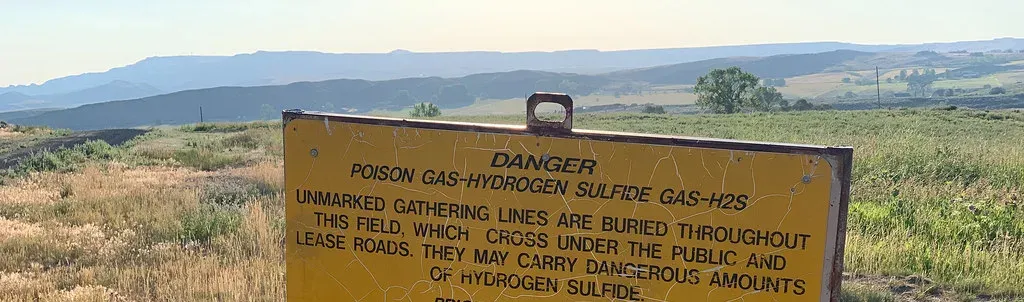
NACE MR0175 is the standard that says which metals can be used in oil and gas production equipment that sees hydrogen sulfide. Its job is to stop sulfide stress cracking (SSC), where H2S drives hydrogen into hard steel and the part cracks under load. The two numbers most crews need are the sour trigger, an H2S partial pressure of 0.05 psia in the wet gas, and the hardness ceiling of 22 HRC for carbon and low-alloy steel. In Texas, Statewide Rule 36 writes the standard into the rules for wells and facilities that handle H2S.
What NACE MR0175 covers
NACE issued MR0175 in 1975 under the title “Sulfide Stress Cracking Resistant Metallic Materials for Oilfield Equipment.” According to a 2004 NACE conference paper by authors from Emerson, Motiva and Shell, its scope is oilfield equipment and the facilities that go with it, including gas production and treatment. Refineries got their own standard, MR0103, in 2003.
The document has since been merged with ISO 15156. The edition sold through ANSI is listed as ANSI/NACE MR0175-2021/ISO 15156:2020. It comes in three parts:
| Part | What it covers |
|---|---|
| ISO 15156-1 | General principles, definitions and how materials are qualified for sour service |
| ISO 15156-2 | Carbon and low-alloy steels, the steels most lease iron and tubing are made of |
| ISO 15156-3 | Corrosion-resistant alloys (stainless, duplex, nickel alloys) |
One point gets missed on a lot of jobs. The 2004 paper stresses that under MR0175 the user is responsible for deciding whether the environment is sour enough for the standard to apply. A vendor won’t make that call for you, and Projectmaterials adds that a manufacturer isn’t obliged to meet sour service requirements unless the purchase order calls for MR0175.
Sulfide stress cracking: why sour wells crack steel
SPE’s PetroWiki explains the mechanism. Corrosion on the steel surface makes atomic hydrogen. Normally two hydrogen atoms pair up and leave as gas. H2S slows that pairing, so the atoms go into the metal instead. In softer steel that can cause blisters at inclusions. In hard, high-strength steel it causes embrittlement and cracking well below the yield strength.
PetroWiki lists what makes it worse:
- SSC needs only low concentrations of H2S.
- Time to failure drops as stress rises.
- Cracking tendency goes up as pH goes down.
- Embrittlement usually shows up in hard steels, generally with yield strengths of 90,000 psi or more, and tubing and line pipe are susceptible.
- Stress-relieved alloys held up better than cold-worked ones.
Wikipedia’s entry adds a temperature point that matters on surface equipment: because SSC is a hydrogen embrittlement mechanism, it is most likely at or somewhat below room temperature.
Sour service also brings ordinary weight-loss corrosion. PetroWiki notes H2S forms iron sulfides on the metal and speeds up both halves of the corrosion reaction. Our guide to CO2 corrosion in Permian tubing covers the sweet side of the same problem.
The 0.05 psia trigger, worked out in ppm
The 2004 NACE paper sums up MR0175’s sour definition as an H2S partial pressure in the wet gas phase of 0.0003 MPa absolute (0.05 psia) or more. It gives low-pressure cut-offs of 0.45 MPa (65 psia) total pressure for gas systems and 1.83 MPa (265 psia) for multiphase systems, with other conditions applying. Current editions are more detailed, so check the text you buy before you specify.
Partial pressure is total pressure times the H2S mole fraction. That means the ppm that makes a system sour falls as pressure rises. The table below is plain arithmetic (0.05 psia divided by total pressure):
| Total pressure (psia) | H2S that reaches 0.05 psia |
|---|---|
| 265 | about 189 ppm |
| 500 | 100 ppm |
| 1,000 | 50 ppm |
| 5,000 | 10 ppm |
| 15,000 | about 3.3 ppm |
Hart Energy made the same point in 2009: at 15,000 psig bottomhole pressure, about 3.5 ppm of H2S invokes the standard, and it’s close to impossible to measure that little accurately. Some operators treat high-pressure wells as sour from the start for that reason. Hart also notes that the 0.05 psia limit was an empirical choice and that at high pressure the partial-pressure approach isn’t strictly correct.
Permian numbers can be far above the threshold. A Baker Hughes case study describes a Permian shale well making 73 to 96 Mcf of gas a day with 1,100 ppm H2S in the gas phase. The same study lists metallurgical upgrades among the costs of producing H2S.
The 22 HRC hardness limit and other material rules
For carbon and low-alloy steels, the main control is hardness. Projectmaterials summarizes it as 22 HRC maximum, equivalent to 237 HV or 248 HBW, with the same limit on weld metal and the heat-affected zone. The 2004 NACE paper lists rules MR0175 shares with the refinery standard:
- Carbon steel must be in an approved heat-treated condition, such as normalized, normalized and tempered, or quenched and tempered.
- Carbon steel cold worked past 5% outer-fiber deformation must be stress relieved so it ends up below 22 HRC.
- Welding procedures that control hardness by means other than stress relief need a hardness check showing 22 HRC maximum.
PetroWiki says the material most often used for sour service is AISI 4130 steel, modified with microalloy additions and quenched and tempered.
Tubing and casing grades are where buyers get caught. Hart Energy reports that API 5CT Q125 has no resistance to sulfide stress cracking, that C110 can’t be run to surface under the standard and is limited to deeper, hotter sections (Hart cites 150°F), and that T95 was the grade that met the standard at all temperatures all the way to surface. Treat those as 2009 statements and confirm against the current edition.
What Texas Statewide Rule 36 adds
Rule 36 (16 TAC § 3.36) is the Railroad Commission rule for oil, gas and geothermal operations in hydrogen sulfide areas. It was last amended effective February 18, 2025. A few parts matter for materials:
- It excludes operations where the H2S concentration in the system is less than 100 ppm.
- Where it applies, metal components must be “selected and manufactured so as to be resistant to” hydrogen sulfide stress cracking, and must meet “the latest editions of NACE Standard MR-01-75 and API RP-14E.”
- Handling and installation must not make the metal susceptible to SSC, so the duty carries on after the part leaves the mill.
- Nonsusceptible materials such as fiberglass and plastics are allowed if they meet industry standards.
- Facilities in service before the rule’s effective date can qualify if they’ve had no sulfide stress cracking failure.
The rule also sets extra controls based on the radius of exposure. One example is a 100 ppm radius of more than 50 feet that takes in a public area other than a public road. Check the full text for your site.
Checklist before sour iron and tubing go to work
- Get a gas analysis with H2S, and the flowing and shut-in pressures. Work out the partial pressure.
- Decide whether the system is sour under MR0175 and whether Rule 36 applies (100 ppm and up). That decision belongs to the operator.
- Write “NACE MR0175/ISO 15156” on the purchase order for every pressure-containing part: tubing, valves, flanges, hammer unions, swivels and treating iron.
- Check the mill test reports for the statement of compliance, heat treatment and hardness results. Projectmaterials lists these as the usual proof.
- Don’t mix sweet and sour iron in the same rental pile without marking it, because the two look alike on the rack.
- Keep field welding and heating off sour-rated parts unless a qualified procedure covers it.
- Restrain high-pressure lines. A cracked fitting under pressure lets go like any other failed connection, and a restraint system keeps the line from whipping.
- Inspect tubing when it’s out of the hole. Sour corrosion pits and thins the wall long before anything shows on the outside, as our guide to pitting corrosion in oilfield tubing explains.
Hardness and paperwork tell you whether steel was right for sour service when it was made. A scan of pulled tubing tells you how much wall is left after the H2S has had a few years at it.
EMI tubing inspection for sour Permian wells
Site Safe Solutions runs EMI tubing inspection at the wellhead or on the lease. The non-contact scan finds wall loss, rod wear, corrosion and other defects along each joint and produces digital trace records, so repeat scans of the same string show how fast it’s losing metal. The company describes itself as the only provider in the Permian Basin with ACE-Making technology, and it also installs high-pressure restraint systems for iron and hose lines. If a sour well is coming in for a workover, send us the tubing size and joint count and we’ll scan it while it’s on surface.