A radar trailer, also called a speed radar trailer or speed monitoring trailer, measures the speed of each approaching vehicle and shows it to the driver on a large display. On public roads the studies are consistent about one thing: it lowers average speeds by a few miles per hour, more where drivers can see a reason to slow down, and the effect fades if the trailer sits in one spot for weeks. On an oilfield lease road, where the traffic is mostly the same crews and haulers every day and where a trailer can also log speeds and photograph vehicles, the records it keeps can be worth more than the display.
Why speed on lease roads is an HSE problem
Driving kills more oil and gas workers than anything else on the job. NIOSH’s Fatalities in Oil and Gas Extraction (FOG) database counted 470 worker deaths from 2014 through 2019, and vehicle incidents were the most common fatal event at 26.8%. Most of those (77%) happened on the roadway. The rest happened on site or at other locations.
FOG also counts crashes during commutes, which the federal Census of Fatal Occupational Injuries usually leaves out. The CDC report explains why that matters for this industry: the work is remote, so long drives to location are normal. The same report says an earlier NIOSH analysis of crash deaths “highlighted speeding and lack of seat belt use as contributing factors.”
That earlier NIOSH study looked at 202 oil and gas extraction workers killed in work-related crashes from 2003 to 2009. Their motor vehicle fatality rate was 8.5 times the rate for all private wage and salary workers. Pickup trucks were the vehicle in 51.5% of the deaths, and workers at small companies (fewer than 20 workers) and well servicing companies were at the greatest risk.
The Permian is where the traffic is. TxDOT’s energy sector campaign reports that in 2024 the Permian Basin had 25,309 traffic crashes, with 320 people killed and 915 seriously injured. Across Texas’s five major energy regions, 1,023 people died in crashes, one in four of all traffic deaths in the state. TxDOT names “failure to control speed and driver inattention” as the leading contributors. Its advice to drivers includes a line every company man has said on a caliche road: “In some situations, the only safe speed may be below the posted speed limit.”
How much does a radar speed trailer actually slow traffic?
Usually by a few mph, and more where drivers can see a reason to slow. In 2022 the Delaware Department of Transportation had the consultant RK&K study 23 sites with radar speed signs and review earlier research. Its literature review pulls the earlier findings together.
| Study (as summarized in the DelDOT report, except where noted) | Setting | Speed change |
|---|---|---|
| Overall literature review | Typical public-road sites | Average reductions “on the order of 0.5 to 6 mph” |
| Same review | Sites where drivers understand the need to slow (school zones, work zones) | Larger and more sustained, up to 11 mph |
| FHWA Desktop Reference of Potential Effectiveness in Reducing Speed | School zones, curves, work zones, community entrances, intersections | Mean speed 0 to 7 mph lower; 85th percentile 1 to 6 mph lower |
| 2020 ITE long-term meta-analysis | Earlier installations | Initial drops of 1 to 3 mph that returned to normal after about 4 weeks |
| NITC study | Sites where signs were switched off | Speeds rose 0.5 to 2.1 mph when the signs were disabled |
| Texas A&M Transportation Institute | Sharp horizontal curves | No change in speed |
| McCoy et al. 1995 (South Dakota interstate work zone, separate paper) | Approach to a work zone | Mean speeds 4 to 5 mph lower; vehicles over the 45 mph advisory speed down 20 to 40 percentage points |
Delaware’s own sites didn’t show consistent, statistically significant reductions, and where speeds did drop, the effect faded farther from the sign. The study found the signs worked slightly better where drivers could see a reason to slow down, such as school zones, parks and speed transition zones.
For a lease road, that means putting the trailer where the hazard is obvious, rather than on a straight open stretch, and moving it before drivers stop noticing it. At a blind curve, don’t count on the display alone: TTI measured no change in speed at sharp curves.
Where to put a speed trailer on a lease road
On a lease, the places where drivers already understand why they should slow down are easy to name.
| Location | Why it fits | Watch for |
|---|---|---|
| Entrance off the county road or highway | It’s the transition from highway speed to lease speed, like the speed transition zones in the studies | Sight distance for traffic turning in; don’t block the cattle guard or gate |
| Approach to a pad during a completion or workover | Lots of people on foot and equipment moving in and out | Keep it outside the work area and clear of the road edge |
| Shared road past a battery or SWD facility | Heavy truck traffic mixed with light pickups | Trucks need room to pass the trailer safely |
| Stretch with a speed complaint or a near miss | The data shows whether the complaint is real | Plan to move it within a few weeks |
| Crest or blind curve | Drivers can’t see what’s past it | The display alone may do little here; add signs and enforcement |
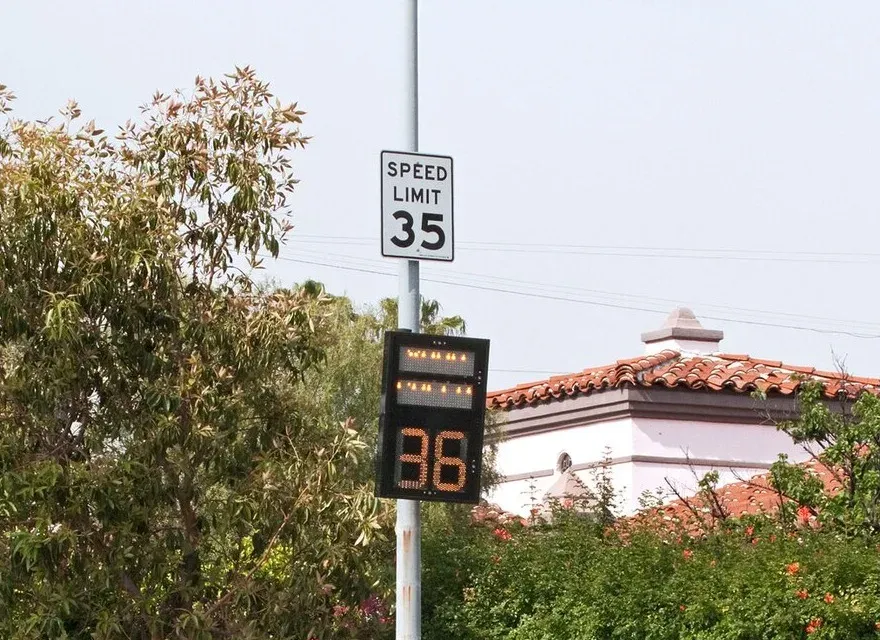
Many lease roads have no posted limit at all. If you want a display to mean something, post a limit next to it, the way the Los Angeles sign in the photo has its display mounted right under the limit.
Data and cameras matter more than the display
A display tells one driver how fast he’s going. The records tell the HSE manager who keeps speeding, which is usually the better reason for an operator to rent a trailer. Look for these features:
- Speed logging, so you can show before and after numbers instead of arguing about anecdotes.
- Front and rear cameras that capture license plates and the driver, so a speeding vehicle can be tied to a contractor.
- Wireless upload, so someone can review the data without driving out to pull a memory card.
- Delivery, rig-up and on-site maintenance, because a trailer with a dead battery stops recording and nobody notices for days.
Then use the data: share it with contractors at the next safety meeting, put the speed rule in the contract, and follow up on repeat offenders.
A radar trailer won’t fix these
Seat belts and distraction come up in the federal numbers as often as speed does. In the 2003-2009 NIOSH study, belt non-use was identified in 38.1% of the crash deaths, and TxDOT puts driver inattention next to speed as a leading cause of crashes in energy regions. A speed trailer does nothing for either, or for road surface, dust and fatigue from long commutes. It belongs in a journey management program next to your driving policy.
Before you rent one: a checklist
- Which stretch of road, and why: a complaint, a near miss, a new pad coming online.
- Whether the road has a posted limit, and if not, what limit you’ll post.
- What you want recorded: speeds only, or plates and driver photos too.
- Who reviews the data, how often, and what happens after a violation.
- How long it stays in one spot, and when it moves.
- Power and maintenance: who checks it, and how fast a fault gets fixed.
- A spot that’s off the travel lane, with room for trucks to pass.
Speed monitoring trailers from Site Safe Solutions
Site Safe Solutions rents speed monitoring trailers for oilfield lease roads. They have front and rear cameras with wireless video upload, and they capture two photos of the license plate and one of the driver, so the company HSE manager can see video from the truck. We deliver and rig up the trailer on location, maintain it on site, and lease it short term or long term, from completion through production. For the people on location at the end of those roads, we also rent emergency shower trailers. If traffic is part of your pad plan, see our guides to the well pad life cycle and flowback hazards, or tell us which road needs watching.