A frac tank is a portable steel tank, usually rated at 500 barrels (21,000 gallons), that gets pulled onto a location behind a semi and parked wherever a job needs temporary fluid storage. On a Permian lease that means fresh or recycled water before a frac, flowback and produced water after it, and oily water or drilling fluid during a workover or a cleanup. The tank is the easy part. What decides whether a frac tank job goes well is everything around it: whether the right type of tank showed up, whether it sits in containment sized for it, and whether the people gauging and draining it know what’s coming out of the hatch.
This guide covers the main frac tank types and sizes, what the federal SPCC rule and the Texas Railroad Commission expect when a frac tank holds oil, and a short checklist for setting tanks on a pad.
What is a frac tank?
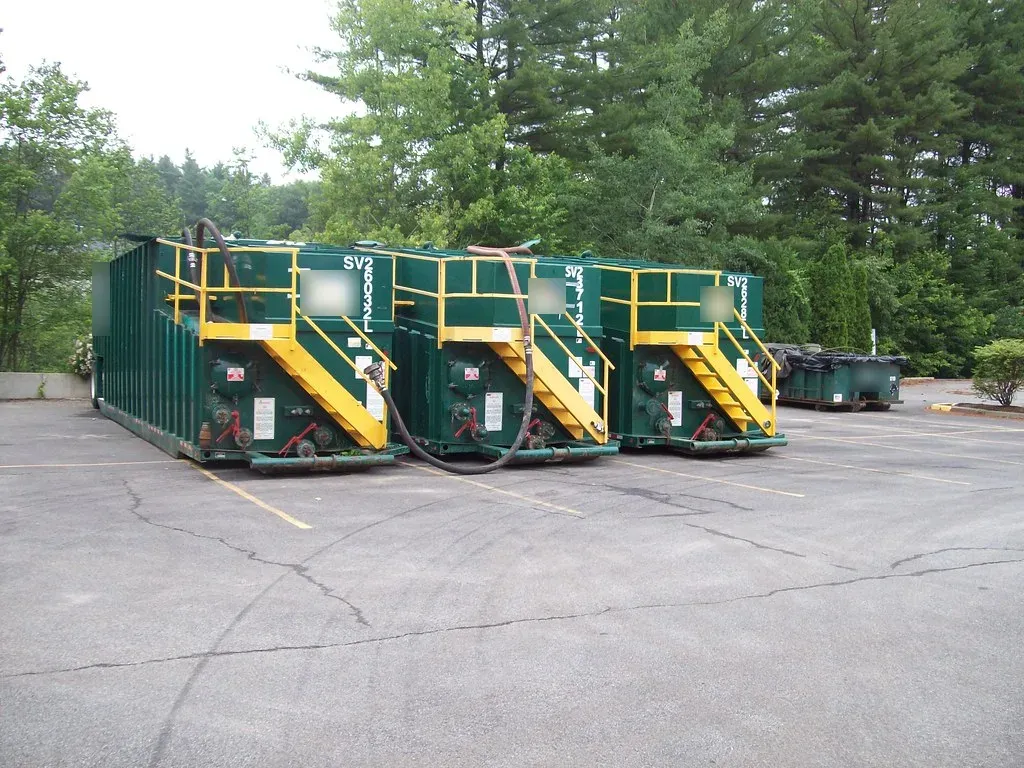
The name comes from hydraulic fracturing, where rows of these tanks hold the water a frac spread pumps downhole. The design spread well beyond fracking. One rental supplier lists construction runoff, cooling tower cleaning, wastewater storage and environmental remediation among its frac tank jobs, and the photo in this guide shows a row of them holding contaminated water at a cleanup site in Massachusetts.
Most frac tanks share a few features:
- A sloped “V” or rounded bottom that drains to a low point, so the tank empties without being tilted.
- A front kingpin, so a standard semi-tractor can haul it on its fifth wheel. One tank dealer puts the tongue weight at about 8,000 pounds.
- A manifold of valves at the front or along the bottom. The same dealer lists 4-inch wafer-style butterfly valves on its standard 21,000-gallon tank.
- Stairs, a top walkway with guardrails, and hatches or a manway for gauging and cleaning.
Frac tank capacity and dimensions
The standard frac tank holds 500 barrels. At 42 US gallons to the barrel, that’s 21,000 gallons. One tank dealer says the size stuck because it’s the largest container a semi can haul, which is why so many thousands of identical 500-barrel tanks exist.
Smaller tanks exist too. Ironclad Environmental Solutions, one of the top-ranking frac tank suppliers, gives a range of roughly 8,400 to 21,000 gallons for closed-top tanks, and mini mix tanks as small as 7,070 gallons. Exact length, width and height vary by builder, so check the spec sheet for the tank on your ticket before you lay out a pad or size a berm.
Types of frac tanks
Rental fleets carry several variants. The table uses the sizes Ironclad publishes for its own fleet. Other suppliers’ numbers will differ a little.
| Tank type | What it’s built for | Example capacity | Where it fits on a lease |
|---|---|---|---|
| Closed top (flat top) | General liquid storage with a sealed roof | 8,400 to 21,000 gal | Frac water, produced water, flowback where vapors need controlling |
| Open top | Easy level checks and cleanout | Up to 21,000 gal | Runoff water, non-hazardous fluids, solids that need digging out |
| Open-top weir | Internal weirs or baffles that let oil, water and solids separate | 18,000 gal, flow up to 100 gpm | Settling oily water or wash water before transfer |
| Double wall | A built-in second wall around the stored fluid | 16,380 gal | Sensitive sites where a single wall isn’t enough |
| Mix tank | Agitators that keep fluid circulating | 7,070 or 18,270 gal | Blending fluids that settle out |
| Gas buster | A top vent that lets entrained gas escape while liquid drains from the bottom | 18,000 gal | Gassy returns during drilling |
If the fluid is flowback or anything with oil and gas in it, a closed-top tank built to control vapors is the usual choice. An open top makes sense for water and for solids you need to dig out. A weir tank earns its place when you need oil to float off and solids to drop out before the water moves on.
Does a frac tank need secondary containment?
It depends on what’s in it. EPA’s SPCC rule in 40 CFR Part 112 covers oil storage. A facility generally falls under the rule once its aboveground oil storage capacity is more than 1,320 gallons, counting only containers of 55 gallons or more. A single 500-barrel frac tank holding oil, or oily water, is nearly sixteen times that threshold on its own. A tank of fresh water isn’t oil storage and doesn’t count toward it.
Where a frac tank holds oil, the rule asks for secondary containment in several places, depending on the kind of facility:
- Mobile or portable containers. Section 112.8(c)(11) says to position mobile or portable oil storage containers to prevent a discharge, and to provide a secondary means of containment, “such as a dike or catchment basin,” big enough for the largest single compartment or container, with freeboard for rain. Frac tanks on wheels fit that description.
- Tank batteries and treating equipment at production sites. Section 112.9(c)(2) requires containment for the entire capacity of the largest single container, plus freeboard for precipitation.
- Drilling and workover locations. Section 112.10(c) calls for catchment basins or diversion structures to intercept and contain discharges of fuel, crude oil or oily drilling fluids.
One 21,000-gallon tank is about 2,807 cubic feet of fluid (21,000 divided by 7.48 gallons per cubic foot). A berm with an 18-inch wall needs about 1,871 square feet of floor just to hold that volume, before you add freeboard for a West Texas thunderstorm or subtract the space the tank itself takes up. Six tanks sharing one berm still size to the largest single tank, unless they’re permanently manifolded to work as one unit. EPA’s inspector guidance then makes the total capacity of the manifolded tanks the design standard. That case and a full worked example are in our guide to frac tank secondary containment.
In Texas, the Railroad Commission’s Statewide Rule 20 (16 TAC 3.20) requires notice to the Commission of oil losses that exceed five barrels. A failed valve on a full frac tank can put out far more than that before anyone notices.
Gauging hazards at the tank hatch
Gauging and sampling a frac tank means climbing to the hatch. On flowback and produced fluid tanks, that climb has killed people. A CDC/NIOSH review in the MMWR identified nine oil and gas workers who died suddenly between January 2010 and March 2015 while gauging, sampling or transferring fluids at well site tanks. One of the deaths was in Texas. Every victim was working alone. In an OSHA exposure assessment after one of the deaths, oxygen measured as low as 11% one foot above an open thief hatch, against about 21% in normal air, and hydrocarbon vapors were above the lower explosive limit.
The practical controls follow from that:
- Gauge remotely wherever the tank allows it, and don’t open hatches you don’t have to.
- If someone has to climb, they stand upwind, wear a gas monitor and don’t go alone.
- Treat a flowback tank as a vapor source, even when it’s mostly water.
Getting inside a tank for cleaning is a separate problem. A frac tank can be a permit-required confined space under OSHA’s 29 CFR 1910.146. That’s covered step by step in frac tank cleaning.
Setting frac tanks on a pad: a short checklist
This list isn’t from any one rulebook. It’s the order a careful company man works through when a row of tanks is on the way.
- Confirm the fluid and the tank type. Fresh water, flowback, produced water and oily wash water each point to a different tank and a different set of rules.
- Get the spec sheet. Capacity, footprint and valve positions decide how the berm is laid out and where the hoses run.
- Lay containment first. The liner and berm go down before the tanks arrive, sized to the largest single tank plus freeboard, with room to walk the valve end.
- Plan the truck path. Haul trucks and vacuum trucks need a way in and out that doesn’t drive over hoses or berm walls. Drive-over sections go where trucks actually cross.
- Check every valve and cap on arrival. A missing bull plug or a cracked butterfly valve is enough to put a full tank’s contents on the ground.
- Decide who gauges and how. Remote gauging, gas monitors and no lone climbs, written into the job plan.
- Plan the rig-down. Who drains the tank, where the fluid goes, and who cleans the liner and berm before they leave the lease.
Containment around frac tanks in the Permian
Site Safe Solutions builds and installs containment systems for Permian well pads and production sites: modular drive-over containment, primary containment pads laid out to the site, and high-wall systems for big volumes or steep ground. The company’s archived high-wall page describes systems for anything from one tank to more than 100, with wall heights from 6 to 36 inches. For a single tank change-out or a small transfer at the valve end, Fast Mats are drive-over containment mats that go down without a full pad build-out. If you have a row of frac tanks scheduled for a location, send us the tank count and the pad layout.