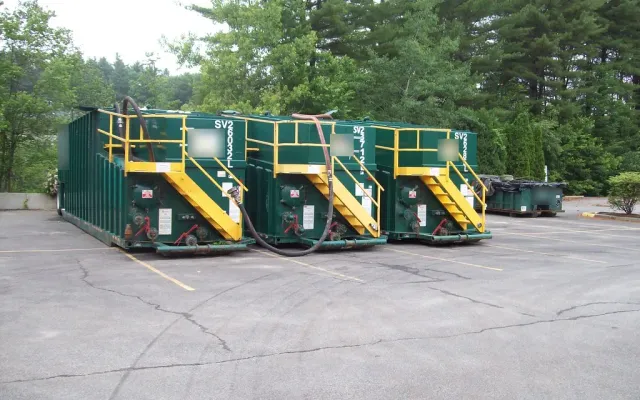
A LACT unit (lease automatic custody transfer unit) is the skid that pumps crude out of the stock tanks, checks it for sediment and water, meters it and hands it to the buyer’s pipeline or truck. It’s where the lease gets paid, which is why people call it the cash register of the oilfield. It is also a pump, a strainer, a sampler and a run of threaded and flanged connections sitting next to the tank battery, so it leaks like any other piece of transfer equipment. Below: what’s on the skid, the proving rules on federal and Indian leases, where LACT units drip, and how to contain them.
What does a LACT unit do?
Custody of oil changes hands at the lease. Without one, someone climbs the tank, gauges it by hand and pulls a sample through the thief hatch. In Kimray’s training write-up, the LACT samples and measures oil “so it can be transferred from one company to another,” and it checks quality as well as quantity. Oil with too much sediment and water gets sent back instead of sold. The allowable BS&W is whatever the seller and purchaser agreed to.
LACT unit components, in flow order
Here is a typical skid, following Kimray’s walk-through and the federal measurement rule (43 CFR 3174.8):
| Component | What it does | What to watch |
|---|---|---|
| Charge pump | Draws oil from the sales tank into the unit | Seal leaks, vibration, suction-side air |
| BS&W monitor (probe and sensor) | Reads basic sediment and water and reports it to the controller | Coating on the probe gives bad readings |
| Air eliminator | Removes gas or air so the meter sees liquid only | Vent line must go somewhere safe |
| Static mixer | Mixes the stream so the sample and meter see the whole fluid, not one phase | Usually trouble-free |
| Three-way diverter valve | Sends good oil to the meter and high-BS&W oil to a “bad oil” tank or treater | A sticking valve sells bad oil or diverts good oil |
| Sampler and composite sample container | Pulls a proportional sample for gravity and S&W tests | Sample pot drains and lids drip |
| Custody meter (positive displacement or Coriolis) | Measures volume | Must have a non-resettable totalizer |
| Temperature averaging device and pressure gauge | Feed the volume corrections | Must be verified at every proving |
| Block-and-bleed valves and prover connections | Where the prover ties in to check meter accuracy | Connections get broken every quarter |
| Back pressure valve and check valve | Hold pressure for single-phase flow; stop backflow from the pipeline | Set point changes after proving must be logged |
A PLC ties it together. Kimray notes that the controller is most of what makes the unit automatic: the BS&W monitor, meter, tank level controls, pump and diverter all report to it, and it decides what opens and runs.
LACT requirements on federal and Indian leases (43 CFR 3174)
If the lease is federal or Indian, the BLM’s oil measurement rule, 43 CFR Subpart 3174, sets hard requirements on top of the industry standard. The rule requires every LACT to include the equipment listed in API MPMS Chapter 6.1 (Second Edition, May 1991, reaffirmed May 2012), with some changes. The custody meter must be a positive displacement or Coriolis meter of a BLM-approved make and model. An electronic temperature averaging device is required, and automatic temperature compensators are prohibited.
The rule also sets operating details:
- The sampler probe must sit in the center half of the flowing stream, be horizontal, and have the flow direction marked on its body.
- The composite sample container must be emptied and cleaned after each sample withdrawal.
- The meter needs a non-resettable totalizer and a pulse output of at least 8,400 pulses per barrel.
- A pressure-indicating device must sit downstream of the meter and upstream of the prover connections.
- The temperature averager must read to ±0.5 °F or better with 0.1 °F graduations.
- All LACT components must be accessible for inspection by the BLM.
- The operator must tell the BLM within 72 hours of discovering any LACT failure or malfunction that may have caused a measurement error.
How often does a LACT meter have to be proved?
Under 43 CFR 3174.11, a LACT meter on a federal or Indian lease gets proved at initial installation and then every three months, or every time 75,000 barrels pass through the meter since the last proving, whichever comes first. It doesn’t have to be proved more than monthly. It also gets proved after repairs, zeroing of a Coriolis meter, changes to mounting, or when conditions move outside the proving limits.
A proving takes at least five consecutive runs that match within 0.0005 (0.05 percent). The runs have to happen at normal conditions: flow rate and absolute pressure within 10 percent of normal, temperature within 10 °F, and oil gravity within 5° API. The meter factor has to land between 0.9900 and 1.0100, and between 0.9950 and 1.0050 for a new or repaired meter. If two successive meter factors differ by more than ±0.0025, the meter comes out of service until it’s checked, repaired and proved again.
Fee and state leases, which covers most of the Texas side of the Permian, aren’t under the BLM rule. There, how often the meter gets proved comes from your measurement contract with the purchaser.
Why a LACT unit is also a safety control
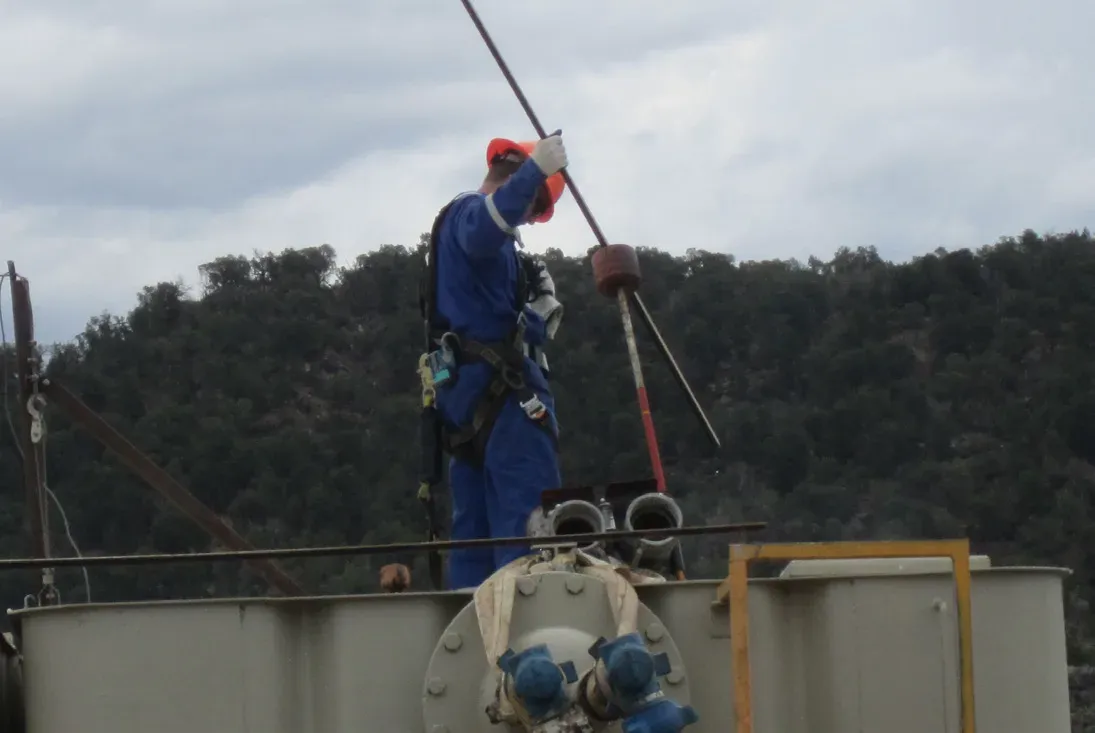
A LACT also keeps people off the top of the tank. In a 2016 hazard alert, OSHA and NIOSH identified nine workers who died while manually gauging or sampling crude oil production tanks between 2010 and 2014. Four were gauging and five were collecting samples at an open thief hatch. Every one of them was working alone or unobserved. One of the deaths was in Texas. The alert says an opened thief hatch can release more than 100,000 parts per million of hydrocarbon gas and vapor, and the first engineering control it lists is remote or automatic gauging and sampling.
A LACT with an automatic sampler is that control. Tanks still need gauging when the LACT is down or trucks haul, but a working LACT cuts the number of times somebody leans over an open hatch.
Where LACT units leak
The SPCC rule treats the LACT area as transfer equipment. Under 40 CFR 112.9(d)(1), a production facility has to inspect “all aboveground valves and piping associated with transfer operations” on a regular schedule, naming flange joints, valve glands and bodies, drip pans, pipe supports, and bleeder and gauge valves. On a LACT skid that list maps almost one to one:
- Pump seals and the suction strainer lid, opened every time the basket gets cleaned
- Sample pot and composite container drains
- Prover connections and block-and-bleed valves, made up and broken at every proving
- Air eliminator vents
- The diverter valve and the line back to the bad-oil tank
- The truck load hose and its connection, where there’s a truck LACT
Then there’s the tank side. The LACT pulls oil out of the sales tank fast. Section 112.9(c)(4) requires every tank battery to have at least one overfill or failure safeguard, and one of the options it lists is “vacuum protection adequate to prevent container collapse during a pipeline run.” A stuck or plugged vent on a tank being drawn down by a LACT is how a tank gets sucked in.
Containment for the LACT skid and load-out
The general rule, 40 CFR 112.7(c), asks for containment sized to “the typical failure mode, and the most likely quantity of oil that would be discharged.” Curbing, drip pans, sumps and lined berms all qualify. For a LACT skid, the likely failures are seal drips, a sampler that overflows, and a prover hose that lets go during make-up or break-out. That points to a lined pad or curbed containment under the skid, big enough for the hose volume and a short pump run, rather than a berm sized for a whole tank.
Truck load-outs are different. If the load-out is built as a loading rack, 40 CFR 112.7(h) requires containment for at least the largest single compartment of a tank truck loaded there. It also requires warning lights, physical barriers, wheel chocks or brake interlocks so a truck can’t pull away with the hose still connected, and an inspection of the truck’s lowermost drain and outlets before filling and before departure. Whether your load line counts as a rack is a question for whoever writes your SPCC plan. The truck still drives onto the spot either way, so whatever you put down has to take a loaded axle and keep holding fluid.
Two field mistakes are common: a skid set on bare gravel, where years of seal drips soak into the pad, and a prover truck that parks wherever it fits, so the hose make-up happens off the containment. Lay the containment out to cover the spots where the prover and the trucks connect, as well as the skid frame.
A LACT walkdown checklist
Use this on a routine lease visit, and before every proving:
- Look under the skid. Fresh stains or wet gravel mean a seal, drain or connection is weeping.
- Check the sample container: emptied and clean after the last withdrawal, lid shut, drain closed.
- Read the BS&W monitor and confirm the diverter is sending oil where it should.
- Walk the prover connections. Caps on, valves closed, no drips at the block-and-bleed.
- Check the sales tank vent and any vacuum protection.
- Look at the containment itself: liner intact, no standing oil, drain valves closed and sealed as 112.9(b) requires for dike drains.
- If you’re on a federal or Indian lease, note the date of the last proving and the barrels since. Three months or 75,000 barrels comes up fast on a good well.
LACT containment from Site Safe Solutions
Site Safe Solutions builds primary containment pads and lined containment on Permian Basin leases, laid out around the equipment that’s actually on the site. For truck load lines and prover connections where vehicles have to drive across the contained area, Fast Mats give drive-over spill protection without a full pad build-out. For the rest of the battery, see where tank batteries leak and how to contain them, and how spill containment pads at transfer areas are sized.