Nitrogen pumping is the service where a crew brings liquid nitrogen to location on a transport, warms it to gas in a pump unit, and pumps that gas at high pressure into a well, a pipeline or a vessel. In the oilfield it gets used to unload wells, assist fracs, support coiled tubing, free differentially stuck pipe, and purge or pressure test lines and vessels. Nitrogen is inert and doesn’t burn, which is why it’s chosen for those jobs. It still brings three hazards to location: it can suffocate people without any warning, the liquid is cold enough to cause severe burns, and a line full of compressed gas stores far more energy than the same line full of water.
Most of what’s published about nitrogen pumping describes fleets and flow rates. This guide is for the people on the other side of the job: the company man, the HSE lead and the crews who share the location while the nitrogen unit is rigged up.
What nitrogen pumping is used for in oil and gas
One oilfield nitrogen provider, KLX, lists these jobs for its nitrogen units:
- N2 assist on fracs
- drilling rig, workover rig and snubbing support
- displacing fluid when a drill string gets differentially stuck
- coiled tubing support, including reel purges
- pipeline and vessel purging and pressure testing
- drying and pigging vessels, pipelines and process piping
Several of those come down to the same idea. Nitrogen is light and compressible, so pumping it into a wellbore lowers the weight of the fluid column. KLX describes this as liquids displacement and “hydrostatic pressure reduction.” That’s how nitrogen helps unload a well or lift returns during a cleanout. Purging uses nitrogen’s other property: it doesn’t react, so it can push oxygen or hydrocarbons out of a line before the line is opened or put into service.
Nitrogen pumping services: what the equipment can do
Published numbers from two of the large providers show the scale of what gets rigged up next to your crew:
| Provider (published figures) | Rates | Pressure | Temperature range |
|---|---|---|---|
| KLX | 250 to 3,000 SCFM per unit, up to 6,000 SCFM with dual pumps, max 10,000 SCFM | Up to 10,000 psi; max 10,000 SCFM at 15,000 psi | Direct-fire burner for high-temperature discharge |
| Airgas Nitrogen Services | Up to 880,000 scfh (14,660 scfm) per unit, with units manifolded for more | Not stated on the page | -320°F to 500°F |
Airgas also says its units are never left unattended, with at least two operators per pumper, and that they carry low-temperature and overpressure shutdown systems with certified relief valves and hoses. That’s what a good provider brings to the job. The location still has to handle what happens around the unit and along the line.
Nitrogen asphyxiation on location
The US Chemical Safety Board published a safety bulletin on nitrogen asphyxiation in 2003. Between 1992 and 2002, CSB identified 85 workplace nitrogen asphyxiation incidents in the United States. They killed 80 people and injured 50. Almost half involved contractors.
The bulletin explains why it keeps happening. Air is 78% nitrogen, so people assume it’s harmless. Nitrogen and oxygen can’t be detected by smell. Breathing a nitrogen-enriched, oxygen-deficient atmosphere can cause unconsciousness “after only one or two breaths,” and the person gets no warning. At 4 to 6% oxygen, a victim falls into a coma in less than 40 seconds. OSHA requires workplace oxygen between 19.5% and 23.5%.
On location, the places where that happens are predictable:
- Vents and bleed-offs. Where a purged line or vessel is vented, nitrogen comes out at ground level and pools in low spots, cellars and pits.
- Tanks and vessels that were just purged. A tank full of nitrogen looks exactly like a tank full of air. Nobody enters, or puts their head into a hatch, until the atmosphere has been tested.
- Returns tanks during an N2-assisted job. Gas comes back with the fluid. A flowback tank can be short of oxygen as well as full of hydrocarbon vapor. Our flowback hazards guide covers the tank-hatch deaths that NIOSH documented.
The CSB bulletin’s case studies include would-be rescuers who were overcome too. That’s the reason for gas monitors on everyone near a vent and a rescue plan that doesn’t send a second person in.
Liquid nitrogen hazards
Nitrogen arrives as a cryogenic liquid. Hudson Valley Community College’s liquid nitrogen safety guideline gives its boiling point as -320°F (-196°C) and its liquid-to-gas expansion ratio as about 700 to 1. That expansion is what lets a single transport supply so much gas, and it’s also the hazard. Liquid trapped between two closed valves warms up, turns to gas and builds pressure until something gives.
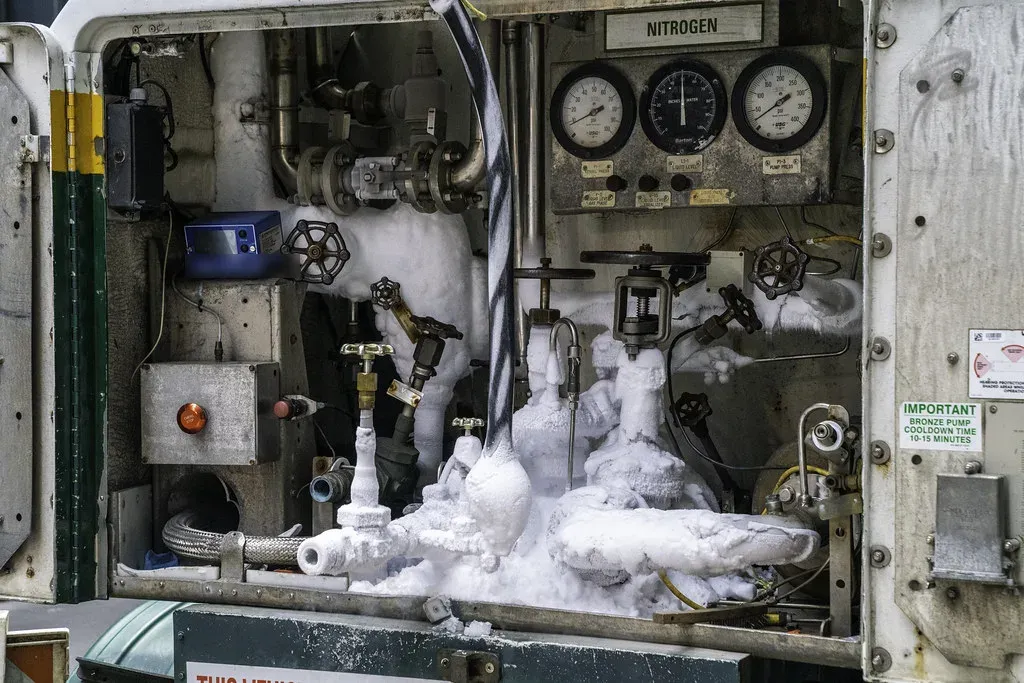
The cold side brings frostbite-type burns from splashed liquid, from frosted piping on the unit, and from hoses and fittings near the pump. The photo in this guide shows what a nitrogen transport’s valve panel looks like in service, with every line iced over. Keep everyone except the nitrogen crew back from the unit, the transport and the transfer hoses.
Compressed gas and line restraint
A nitrogen line carries the same whip hazard as any other high-pressure line on location, with more energy behind it. PHMSA’s fact sheet on pressure testing says “the amount of energy stored in a compressed gas greatly exceeds the energy stored in a compressed liquid.” It adds that pipeline operators rarely run pneumatic tests above 100 psig for that reason. A nitrogen line on a well site can run at thousands of psi. If a connection lets go, the gas keeps expanding and driving the line long after a water line would have dropped to zero.
OSHA’s hydraulic fracturing and flowback hazard publication (OSHA 3763) gives the baseline controls for high-pressure lines, and they apply directly to nitrogen work:
- Restrain or secure high-pressure lines, including relief lines, “with proven restraint devices and methods,” so they can’t whip if a connection fails.
- Follow the company’s exclusion zone, with only essential workers inside it.
- Pressure test the pump and discharge lines at no less than the maximum expected treating pressure, but not above the rated working pressure of the lowest-rated component.
- Inspect the lines from the pump trucks to the wellhead before the job starts, then walk the equipment down and check valve positions and relief settings.
The “lowest-rated component” point matters on nitrogen jobs because the line often ties into iron that was rigged up for something else. A mismatched or under-rated union is the weak link. For why an unrestrained line whips and what it does when it does, see why an unrestrained line whips.
A nitrogen job checklist for the location
- Know what the nitrogen is for. Unloading, frac assist, purging or a pressure test each change where the gas ends up and where it vents.
- Mark the exclusion zone around the unit, the transport and the full line route to the wellhead or tie-in, and keep it to the people the job needs.
- Check every component’s rating against the planned pressure, and test to the lowest one.
- Restrain the line, including the relief and bleed-off lines.
- Put monitors at the vents. Oxygen monitors belong on anyone working near vents, bleed-offs, cellars or tanks that took nitrogen.
- Test before entry or opening. No one opens or enters a purged vessel or tank on the assumption that it has aired out.
- Plan the rescue so the first person to arrive doesn’t become the second victim.
Restraints for nitrogen and energized fluid lines
Site Safe Solutions supplies high-pressure restraint systems for oilfield hoses and iron lines in the Permian Basin, from hose restraint systems to custom high-pressure iron line restraints, with modular hardware that simplifies installation and line changes. Nitrogen is one of the applications they’re built for, along with slick-water, energized fluids and standard pumping. The company’s older restraint page recommended restraints for all high-pressure pumping, “especially during slick water, nitrogen and energized fluid pumping operations.” If a nitrogen job is coming up on one of your locations, send us the working pressure and the line route.