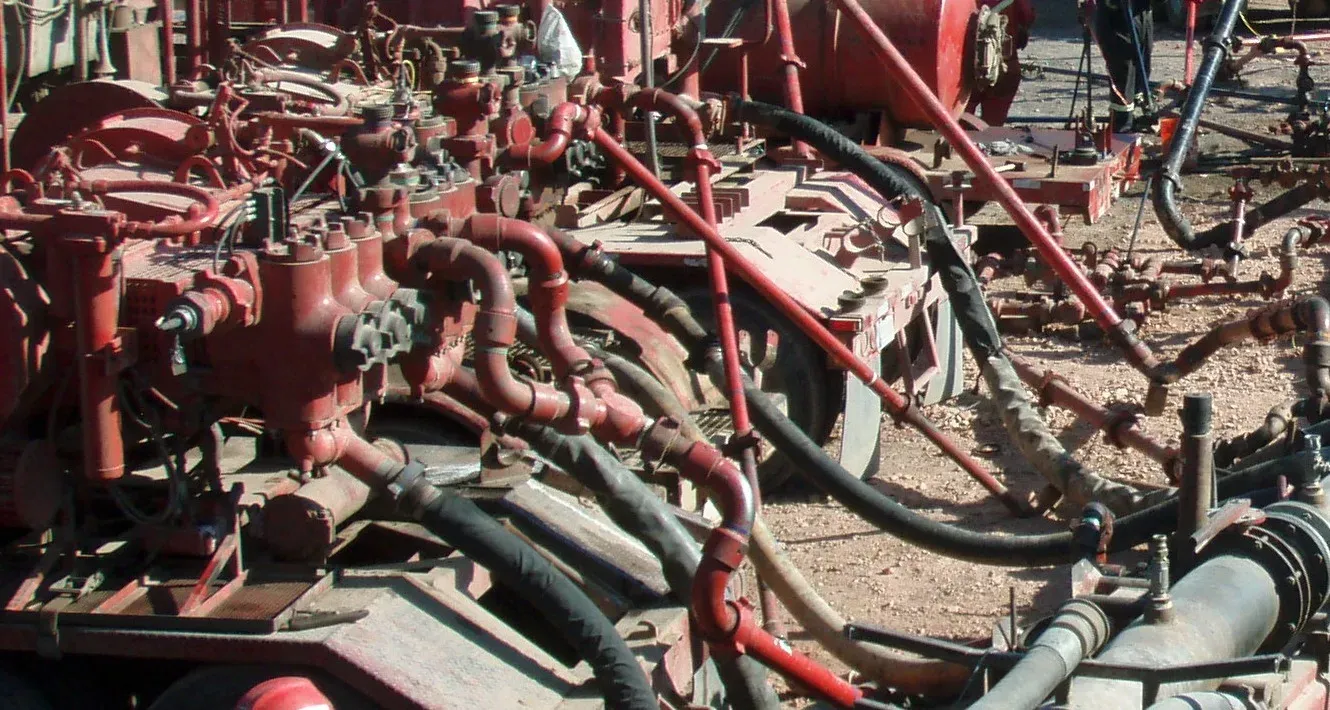
A chiksan swivel is a high-pressure swivel joint: a run of elbows and ball-bearing swivels that lets a steel line bend and turn while it carries pressure. Chiksan is a trade name, but crews use it for any brand of swivel joint, the same way they say “frac iron” for every piece of temporary high-pressure pipe. You’ll find chiksans at pump discharges, on cementing lines, in flowback and test lines, and on rig floors. They’re handy because they flex. They also wear at the ball races, the packing and the pipe wall, and when one lets go under pressure, the loop it’s part of can whip.
What a chiksan swivel joint is
A swivel joint has two parts doing two jobs. The elbows give the line its shape. The swivels, each a set of hardened ball races between two pieces of pipe, let one section rotate against the next. Put two or three swivels in a loop and a crew can connect a pump to a manifold without the iron lining up perfectly. Swivel loops also take up some movement and vibration that rigid iron would pass straight to the connections.
The ends are usually hammer union halves (male, female or one of each), so a swivel joint rigs up to straight iron, valves and manifolds the same way any other iron does. The union figure has to match on both ends. A swivel that’s been mixed into the wrong pressure class is a mismatched connection waiting to happen, which our article on hammer union mismatch covers in detail.
Swivel joint styles 10 through 80
Swivel joints are sold by “style,” a number that tells you how many swivels and elbows the joint has. The style numbers below come from a Parveen Industries treating iron catalog, one of the top results for this search, and are the common industry convention:
| Style | Swivels | Elbows |
|---|---|---|
| 10 | 3 | 2 |
| 20 | 1 | 0 (single swivel coupling) |
| 30 | 1 | 1 |
| 40 | 1 | 2 |
| 50 | 2 | 2 |
| 60 | 2 | 1 |
| 70 | 2 | 3 |
| 80 | 3 | 3 |
The same catalog says styles 50 and 10 are the most used, and that long sweep swivel joints run from 6,000 psi to 20,000 psi cold working pressure in standard and sour service. Long sweep elbows have a gentler bend than short sweep ones. The catalog says the smooth, round bore keeps pressure drop low and reduces turbulence, which matters when the fluid carries sand.
Sour service swivels are built to NACE MR0175 and API RP 14E, according to the catalog. If the line will see H2S, the joint’s service rating has to say so. A standard service joint and a sour service joint can look alike once both are painted.
Inside a swivel: ball races, packing and the leak port
Most of the wear parts in a swivel are inside, out of sight. The Parveen catalog describes a typical design:
- Dual or triple rows of ball bearings in races that are carburized and hardened, or use a stainless snap ring.
- A primary seal with a stainless anti-extrusion ring, plus an O-ring between the ball races and the primary seal as a secondary seal.
- A leak detection port. When the primary seal leaks, fluid comes out of the port, and “a leak at this port indicates the necessity of primary seal replacement.”
- A self-relieving grease retainer, so pressure can’t build up in the ball race chamber if fluid gets past the secondary packing.
The leak port gives a crew an early warning. Fluid weeping from the port of a swivel under pressure means the primary seal has failed and only the backup is holding. Pull that joint at the next chance instead of finishing the stage on it.
How chiksans fail on location
IADC Safety Alert 03-14 describes a failure that shows the typical pattern. A slick line lubricator was rigged up on a wellhead, with the rig’s chiksan swivel joints and straight joints run from the christmas tree wing valve to the choke manifold. The crew was testing the lubricator and lines with nitrogen to 6,500 psi. When pressure came on, a straight joint between the tree and the choke parted about an inch past the weld on the wing-half end. Nobody was hurt.
The alert reported two findings:
- The cause was wall loss. A visual inspection of the failed pipe “showed a decrease in metal thickness in the area where it parted.” The iron had thinned from the inside, where a walkaround can’t see.
- The safety chain didn’t hold. Chains were attached to every connection, but the chain on the failed joint “slid off due to a clean break.” A restraint that relies on the shape of the connection can slip off when the connection itself is gone.
OSHA’s guide to hydraulic fracturing and flowback hazards (OSHA 3763) points at the same cause. It tells employers to inspect and test iron before use and to “be aware of possible sand erosion.”
Other things that take a chiksan out of service:
- Weeping at the leak port (primary seal gone).
- A swivel that won’t turn by hand or turns rough, which points to damaged races or no grease.
- Damaged union threads, cracked wing nuts or a worn seal face on the union ends.
- Dents, gouges or heavy external corrosion on elbows and straight sections.
- Mixed-up figure numbers, or a joint with no legible pressure rating.
Inspecting swivel joints: what the alert recommended
The operator in IADC 03-14 issued these corrective actions to its rig crews. IADC notes that they’re one company’s response and not an IADC position, but they make a sound baseline:
| When | What |
|---|---|
| Before each use | Visually inspect every chiksan. Remove any joint that looks worn or suspect and send it in for inspection. |
| On a schedule | Non-destructive testing of chiksans on the company’s 24-month maintenance interval, which it told engineering to review. |
| Before pressure | Secure chiksans before applying pressure or pumping through them. |
| During pumping | Personnel stay clear of lines under pressure or during high-pressure pumping. Cover this in the JSA. |
Your own interval should come from the manufacturer, your company’s iron management program and the service the joints see. OSHA’s sand erosion warning is a reason to look harder at joints in sand service. API Std 16FI, Frac Iron Guidelines and Requirements, published in January 2026, now sets guidelines for the design, manufacture and use of frac iron, including the piping, hoses, connections and manifolds that swivel loops are part of. Our frac iron safety guide covers what it changes.
A visual check can’t measure wall thickness from the inside. Ultrasonic or other NDT readings at the bends and near welds find thinning before it parts.
Restraining swivel loops
A swivel loop is built to move, which makes it hard to restrain. OSHA 3763 tells employers to “restrain or secure high pressure lines including relief lines with proven restraint devices and methods” to prevent whipping if a line fails, and lists flowback pipe restraint systems among its controls.
The IADC alert shows what a proven method has to handle. A clean break leaves nothing for a loose chain to catch on. A restraint has to tie each section to the next and to anchor points that can’t move, so a separated joint stays close to where it was. Restraint also has to go back on after every line change. Hardware that’s slow to refit tends to get left off when the crew is short on time.
Restraint limits the damage when inspection and exclusion zones miss something. The line whip hazard guide explains why an unrestrained line moves the way it does.
Restraint systems from Site Safe Solutions
Site Safe Solutions supplies high-pressure restraint systems for oilfield lines: hose restraint systems and custom high-pressure iron line restraints for slick-water, nitrogen, energized fluid and standard pumping. The company’s high-pressure stabilization restraints use a clevis connection at each joint, rig up and down without tools, and are installed by certified technicians, with modular hardware meant to make iron changes faster. To talk through a rig-up, send us the working pressure, the line layout and how often the iron gets broken and remade.